
Does Hammered Titanium Really Make a Pan Nonstick?
Hammered titanium cookware is becoming more visible in premium cookware collections. Its three-dimensional cooking surface is easy to recognize, while the combination of titanium, coating-free construction and distinctive texture gives brands a strong product story.
It is also increasingly described as “naturally nonstick.”
That description contains some truth, but it needs context.
A properly engineered hammered titanium surface may improve practical food release compared with an ordinary untreated titanium surface. The shallow peaks and depressions can influence how oil spreads, how food contacts the pan and how browning develops.
However, hammering does not turn titanium into PTFE. It remains a bare-metal cooking surface, and cooking results still depend on temperature, oil, food moisture and technique.
The most accurate answer is:
Hammered titanium cookware can improve food release through engineered surface geometry, but it does not provide the same low-friction mechanism as a conventional nonstick coating.
For consumers, that means the pan should not be treated exactly like PTFE cookware. For brands, importers and distributors, it means product claims should explain the real material advantages without promising completely effortless release under every cooking condition.
What Is Hammered Titanium Cookware?
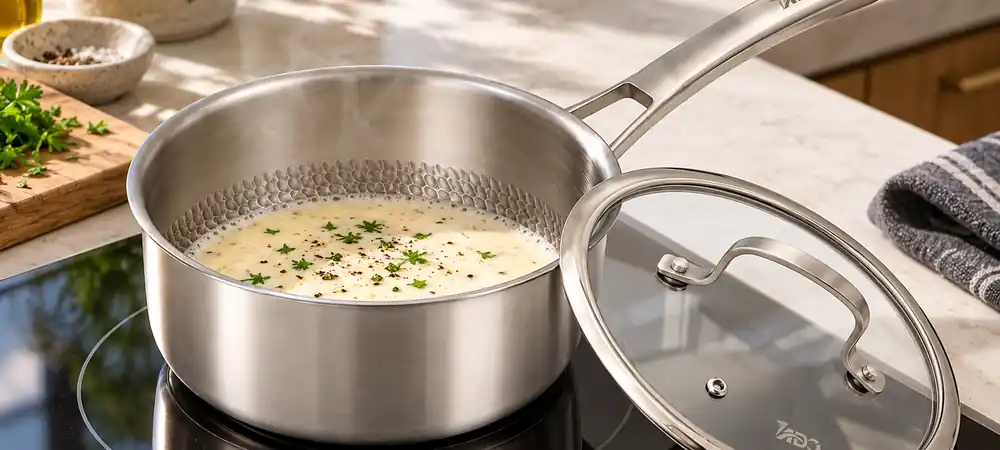
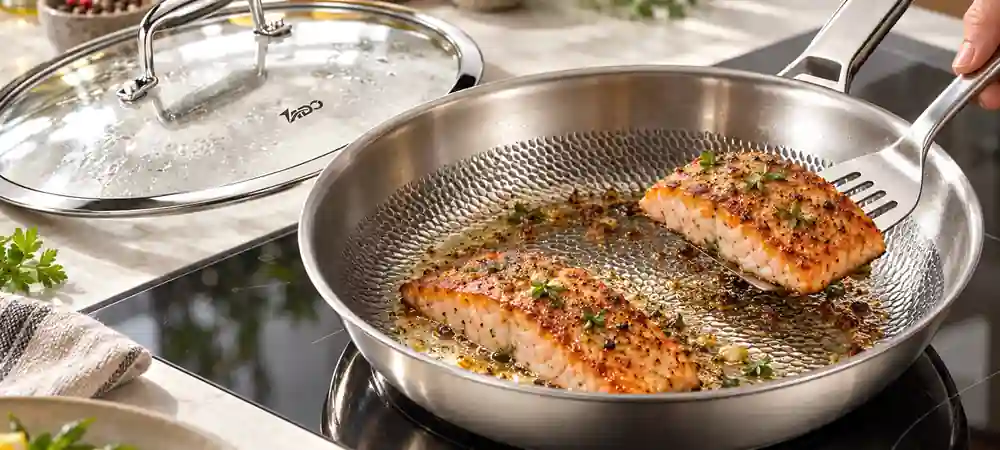
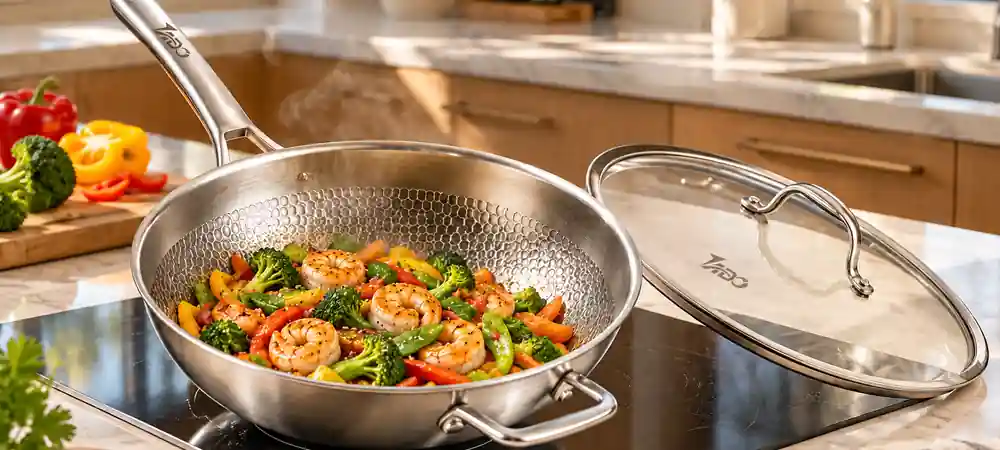
Hammered titanium cookware uses titanium as the food-contact surface and introduces a repeated three-dimensional pattern through mechanical forming.
The resulting surface contains controlled peaks and shallow depressions instead of being completely smooth. Depending on the manufacturing process, the pattern may be decorative, functional or both.
A genuine hammered titanium surface should not be confused with an applied coating. When the product is specified as uncoated titanium cookware, the texture is formed directly in the titanium layer, and titanium remains the material touching the food.
This distinction matters because the cookware market uses the word “titanium” in several different ways.
A product may be:
- Solid titanium cookware
- Titanium-clad or multi-ply cookware
- Cookware with a titanium-reinforced polymer coating
- Cookware with a titanium-colored finish
- Cookware containing only a small amount of titanium-related material
These constructions are not equivalent.
A titanium-reinforced nonstick coating may contain titanium-related particles, but the food still contacts an applied coating system. In genuine uncoated titanium cookware, the food-contact surface is titanium metal itself.
For professional buyers, the most important initial question is therefore not simply, “Is this a titanium pan?”
The better question is:
What is the exact material of the food-contact surface, and is any additional coating applied above it?
Does Hammering Improve Food Release?
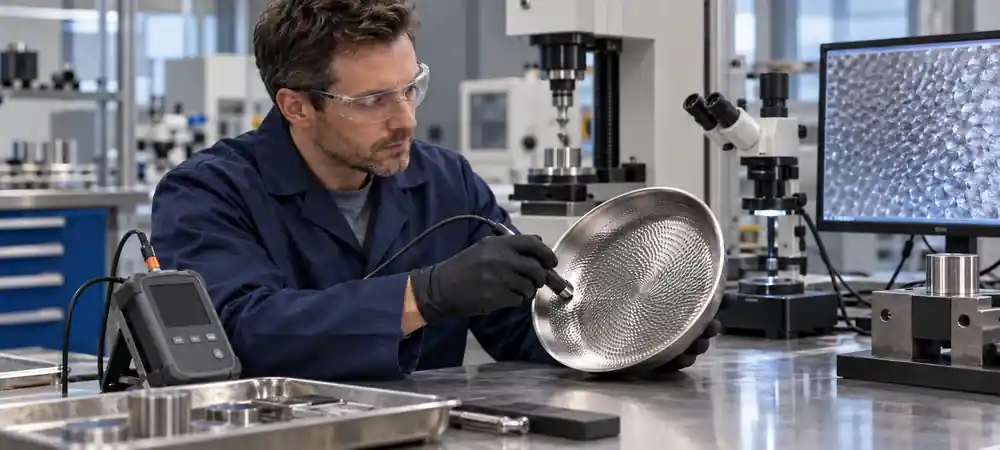
A controlled hammered pattern can improve practical food release, but the result depends on the complete surface system.
On a smooth metal pan, food can make continuous contact with a relatively large surface area. A hammered pattern interrupts that contact by creating many shallow peaks and depressions.
The texture may provide several practical effects:
- It can change the effective contact area between food and metal.
- It may help distribute cooking oil across the cooking surface.
- Small depressions may temporarily retain oil during cooking.
- It can influence browning and the point at which proteins release.
- It may reduce the visual impact of minor scratches and wear.
These effects can make a hammered titanium pan easier to use than an untreated smooth titanium pan under comparable cooking conditions.
Nevertheless, the pattern alone cannot guarantee nonstick performance. The outcome also depends on the titanium grade, surface roughness, pattern depth, cookware construction, pan temperature and cooking method.
This is why “improved food release” is usually more accurate than “completely nonstick.”
It communicates a genuine functional benefit while avoiding the suggestion that a bare titanium surface behaves exactly like a new PTFE coating.
How Does the Hammered Pattern Affect Cooking Oil?
Oil distribution is one of the most practical reasons for introducing texture to a cooking surface.
On a completely smooth pan, oil may quickly move toward the lowest point or outer edge, especially if the base is not perfectly level. A controlled hammered texture creates many small depressions that can interrupt this movement.
After preheating, oil can spread across the raised and recessed areas of the pan. Depending on the texture depth, oil viscosity and cooking temperature, the depressions may help maintain a more continuous lubricating layer between the food and the titanium surface.
This can be useful when cooking meat, fish, vegetables and other foods that benefit from browning.
However, the effect should not be overstated. A hammered pattern does not create an unlimited oil reservoir, and it does not eliminate the need to use an appropriate amount of cooking oil.
Performance is influenced by:
- Pattern depth and spacing
- Surface roughness
- Pan flatness
- Oil type and viscosity
- Cooking temperature
- Food moisture
- Surface cleanliness
A well-designed texture can support oil distribution. A shallow decorative pattern may provide little functional difference.
This is one reason buyers should evaluate production samples through cooking tests instead of judging the product only from photographs.
What Does Hammering Do to the Titanium Surface?
Hammering involves mechanical deformation, and mechanical deformation can change more than appearance.
When titanium is deformed, the near-surface structure may develop increased dislocation density, twinning, residual stress and grain refinement. These changes can produce work hardening and increase surface hardness.
Research on commercially pure titanium subjected to intensive mechanical surface treatment supports this general mechanism. Some studies have reported higher hardness and improved wear behavior after controlled surface mechanical treatment.
However, laboratory processes such as surface mechanical attrition treatment are not identical to cookware hammering.
The impact energy, treatment duration, deformation depth, equipment and resulting surface structure can be very different. Laboratory data should therefore not be used to claim that every hammered titanium pan automatically reaches the same hardness or wear improvement.
The defensible conclusion is:
Controlled mechanical deformation can modify and strengthen the near-surface region of commercially pure titanium, but the actual result depends on the manufacturer’s process.
For cookware, surface performance should be verified using the actual product rather than inferred solely from general titanium research.
Why Does Surface Hardness Matter in Titanium Cookware?
Commercially pure titanium provides excellent corrosion resistance, but it is relatively soft compared with many hardened engineering surfaces.
During normal use, an untreated titanium surface may develop polishing marks, scratches or changes in appearance. These marks do not necessarily affect food-contact safety, but they can influence product appearance and customer perception.
Increasing surface hardness can improve resistance to scratching, wear and local deformation. It may also help the engineered texture retain its geometry during long-term use.
Selected TADO hammered titanium surfaces can reach 600 HV or above after the specified strengthening process. This is a model-specific value measured under defined test conditions; it should not be interpreted as a universal value for every titanium product.
When reviewing a hardness claim, B2B buyers should ask for:
- The titanium grade
- The surface-treatment process
- The hardness test method
- The applied test load
- The test location
- The sample condition
- The relevant product model
A hardness value is meaningful only when the test conditions and product configuration are clear.
Why Is Pure Titanium Used as the Food-Contact Surface?
Titanium naturally forms a thin and stable oxide film when exposed to oxygen. This passive layer contributes to titanium’s well-known corrosion resistance and chemical stability.
For cookware, commercially pure titanium offers several useful characteristics:
- Strong corrosion resistance
- Low density
- A genuine metal food-contact surface
- No need for a conventional fluoropolymer cooking layer
- Resistance to coating peeling because titanium itself is the surface
- Premium material positioning
- Compatibility with multi-ply construction
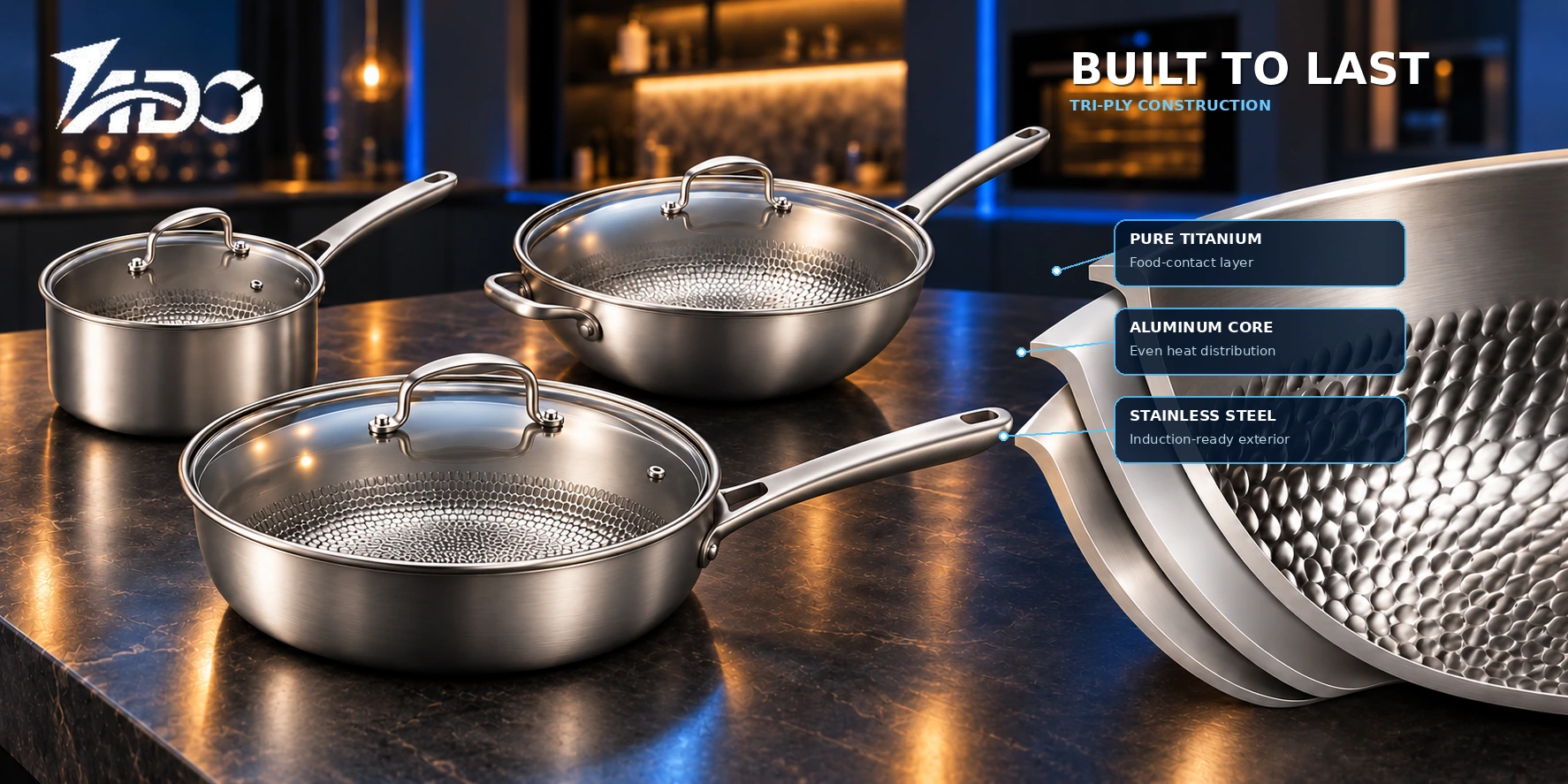
TADO selects TA1, broadly corresponding to Grade 1 commercially pure titanium, for the food-contact layer of its tri-ply cookware.
Grade 1 titanium is valued for its formability and corrosion resistance. These properties make it suitable for products that require deep drawing, shaping and direct food contact.
This does not mean that every product marketed as titanium cookware uses Grade 1 titanium. The term “titanium cookware” alone is not a material specification.
Buyers should request:
- Titanium grade
- Chemical composition or material certificate
- Nominal titanium layer thickness
- Food-contact declaration
- Relevant migration or compliance testing
- Confirmation of any additional surface material
These documents help distinguish genuine titanium cookware from products that use titanium only as a marketing term.
Is Hammered Titanium the Same as Titanium-Coated Cookware?
No. The two product types use different food-contact systems.
In genuine hammered titanium cookware, the pattern is formed directly in the titanium layer. If the product is uncoated, food contacts titanium metal.
In titanium-reinforced coated cookware, titanium-related particles may be included in a polymer or ceramic-style coating. Food contacts that applied coating rather than a sheet of pure titanium.
The distinction affects:
- Product positioning
- Care instructions
- Durability expectations
- Temperature limitations
- Material declarations
- PFAS-related claims
- End-of-life surface behavior
A titanium-reinforced coating may still be a valid product, but it should not be presented as equivalent to an uncoated pure-titanium cooking surface.
For buyers developing a coating-free or PFAS-free cookware range, the entire food-contact system must be reviewed. Product-specific declarations and testing should support any chemical or coating-related claim.
Why Combine Titanium With Aluminum and Stainless Steel?
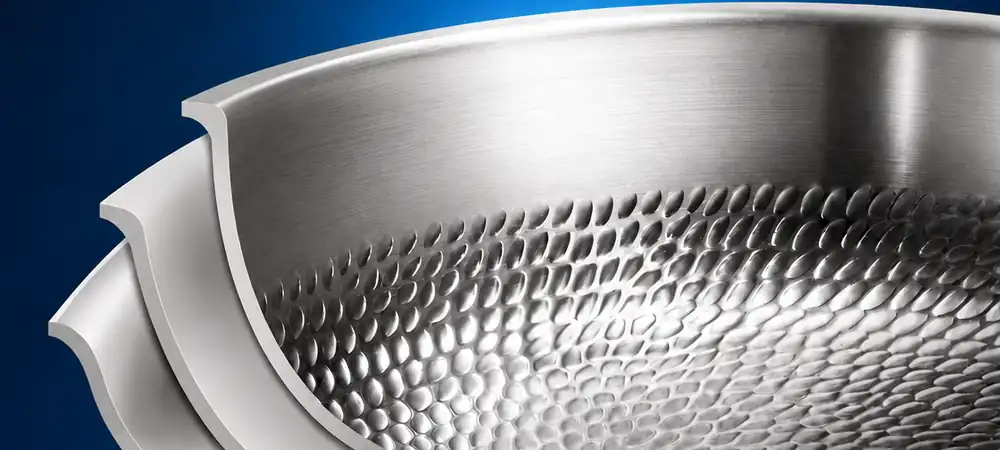
Pure titanium has valuable food-contact properties, but it does not distribute heat as efficiently as aluminum.
A pan made only from thin titanium may heat quickly in certain areas but provide less even heat distribution across the base and sidewalls. Making the titanium body much thicker can increase cost without delivering the same thermal efficiency as an aluminum core.
Multi-ply cookware addresses this limitation by combining materials with complementary properties.
TADO’s tri-ply titanium cookware uses:
- TA1/Grade 1 pure titanium as the inner food-contact layer
- 1050 aluminum as the heat-distribution core
- 430 magnetic stainless steel as the exterior layer
The titanium inner layer provides corrosion resistance and direct titanium food contact.
The aluminum core helps spread heat across the cookware body, reducing concentrated hot spots and improving temperature response.
The 430 stainless-steel exterior provides structural support and magnetic compatibility for induction cooking.
This structure allows buyers to position the product as titanium cookware while providing more practical thermal performance than a comparable thin, single-layer titanium pan.
The final result still depends on:
- Titanium, aluminum and stainless-steel layer thicknesses
- Bonding integrity
- Base flatness
- Sidewall forming
- Overall pan geometry
- Handle attachment
- Production consistency
The word “tri-ply” is useful, but it is not a complete measure of quality.
How Should You Cook With a Hammered Titanium Pan?
Hammered titanium cookware performs best when treated as high-quality bare-metal cookware rather than as conventional PTFE cookware.
Preheat Gradually
Use medium-low or medium heat. Allow the pan to warm evenly before adding food.
Immediate maximum power can create uneven temperature zones and increase the risk of burning oil or causing food to stick.
Add Oil After Preheating
Once the pan is warm, add a thin and even layer of cooking oil. Allow the oil to spread across the hammered texture before placing food in the pan.
Reduce Excess Food Moisture
Water on the surface of meat, fish or vegetables can lower the local pan temperature and interfere with browning. When appropriate, dry the food before cooking.
Allow Protein to Release Naturally
Protein-rich foods often adhere briefly to an uncoated metal surface. As browning develops, they may release more easily.
Trying to move meat or fish immediately can tear the food and make the pan appear more prone to sticking.
Avoid Unnecessary High Heat
Titanium cookware does not require continuous maximum burner power. Moderate heat usually provides better control, especially when an aluminum core distributes heat efficiently.
Let the Pan Cool Before Cleaning
Allowing the cookware to cool helps avoid thermal shock. Follow the cleaning recommendations for the complete product, including its handle, lid and edge construction.
Good technique does not mean the product is difficult to use. It simply reflects the difference between an engineered metal cooking surface and a low-friction polymer coating.
How Does Hammered Titanium Compare With PTFE Nonstick Cookware?
The two systems achieve food release in different ways.
PTFE provides a low-friction polymer surface. It normally offers easier initial release for eggs, pancakes and delicate foods, particularly when used with little oil.
Hammered titanium remains a metal surface. Its texture may improve oil distribution and reduce continuous food-to-metal contact, but preheating and cooking technique remain important.
Hammered titanium offers:
- Direct titanium food contact
- No conventional PTFE layer when specified as uncoated
- No separate polymer film that must remain bonded
- An engineered three-dimensional surface
- Strong corrosion resistance
- Potentially greater long-term surface continuity
- Premium visual and material differentiation
PTFE cookware offers:
- Very easy initial food release
- Lower dependence on preheating technique
- Convenient low-oil cooking
- Performance that depends on the condition of the applied coating
- Product-specific temperature and utensil restrictions
Neither system is automatically best for every consumer.
Customers prioritizing effortless egg release may prefer conventional nonstick cookware. Customers prioritizing an uncoated metal food-contact surface may prefer titanium and accept a slightly different cooking method.
For cookware brands, the important task is to define the target customer honestly rather than presenting one material as universally superior.
How Durable Is Hammered Titanium Cookware?
With genuine uncoated titanium cookware, titanium itself remains the food-contact material throughout normal use. There is no separate PTFE film that must remain attached for titanium to continue touching the food.
The surface can still develop:
- Fine scratches
- Heat discoloration
- Mineral deposits
- Oil residue
- Changes in sheen
- Utensil marks
These cosmetic changes should not automatically be confused with the peeling or delamination of a conventional polymer coating.
The durability of the complete pan also depends on its construction. Buyers should evaluate:
- Layer bonding
- Thermal cycling resistance
- Base flatness
- Rim and edge finishing
- Handle attachment
- Rivet or weld quality
- Induction performance
- Dishwasher compatibility
- Packaging protection
A durable titanium cooking surface is valuable, but the weakest component of the cookware may still determine its practical service life.
What Should B2B Buyers Verify Before Ordering?
For brands, importers, wholesalers and distributors, visual appearance should be only one part of supplier evaluation.
A useful RFQ should address the following points.
Food-Contact Material
Confirm the titanium grade and request documentation showing that titanium is the actual cooking surface.
Layer Configuration
Define the material and nominal thickness of the titanium, aluminum and stainless-steel layers.
Surface Construction
Confirm whether the hammered surface is bare titanium, strengthened titanium or titanium covered by an additional coating.
Hammered Pattern
Specify the pattern depth, spacing, coverage and appearance. Ask whether the pattern is decorative or designed for functional performance.
Hardness and Wear Data
If specific values are advertised, request the test method, test load, sample condition and applicable product model.
PFAS and Coating Status
Confirm whether PTFE, PFOA or other PFAS-based fluoropolymers are intentionally used in the food-contact system. Any PFAS-free claim should be supported by product-specific documentation.
Food-Contact Compliance
Request testing and declarations relevant to the target market. The exact requirements may differ between the European Union, United States and other regions.
Induction Compatibility
Verify the external magnetic layer, base design and performance on the intended induction platform.
Dishwasher Requirements
Dishwasher suitability can depend on edge sealing, handle materials, fasteners and overall construction. It should be specified before production.
OEM Requirements
Define dimensions, wall height, total thickness, handles, lids, logos, packaging, order quantity and inspection criteria before tooling or sample approval.
These questions reveal much more about product quality than the word “titanium” printed on a package.
TADO’s Approach to Hammered Titanium Cookware
TADO develops hammered titanium cookware as a complete material and manufacturing system rather than treating the texture only as decoration.
The standard tri-ply concept combines a TA1/Grade 1 pure-titanium cooking surface, a 1050 aluminum core and a 430 magnetic stainless-steel exterior.
Selected products may also receive additional surface strengthening to improve hardness and wear resistance. Model-specific test conditions should accompany quantified performance claims.
OEM and ODM options may include:
- Smooth or hammered titanium surfaces
- Custom hammered patterns
- Cookware diameter and depth
- Body and layer thickness
- Frying pans, woks, saucepans and stockpots
- Handle and lid design
- Induction-compatible construction
- Dishwasher-suitable edge finishing
- Laser marking and brand logos
- Color boxes and shipping cartons
- Material declarations
- Testing documentation
For private-label development, the target market, cooking application, price range, annual volume and compliance requirements should be discussed before sample production.
This allows the construction and surface process to be matched to the actual commercial project rather than relying on a single standard configuration.
Final Answer: Is Hammered Titanium Really Nonstick?
Hammered titanium cookware can provide better practical food release than an ordinary untreated titanium surface, but it does not use the same nonstick mechanism as PTFE.
The engineered texture may help distribute cooking oil, interrupt continuous food-to-metal contact and support easier release after browning. Mechanical forming and additional surface strengthening may also improve hardness and wear resistance.
Its performance still depends on temperature, oil, food moisture, cookware construction and cooking technique.
The most accurate conclusion is:
Hammered titanium cookware is an engineered, coating-free metal cooking surface with improved food-release potential—not a conventional coated nonstick surface.
For consumers, its appeal lies in combining genuine titanium food contact, surface durability and distinctive design.
For B2B buyers, its value depends on the complete construction: verified titanium grade, controlled hammered geometry, suitable surface strengthening, reliable multi-ply bonding and consistent manufacturing.
A well-engineered hammered titanium pan is therefore more than a decorative product. It offers a technically credible option for premium, coating-free and PFAS-free cookware collections—provided that its performance claims are matched to the actual model and supported by appropriate documentation.
FAQ
Is hammered titanium cookware coated?
Not necessarily. A genuine hammered titanium surface can be mechanically formed without applying a conventional nonstick coating. Buyers should confirm the complete food-contact system with the manufacturer.
Is hammered titanium cookware completely nonstick?
No bare-metal surface should automatically be expected to behave exactly like PTFE. Hammered titanium may improve food release, but heat control, oil and cooking technique remain important.
Is hammered titanium cookware PFAS-free?
It can be manufactured without intentionally added PTFE, PFOA or other PFAS-based fluoropolymer cooking-surface coatings. Product-specific declarations or testing should support the claim.
Does hammering improve titanium hardness?
Mechanical deformation can produce work hardening in titanium. The actual hardness improvement depends on the forming and strengthening process and should be verified for the specific product.
What titanium grade does TADO use?
TADO uses TA1/Grade 1 commercially pure titanium as the food-contact layer in its standard tri-ply titanium cookware structure.
Why is aluminum used in titanium cookware?
Aluminum distributes heat more effectively than titanium. It serves as the thermal core while titanium remains the cooking surface.
Can hammered titanium cookware work on induction?
Yes, when the cookware includes a magnetic exterior. TADO’s tri-ply construction uses 430 stainless steel to provide induction compatibility.
Can hammered titanium cookware be customized?
Yes. OEM options may include dimensions, thickness, hammered patterns, handles, lids, logos, packaging and product documentation.
Related Titanium Cookware Guides
The Science Behind Pure Titanium Cookware
https://tieedo.com/news/the-science-behind-pure-titanium-cookware/
Titanium Cookware Explained: Three-Layer Construction and Benefits
https://tieedo.com/news/titanium-cookware-explained-3-layer-construction-benefits-what-buyers-should-know/
Tri-Ply Titanium Cookware Buying Guide
https://tieedo.com/news/tri-ply-titanium-cookware-buying-guide/
Does Titanium Cookware Contain PFAS, PTFE or PFOA?
https://tieedo.com/news/does-titanium-cookware-contain-pfas-ptfe-or-pfoa/
Is Titanium Cookware Really Nonstick? An Honest Guide
https://tieedo.com/news/is-titanium-cookware-really-nonstick-an-honest-guide/
How to Use and Care for Titanium Cookware
https://tieedo.com/news/how-to-use-and-care-for-titanium-cookware-first-use-cooking-cleaning-long-term-care/
How Long Does Titanium Cookware Last?
https://tieedo.com/news/how-long-does-titanium-cookware-last-coating-free-vs-coated-pans/
About TADO
https://tieedo.com/about-us/
TADO Production Base
https://tieedo.com/production-base-3/
Titanium Cookware Products
https://tieedo.com/product/
Contact TADO
https://tieedo.com/contact-us/
Looking for an OEM Hammered Titanium Cookware Manufacturer?
TADO supplies coating-free tri-ply titanium cookware for international brands, importers, wholesalers and distributors.
Contact us for product specifications, samples, material declarations, surface options, testing documentation, wholesale quotations or private-label development.
Xi’an Taidou Metal Products Technology Co., Ltd.
Website: https://tieedo.com/
Email: overjunjun@gmail.com
WhatsApp: +64 27 407 5362
Tel: +86 186 2950 1987
Pure Titanium. Zero Coating. Built for Better Cookware.