
Tri-Ply Titanium Cookware Buying Guide: Materials, Performance and Sourcing
The words “titanium cookware” can describe several very different products. One pan may be made from thin, single-layer titanium. Another may be an aluminum pan with a titanium-reinforced coating. A third may use real titanium as the food-contact layer in a bonded, three-layer body.
These products do not heat, cook or age in the same way. Therefore, buyers should look beyond the word titanium and examine the complete construction.
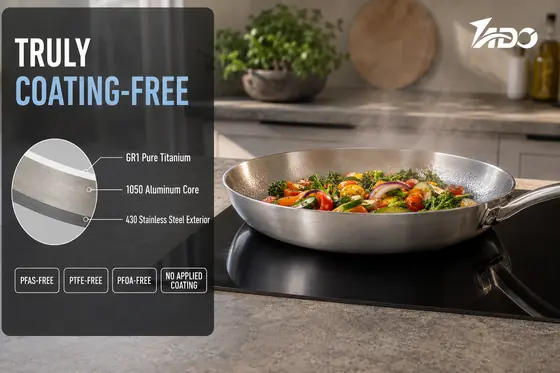
This tri-ply titanium cookware buying guide explains the main product types, the role of each metal and the questions buyers should ask suppliers. It also shows how TADO combines a GR1 titanium interior, a 1050 aluminum core and a magnetic 430 stainless steel exterior in one cookware body.
What Does “Titanium Cookware” Actually Mean?
Before comparing prices or features, identify where the titanium is located. In most cases, titanium cookware falls into one of three groups.
1. Single-Layer Titanium Cookware
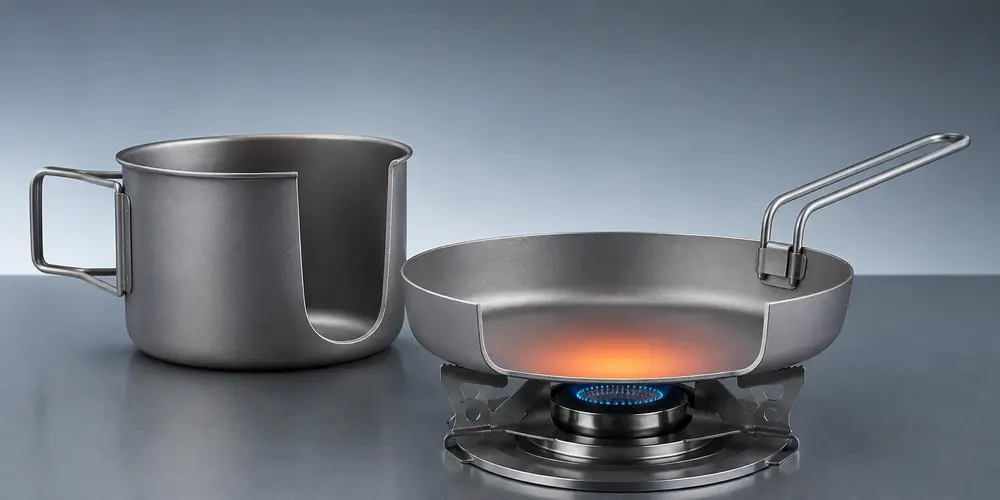
The body of this cookware is made from commercially pure titanium. Because titanium has a relatively low density, these pots can be thin and light. As a result, they are popular for backpacking, camping and boiling water.
However, titanium transfers heat much more slowly than aluminum. A thin, single-layer titanium pan can therefore develop a concentrated hot area above the burner. That is less important when boiling water, but it can make frying, sautéing and sauce preparation harder to control.
2. Titanium-Reinforced Coated Cookware
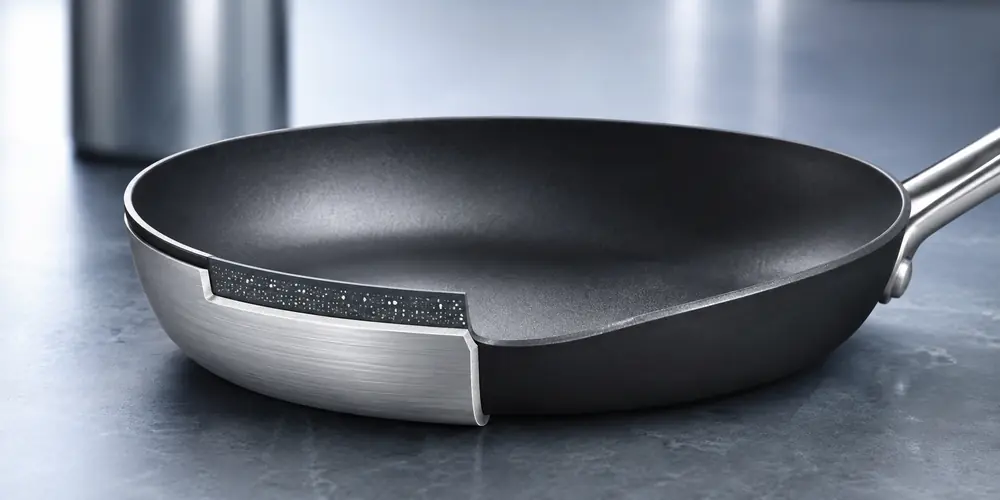
In this category, the pan body is usually aluminum or stainless steel. Titanium compounds or particles are added to a nonstick coating to improve its wear resistance.
This can be a useful coating technology. Still, the food-contact surface is a coating, not a solid sheet of titanium. Its cooking performance and service life depend on the complete coating system, application process and care instructions.
Buyers should not confuse this construction with coating-free titanium-lined cookware.
3. Tri-Ply Titanium Cookware
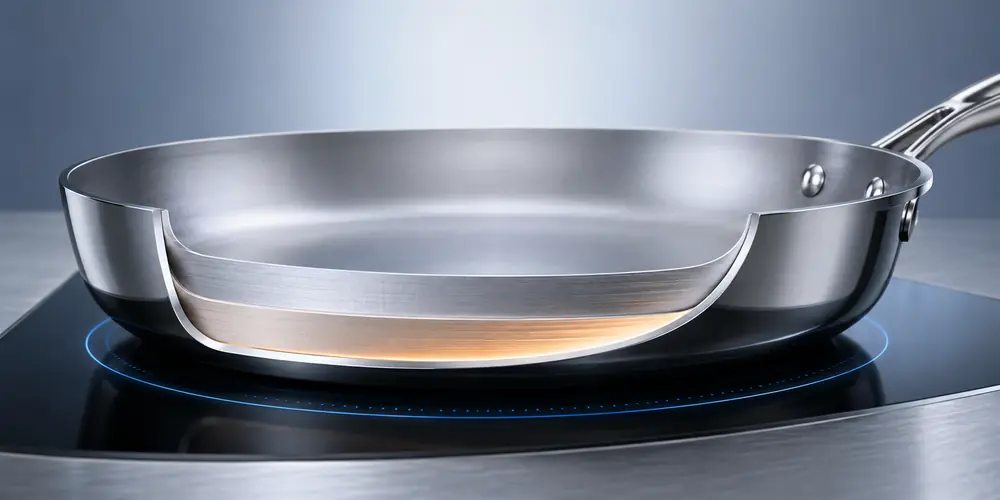
Tri-ply titanium cookware bonds three metals into one body. A typical construction places titanium on the inside, aluminum in the center and magnetic stainless steel on the outside.
Each layer has a separate job:
- The titanium interior provides the food-contact surface.
- The aluminum core spreads heat across the cookware body.
- The stainless steel exterior adds support and enables induction use when a magnetic grade is selected.
This structure addresses the main weakness of single-layer titanium: uneven heat distribution during everyday stovetop cooking.
How TADO’s Three-Layer Titanium Cookware Works
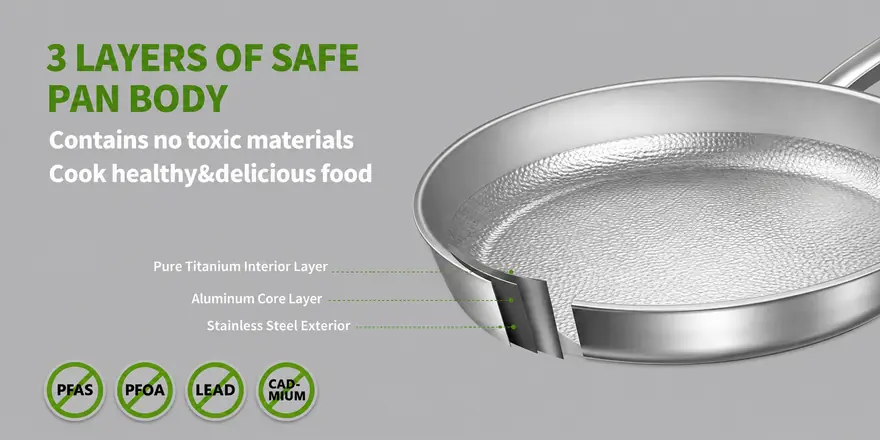
TADO uses a clearly defined material structure rather than a vague “titanium-infused” claim:
| Layer | TADO material | Main function |
|---|---|---|
| Interior | GR1 commercially pure titanium | Coating-free food-contact surface with high corrosion resistance |
| Core | 1050 aluminum | Faster lateral heat distribution and fewer severe hot spots |
| Exterior | Magnetic 430 stainless steel | Structural support and induction compatibility |
The three layers are bonded into the cookware body. Therefore, the cooking surface is not a sprayed titanium coating over aluminum. Food contacts the GR1 titanium layer.
Layer thickness can vary by product and intended use. For example, one representative 2.8 mm TADO construction uses approximately 0.4 mm titanium, 1.8 mm aluminum and 0.6 mm stainless steel. Buyers should confirm the specification for the exact model under evaluation.
GR1 Titanium Interior: A Stable Food-Contact Surface
Commercially pure titanium develops a thin, protective oxide film when exposed to oxygen. This passive surface contributes to titanium’s strong corrosion resistance.
In TADO cookware, GR1 titanium forms the entire interior layer. It is not an applied nonstick film. Consequently, there is no separate nonstick coating designed to provide food release.
That distinction matters. A coating-free surface cannot peel in the same way as an applied coating. However, bare titanium is not automatically nonstick. Good results still depend on heat control, preheating, cooking oil and allowing food to release before turning it.
1050 Aluminum Core: The Heat-Distribution Layer
Titanium offers useful surface properties, but it is not an efficient heat spreader. Aluminum conducts heat far more effectively. That is why TADO places a 1050 aluminum layer inside the bonded body.
The core moves heat away from the area directly above the burner and distributes it across a larger part of the pan. In practice, this supports more consistent browning and more controlled cooking than a thin, single-layer titanium body.
The core remains enclosed between the inner and outer metals during normal use. Therefore, it performs a thermal function without becoming the food-contact surface.
430 Stainless Steel Exterior: Strength and Induction Compatibility
Titanium and aluminum are not suitable induction layers by themselves. An induction cooktop needs a compatible magnetic base.
TADO uses magnetic 430 stainless steel on the exterior. This layer allows the cookware to work on induction hobs while also supporting the composite body. The result is cookware designed for induction, gas, electric and ceramic cooktops, subject to the instructions for the individual product.
Why Tri-Ply Construction Matters More Than the Titanium Label
A material name alone does not predict total cooking performance. The location, grade and thickness of every layer also matter.
For example, a single-layer titanium pot may be ideal when low pack weight is the priority. Yet the same construction may not be the best choice for searing food evenly at home. Meanwhile, a titanium-reinforced coating may provide convenient food release, but it remains a coated system.
Tri-ply titanium cookware takes a different approach. It assigns one task to each metal instead of asking one metal to do everything.
This produces four practical advantages:
- A real titanium cooking surface. The titanium is located where food contacts the pan.
- Better heat distribution. The aluminum core compensates for titanium’s low thermal conductivity.
- Induction readiness. The magnetic stainless exterior responds to induction cookware systems.
- No applied nonstick coating. The inner metal itself is the cooking surface.
Tri-Ply Titanium vs Tri-Ply Stainless Steel
Conventional tri-ply stainless steel often uses a 304 stainless interior, an aluminum core and a magnetic stainless exterior. It is a proven construction and remains a strong choice for many kitchens.
TADO’s structure changes the food-contact layer from stainless steel to GR1 titanium.
| Buying factor | TADO tri-ply titanium | Conventional tri-ply stainless steel |
|---|---|---|
| Food-contact layer | GR1 commercially pure titanium | Commonly 304 stainless steel |
| Heat-spreading layer | 1050 aluminum | Usually aluminum |
| Induction layer | Magnetic 430 stainless steel | Commonly magnetic stainless steel |
| Applied nonstick coating | No | Usually no |
| Nickel at the cooking surface | No intentionally added nickel in GR1 titanium | 304 stainless steel normally contains nickel |
| Cooking technique | Preheat and oil required | Preheat and oil required |
Both constructions can deliver strong everyday performance when they are well made. The main difference is the metal that directly contacts food.
This makes tri-ply titanium especially relevant to brands that want a coating-free titanium surface while retaining the heating behavior and cooktop compatibility expected from clad cookware.
Is Tri-Ply Titanium Cookware Nonstick?
No bare-metal pan should be described as universally nonstick. TADO tri-ply titanium cookware has a coating-free metal surface, so users should cook with suitable technique.
For better food release:
- Preheat the pan gradually over low or medium heat.
- Test the temperature before adding food.
- Add an appropriate amount of oil after preheating.
- Dry proteins before placing them in the pan.
- Let food form a crust and release naturally before turning it.
- Avoid prolonged empty heating or uncontrolled high heat.
This honest explanation helps buyers set the right customer expectations. It also reduces confusion between a titanium cooking surface and a titanium-reinforced nonstick coating.
How to Evaluate Titanium Cookware Before Buying
Retailers, importers and private-label brands should request more than a product name. The following checks reveal what the cookware is actually made from.
Confirm the Food-Contact Material
Ask a direct question: Is the interior a solid titanium layer or a titanium-containing coating?
The supplier should identify the grade and construction in writing. For TADO’s tri-ply cookware, the food-contact layer is GR1 commercially pure titanium.
Request the Full Layer Specification
A useful specification should state:
- The material grade of all three layers
- The total body thickness
- The approximate thickness of each layer
- Whether the layers extend through the body or only across the base
- The material used for handles, rivets and lids
These details help buyers compare products on equal terms.
Verify Induction Compatibility
Do not assume that every titanium pan works on induction. Single-layer titanium is generally not induction compatible. A tri-ply product needs a magnetic exterior or base, such as TADO’s 430 stainless steel outer layer.
Review Finished-Product Test Documents
Material grade is only one part of compliance. Buyers should also review documentation for the finished cookware and its intended market.
In the European Union, Regulation (EC) No 1935/2004 sets general requirements for food-contact materials. In the United States, suppliers and brands must ensure that food-contact substances and finished products meet applicable requirements. The exact test program should reflect the product, construction, food types, use conditions and destination market.
Therefore, ask for current, model-relevant reports rather than relying on a logo or a broad “food safe” statement.
Evaluate Manufacturing Consistency
A good sample is not enough for an OEM or wholesale program. Buyers should also assess:
- Bonding quality between the three layers
- Body thickness and weight consistency
- Flatness and resistance to spinning on a level surface
- Handle attachment and fatigue performance
- Rim, polishing and surface consistency
- Heating behavior across multiple production samples
- Packaging and drop-test requirements
Clear acceptance criteria make later quality inspections more objective.
Who Should Choose TADO Tri-Ply Titanium Cookware?
TADO’s construction is designed for brands, importers, distributors and retailers that want to position titanium cookware beyond a coating claim.
It is a strong fit when the product brief requires:
- A GR1 titanium food-contact surface
- A coating-free interior
- More even heat distribution than thin, single-layer titanium
- Compatibility with induction and common household cooktops
- An OEM, ODM or private-label program
- Model-specific specifications and testing support
However, tri-ply titanium is not the answer to every product brief. An ultralight camping range may benefit more from single-layer titanium. A low-cost pan focused on effortless egg release may need a qualified nonstick coating system instead.
The right construction depends on the customer, price position and cooking task.
Questions to Ask a Titanium Cookware Manufacturer
Before approving a supplier, ask these questions:
- Where is titanium used in the product?
- Is the cooking surface solid titanium or a coating?
- What titanium grade is used?
- What are the material and thickness of each layer?
- Does the aluminum core extend through the cookware body?
- Which layer makes the product induction compatible?
- Which reports apply to this exact model and destination market?
- What controls are used for bonding, flatness and handle strength?
- What customization is available for size, finish, handle, lid and packaging?
- What are the sample, tooling, MOQ and production lead-time terms?
Specific answers are more valuable than general claims such as “premium titanium” or “advanced nonstick technology.”
Frequently Asked Questions
Is tri-ply titanium cookware made entirely from titanium?
No. It uses titanium as one functional layer. TADO cookware combines a GR1 titanium interior, a 1050 aluminum core and a magnetic 430 stainless steel exterior. This is intentional: each metal provides a different performance benefit.
Is TADO tri-ply titanium cookware coated?
The GR1 titanium interior is the food-contact layer itself, rather than an applied nonstick coating. Buyers should still confirm the surface specification of the exact TADO collection because finishes and model details can vary.
Does tri-ply titanium cookware heat evenly?
The aluminum core spreads heat more effectively than single-layer titanium. Actual temperature uniformity also depends on body geometry, layer thickness, burner size and heat setting. Therefore, buyers should compare representative production samples under a defined test method.
Can TADO titanium cookware be used on induction?
Yes. Its magnetic 430 stainless steel exterior provides induction compatibility. Users should follow the instructions for the specific model and match the pan base to the cooking zone.
Is titanium cookware naturally nonstick?
No. A coating-free titanium surface still needs correct preheating, oil and heat control. It should not be marketed as identical to a conventional nonstick coating.
Can TADO support OEM and private-label projects?
Yes. TADO works with international brands, importers and distributors on OEM, ODM and private-label cookware programs. Project details depend on the selected model, customization scope, order volume and compliance requirements.
Conclusion: Buy the Structure, Not the Label
“Titanium cookware” is not one single construction. It may describe a lightweight titanium camping pot, a titanium-reinforced coating or a three-layer pan with a real titanium cooking surface.
For everyday home cookware, TADO’s tri-ply structure brings three complementary materials together. GR1 titanium forms the coating-free interior. The 1050 aluminum core distributes heat. Magnetic 430 stainless steel supports the body and enables induction cooking.
That complete structure—not the word titanium alone—defines the product’s practical value.
If you are developing a titanium cookware range, request TADO’s model specifications, sample options and OEM/ODM information. Comparing the actual layer structure is the best place to begin.
Contact Us
for product specifications, samples, material declarations, testing documentation or wholesale cooperation.
Xi ‘an Taidou Metal Products Technology Co., Ltd.
Room 1604, Block D, Baihualin Financial Innovation Center, No. 51 Fengcheng Second Road, Weiyang District, Xi’an City, Shaanxi Province, P.R.China
Email: overjunjun@gmail.com
WhatsApp: +64274075362
Tel: +86 18629501987
References
- TADO, “A Coating-Free Pot Designed for Safer, More Even Cooking”: https://tieedo.com/news/tado-3-ply-titanium-cookware-a-coating-free-pot-designed-for-safer-more-even-cooking/
- TADO, “Titanium Cookware Explained: 3-Layer Construction, Benefits & What Buyers Should Know”: https://tieedo.com/news/titanium-cookware-explained-3-layer-construction-benefits-what-buyers-should-know/
- U.S. FDA, “Food Chemical Safety”: https://www.fda.gov/food/food-ingredients-packaging/food-chemical-safety
- European Union, Regulation (EC) No 1935/2004 on materials and articles intended to come into contact with food: https://eur-lex.europa.eu/legal-content/EN/TXT/?uri=CELEX:32004R1935