
TADO 3-Ply Titanium Cookware: A Coating-Free Pot Designed for Safer, More Even Cooking
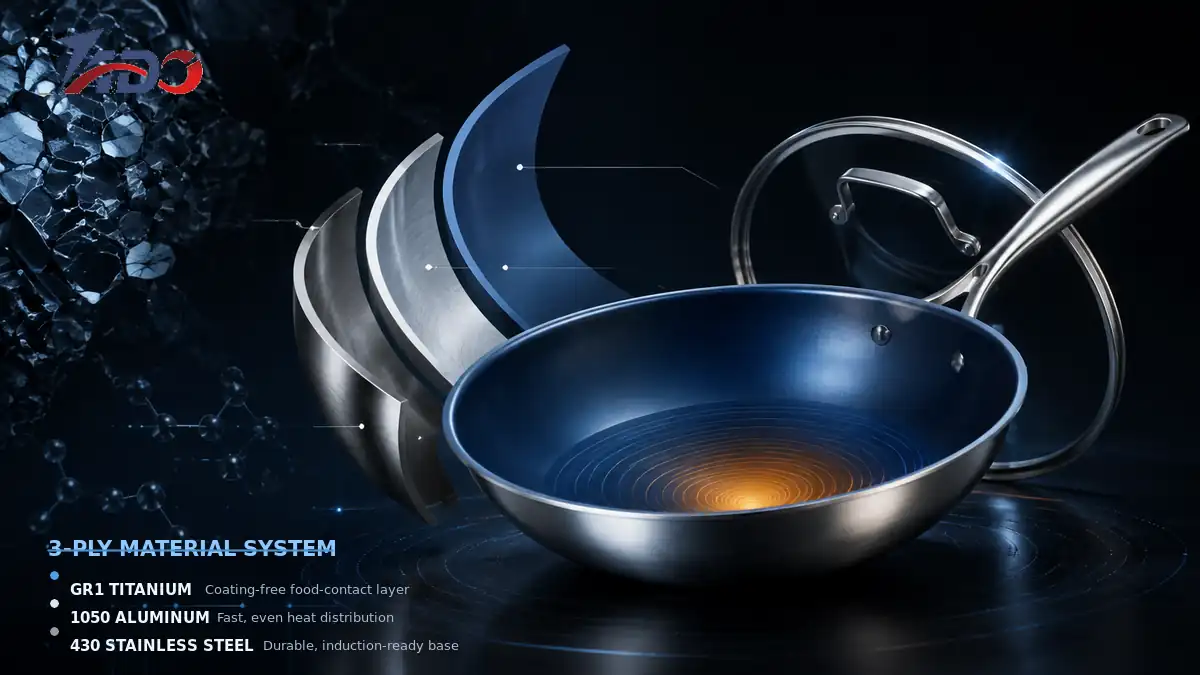
TADO titanium cookware combines a GR1 pure titanium cooking surface, a 1050 aluminum heat-distribution core, and a magnetic 430 stainless steel exterior. The result is a coating-free, induction-compatible pot designed to address three common cookware concerns: chemical coatings, uneven heating, and limited stovetop compatibility.
Unlike cookware marketed as “titanium” because it contains titanium particles in a non-stick coating, the food-contact surface of a TADO pot is titanium itself. There is no PTFE-based non-stick coating and no fluoropolymer layer applied to the cooking surface.
TADO Titanium Pot at a Glance
| Feature | TADO specification | Practical benefit |
|---|---|---|
| Food-contact layer | GR1 commercially pure titanium | Chemically stable, corrosion-resistant cooking surface |
| Core layer | 1050 aluminum | Faster, more even heat distribution than single-layer titanium |
| Exterior layer | Magnetic 430 stainless steel | Durability and induction compatibility |
| Surface system | Modified titanium oxide surface; no applied non-stick coating | No coating layer designed to peel or flake |
| Fluoropolymer coating | None | No PTFE-based coating on the food-contact surface |
| Compatible heat sources | Gas, electric, ceramic, and induction | Suitable for most residential and commercial kitchens |
| Reported surface hardness | Up to HV1200, subject to the applicable test method and report | Improved resistance to scratching and wear |
| Reported weight reduction | Up to 35% versus comparable stainless steel cookware, depending on model | Easier lifting, pouring, and handling |
Material composition, surface hardness, weight comparisons, and food-contact performance should be confirmed against the test reports and specifications for the exact model ordered.
Why Choose a Coating-Free Titanium Cooking Surface?
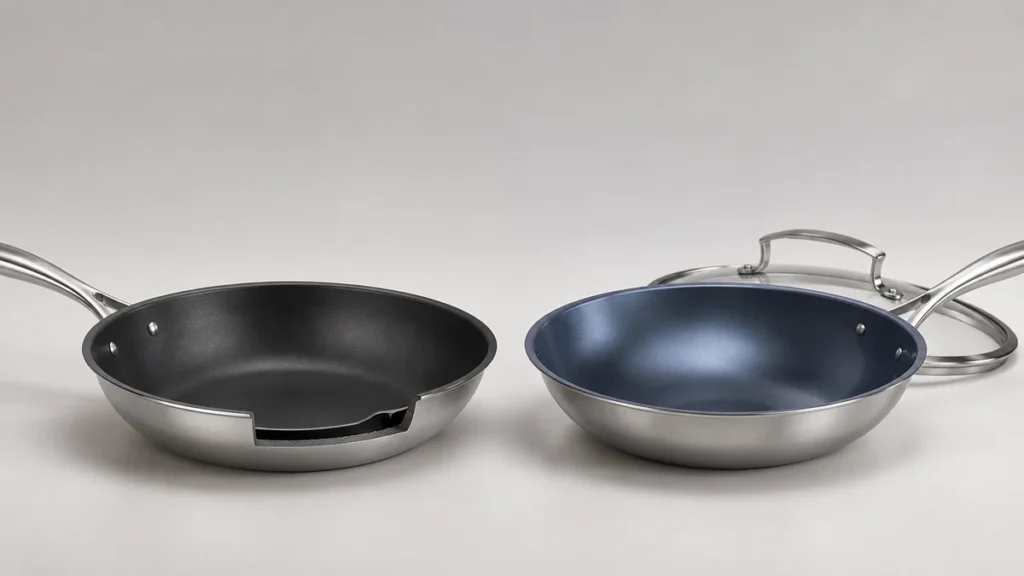
Traditional non-stick cookware usually depends on an applied coating. Any applied coating can lose performance over time if it is overheated, deeply scratched, or cleaned contrary to the manufacturer’s instructions.
TADO takes a different approach. Its food-contact layer is GR1 titanium, and its release performance comes from the engineered titanium surface rather than a conventional fluoropolymer coating. Because there is no applied non-stick layer, there is no coating film intended to peel away from the pan.
Titanium is valued in cookware for several material properties:
- Corrosion resistance: Titanium performs well in contact with many acidic, alkaline, and salty foods.
- Chemical stability: It is relatively non-reactive under normal cooking conditions and is less likely to affect the taste of food.
- Biocompatibility: Commercially pure titanium is widely used in applications where material compatibility matters.
- High strength-to-weight ratio: Titanium offers useful strength without the weight associated with some other cookware constructions.
These properties make titanium an attractive food-contact material for health-conscious households, professional kitchens, and cookware brands developing premium coating-free product lines.
How the TADO 3-Ply Construction Works
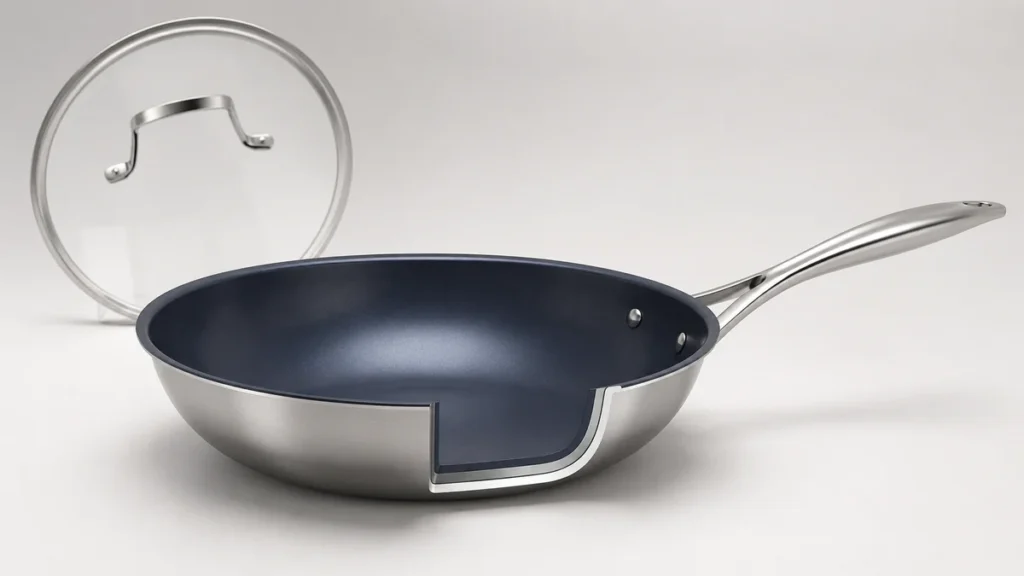
A high-performance titanium pot needs more than a safe food-contact surface. It must also spread heat efficiently, resist deformation, and work with modern cooking appliances. TADO addresses these requirements by permanently bonding three functional metals into one cookware body.
Inner Layer: GR1 Commercially Pure Titanium
The inner layer is the only metal intended to contact food. TADO uses GR1 commercially pure titanium because it offers high purity, corrosion resistance, ductility, and good formability.
For the user, this layer provides:
- A coating-free food-contact surface
- No intentional nickel or chromium in the titanium cooking layer
- Resistance to corrosion from common foods
- Minimal interaction with flavor and aroma under normal cooking conditions
- A surface suitable for an engineered titanium oxide treatment
GR1 is also used in selected medical and industrial applications. However, the term “medical grade” should only be used for a specific product when the supplied material and manufacturing controls meet the relevant medical standard. For cookware, the more accurate description is GR1 commercially pure titanium.
Core Layer: 1050 Aluminum for Heat Distribution
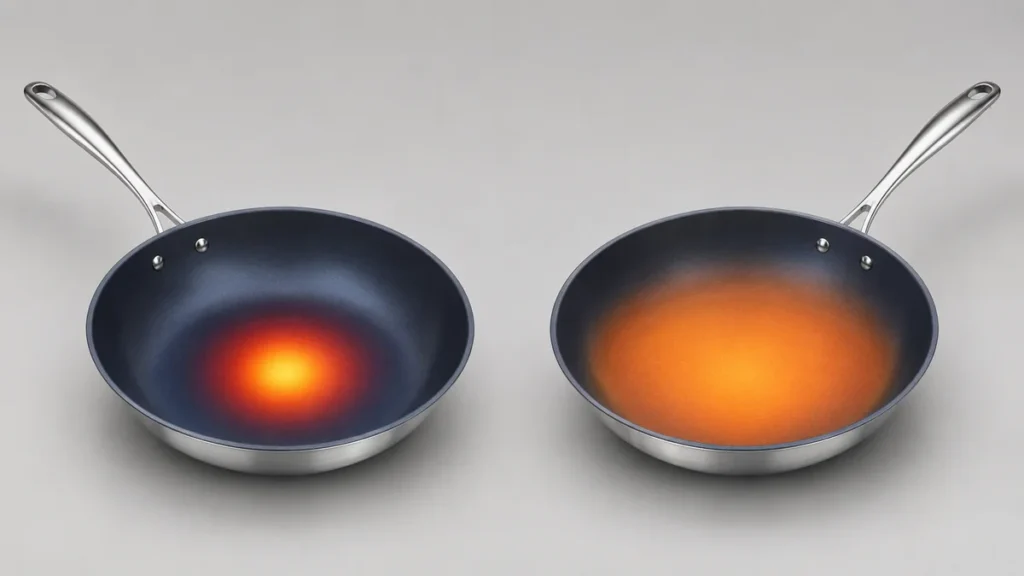
Titanium has substantially lower thermal conductivity than aluminum. A single-layer titanium pan can therefore develop concentrated hot zones, particularly over a small gas flame or heating element.
The 1050 aluminum core acts as a thermal bridge. It receives heat from the base and spreads it across the bottom and sidewalls more quickly than titanium alone. This improves temperature consistency and helps the cookware respond more predictably when the heat setting changes.
Practical advantages include:
- More even browning and searing
- Lower risk of scorching food at the center of the pan
- Better control when cooking eggs, sauces, vegetables, and proteins
- More efficient use of low-to-medium heat
- Greater structural stability than a thin, single-layer pot
Exterior Layer: 430 Magnetic Stainless Steel
Pure titanium is not sufficiently magnetic for standard induction cooktops. TADO therefore uses a 430 ferritic stainless steel exterior.
This outer layer serves two functions:
- It gives the pot a durable exterior that resists everyday impact, abrasion, and deformation.
- Its ferromagnetic properties allow the cookware to work on induction hobs.
Heat generated at the stainless steel exterior moves into the aluminum core, which distributes it before it reaches the titanium cooking surface.
Why Not Make the Entire Pot from Solid Titanium?
Solid titanium is lightweight, corrosion-resistant, and useful for equipment such as camping cookware. It is not, however, the ideal stand-alone material for every style of cooking.
Titanium has a thermal conductivity of approximately 17 W/m·K, while aluminum is around 237 W/m·K. Exact values vary with grade and temperature, but the difference is large: aluminum moves heat far more quickly.
In practical terms, a thin, single-layer titanium pan may heat intensely over the burner while remaining cooler near the edges. That is acceptable for boiling water outdoors, but it makes controlled frying, sautéing, and sauce preparation more difficult.
The TADO 3-ply structure preserves titanium where it matters—the food-contact surface—while using aluminum and magnetic stainless steel where their physical properties add value.
TADO Titanium Cookware Compared with Common Alternatives
| Cookware type | Food-contact surface | Heat distribution | Induction compatible | Applied non-stick coating | Best suited for |
| TADO 3-ply titanium cookware | GR1 titanium | High, due to aluminum core | Yes | No | Daily home cooking, premium retail, professional use |
| Single-layer titanium camping cookware | Titanium | Limited | Usually no | Usually no | Boiling water and ultralight outdoor use |
| Conventional PTFE non-stick cookware | Applied PTFE coating | Usually good with aluminum substrate | Model-dependent | Yes | Low-oil cooking with careful utensil and temperature control |
| Ceramic-coated cookware | Applied sol-gel/ceramic-type coating | Model-dependent | Model-dependent | Yes | Short- to medium-term easy-release cooking |
| Uncoated 304/316 stainless steel cookware | Stainless steel | Depends on construction | Model-dependent | No | Browning, searing, and general-purpose cooking |
Compared with Single-Layer Titanium Camping Pots
Ultralight titanium cookware is designed to minimize pack weight. It performs well for boiling water and reheating simple meals, but its thin walls and low thermal conductivity can create hot spots.
TADO cookware is designed for full kitchen use. Its aluminum core adds the heat-spreading capacity needed for frying, sautéing, and controlled searing.
Compared with Traditional Non-Stick Cookware
Conventional non-stick pans rely on an applied release coating. Their lifespan depends on coating quality, operating temperature, cleaning method, and utensil use.
TADO uses no PTFE-based non-stick coating on the food-contact surface. Its engineered titanium surface is intended to provide release and easy-cleaning performance without a separate coating film.
This does not mean that coating-free titanium cooks exactly like a new PTFE pan. Correct preheating, appropriate oil use, and temperature control still affect food release. Clear care instructions build trust and help customers achieve the intended performance.
Compared with Stainless Steel Cookware
Quality stainless steel cookware is durable and widely used. Its food-contact layer normally contains chromium and may contain nickel, depending on the grade.
TADO instead places GR1 titanium at the food-contact surface. This may be preferred by consumers seeking a nickel-free and chromium-free cooking surface, while the stainless steel remains on the exterior for strength and induction compatibility.
Scratch Resistance and Long-Term Durability
TADO’s modified titanium surface is engineered for high hardness and wear resistance. Internal or third-party testing may report values of up to HV1200, depending on the product, surface process, load, and test method.
This surface is intended to tolerate regular kitchen use, including contact with metal utensils. To maximize appearance and service life, users should still avoid cutting directly inside the pot and should follow the care instructions supplied with the specific product.
For distributors and private-label brands, the durability claim should be supported with the applicable hardness, abrasion, utensil, and corrosion test reports. Publishing the test method is more credible to professional buyers than publishing a hardness number by itself.
A Lighter Pot for Everyday Handling
TADO’s composite construction is designed to reduce weight without giving up the functions required for daily cooking. Depending on the model and the product used for comparison, a TADO titanium pot may be up to 35% lighter than similarly sized stainless steel cookware.
A lower pot weight can make a meaningful difference when users:
- Lift a filled pot from the stove
- Toss or turn food in a frying pan
- Pour liquids with one hand
- Wash and store large cookware
- Cook frequently or have limited wrist strength
For an accurate comparison, buyers should evaluate cookware of the same diameter, capacity, lid configuration, and handle type.
Compatible Cooktops and Recommended Uses
The magnetic 430 stainless steel exterior makes TADO 3-ply titanium cookware compatible with:
- Induction cooktops
- Gas burners
- Electric coil and smooth-top ranges
- Ceramic cooktops
The construction is suitable for frying, sautéing, simmering, boiling, and sauce preparation. Oven compatibility and maximum safe temperature depend on the handle, lid, and accessory materials used on each model; consult the product specification before oven use.
Care and Cooking Guidance
For reliable release performance and a longer service life:
- Preheat the pan gradually over low-to-medium heat.
- Add an appropriate amount of cooking oil before foods that tend to stick.
- Allow proteins to sear before attempting to turn them.
- Avoid prolonged empty heating or uncontrolled overheating.
- Let the cookware cool before washing after high-temperature cooking.
- Use non-abrasive cleaning methods unless the product care guide states otherwise.
These practices apply to most uncoated metal cookware and help users obtain more consistent results.
OEM and Wholesale Titanium Cookware
Xi’an Taidou Metal Products Technology Co., Ltd., the company behind TADO, supplies 3-ply titanium cookware for distributors, retailers, and private-label brands. OEM and ODM support may include product sizing, handle and lid options, surface finishes, branding, packaging, and market-specific compliance documentation.
Buyers can request the following documents for the relevant model and production batch:
- Raw-material specifications and certificates
- Food-contact compliance reports
- Hardness and abrasion test reports
- Corrosion and thermal-cycle test data
- Induction compatibility information
- Quality-control and inspection standards
For factory-direct pricing, minimum order quantities, available tooling, and sample requirements, contact overjunjun@gmail.com.
Frequently Asked Questions
Is a TADO titanium pot coated?
No conventional PTFE or fluoropolymer non-stick coating is applied to the TADO food-contact surface. The inner layer is GR1 titanium with an engineered titanium oxide surface. Buyers should review the specification and test report for the exact model.
Does TADO titanium cookware contain PTFE, PFOA, or other fluoropolymer coatings?
TADO cookware is described as having no PTFE-based or other fluoropolymer coating on the food-contact surface. Any “free from” statement used in a specific market should be supported by current supplier declarations or third-party test documentation.
Is titanium cookware naturally non-stick?
Uncoated titanium is not identical to a conventional PTFE non-stick surface. TADO modifies the titanium surface to improve release and cleaning performance, but cooking technique still matters. Gradual preheating, moderate heat, and appropriate oil use generally produce the best results.
Can I use metal utensils with a TADO titanium pot?
The hardened titanium surface is designed for high scratch and wear resistance and can tolerate normal contact with metal utensils. Avoid cutting food directly in the pot or using tools in a way that could damage any cookware surface.
Is TADO titanium cookware safe for acidic or alkaline foods?
Titanium is highly corrosion-resistant and relatively non-reactive with common foods. This makes the GR1 titanium cooking surface suitable for dishes containing ingredients such as tomatoes, vinegar, citrus, or salt under normal cooking conditions.
Does a titanium pot work on induction?
Pure titanium alone generally does not work on a standard induction hob. TADO cookware is induction-compatible because its exterior layer is magnetic 430 stainless steel.
Why does TADO use aluminum inside the cookware body?
The aluminum is fully enclosed between the titanium inner layer and stainless steel exterior. It does not serve as the food-contact surface. Its purpose is to spread heat more quickly and evenly than titanium alone.
Is GR1 titanium the same as medical-grade titanium?
GR1 is a commercially pure titanium grade used in cookware and selected industrial or medical applications. “Medical grade” is an application-specific designation and should only be claimed when the material and manufacturing system comply with the applicable medical standard. For this cookware, “GR1 commercially pure titanium” is the precise description.
How is TADO cookware different from titanium-coated cookware?
Titanium-coated cookware usually refers to an applied non-stick coating reinforced with titanium particles. In TADO 3-ply cookware, the food-contact sheet itself is titanium; it is not simply an aluminum pan marketed as titanium because of a coating additive.
Is TADO titanium cookware lighter than stainless steel cookware?
It can be. TADO reports weight reductions of up to 35% for selected models compared with similarly sized stainless steel cookware. The actual difference depends on diameter, wall thickness, capacity, handles, and lid construction.
Request Specifications, Samples, or OEM Pricing
TADO combines a GR1 titanium cooking surface, a heat-conductive aluminum core, and an induction-ready stainless steel exterior in one bonded cookware body. The design is intended for buyers who want coating-free food contact, more even heat distribution, broad cooktop compatibility, and long-term durability.
Contact Xi’an Taidou Metal Products Technology Co., Ltd. at overjunjun@gmail.com to request model specifications, material certificates, test reports, minimum order quantities, sample lead times, or factory-direct wholesale pricing.