
Does Titanium Cookware Contain PFAS, PTFE or PFOA?
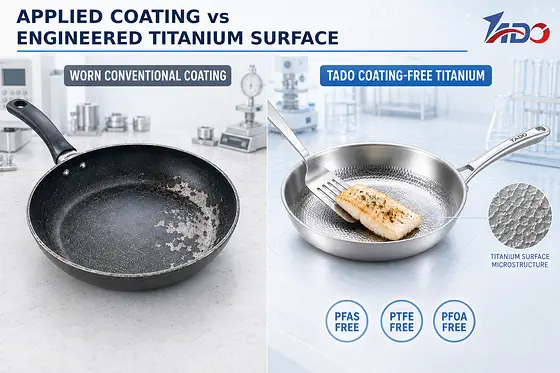
The short answer: Titanium metal does not naturally contain PFAS, PTFE or PFOA. But not every product sold as “titanium cookware” has a genuine titanium cooking surface. Some pans use a conventional fluoropolymer nonstick coating reinforced with titanium-related particles. TADO takes a different approach: Grade 1 commercially pure titanium is the actual food-contact layer, and its coating-free food-release performance comes from engineered titanium surfaces—not from a conventional PTFE coating.
For consumers choosing healthier, longer-lasting cookware—and for professional buyers building a credible PFAS-free product range—this distinction matters more than the word titanium on the package.
This guide explains what PFAS, PTFE and PFOA mean, how to distinguish genuine titanium cookware from titanium-reinforced coatings, and why TADO provides a clearer coating-free solution for modern kitchens.
PFAS, PTFE and PFOA Are Not the Same Thing
Cookware labels often place these three terms close together, making them appear interchangeable. They are not.
| Term | Simple definition | Relevance to cookware |
|---|---|---|
| PFAS | A broad family of synthetic fluorinated substances | Certain PFAS chemistries are used in or associated with traditional nonstick coating systems |
| PTFE | Polytetrafluoroethylene, a high-molecular-weight fluoropolymer | Commonly used to create the slippery surface of conventional nonstick cookware |
| PFOA | Perfluorooctanoic acid, one specific long-chain PFAS | Historically used as a processing aid in manufacturing some fluoropolymers; it is not the finished PTFE coating itself |
The U.S. Environmental Protection Agency describes PFOA as one member of the much broader PFAS group. The U.S. Food and Drug Administration identifies nonstick coatings as one of the food-contact applications in which authorized PFAS-containing substances have been used.
The practical takeaway is simple:
PFOA-free does not automatically mean PTFE-free, and neither claim automatically proves that a product is free from every PFAS.
A conventional nonstick pan may accurately claim “PFOA-free” while still using PTFE as its principal food-release coating.
Does Titanium Itself Contain PFAS?
No. Titanium is a metallic element. PFAS, PTFE and PFOA are synthetic fluorinated substances or polymers. They are not natural ingredients of titanium metal.
Genuine titanium cookware therefore does not need fluoropolymer chemistry in order to provide a titanium food-contact surface.
The source of confusion is not titanium—it is cookware marketing. The term “titanium cookware” can describe several very different constructions.
“Titanium Cookware” Can Mean Three Different Products
1. Titanium-reinforced nonstick cookware
In this construction, the pan body may be aluminum or stainless steel. A conventional nonstick coating is applied over it, and titanium-related particles may be added to reinforce the coating or support a durability claim.
The word titanium may be prominent in the product name, but food still contacts an applied coating. If that coating uses PTFE or another fluoropolymer, the product is not equivalent to an uncoated titanium cooking surface.
2. Titanium-colored or titanium-effect cookware
A metallic gray, gold or blue surface can be created through several different processes. Appearance alone cannot confirm what touches the food. A color description is not a material specification.
3. Genuine titanium food-contact cookware
Here, titanium metal itself forms the cooking surface. It may be a single-wall titanium body or the interior layer of a multi-ply structure.
TADO belongs to this third category. Its tri-ply cookware places Grade 1 commercially pure titanium directly against the food.
| Product description | Actual food-contact surface | May use PTFE? | Material value |
| Titanium-reinforced nonstick | Applied coating containing titanium-related reinforcement | Yes | Depends primarily on the coating system |
| Titanium-effect or titanium-colored | Cannot be confirmed from color | Possibly | Requires specification verification |
| Single-wall titanium | Titanium metal | Not required | Lightweight but limited heat distribution |
| TADO tri-ply titanium cookware | Grade 1 commercially pure titanium | Not required on the cooking surface | Genuine titanium contact plus full-body heat distribution |
Does TADO Titanium Cookware Contain PFAS, PTFE or PFOA?
TADO’s coating-free titanium cooking surface does not rely on intentionally added PFAS, PTFE or PFOA to provide food release. The surface touching the food is Grade 1 commercially pure titanium—not a conventional fluoropolymer coating carrying a titanium marketing name.
TADO’s tri-ply structure assigns a clear function to each metal:
- Grade 1 commercially pure titanium interior
Creates the stable, corrosion-resistant and nickel-free food-contact surface. - 1050 aluminum core
Distributes heat rapidly and evenly through the base and walls. - 430 stainless steel exterior
Provides exterior durability and magnetic induction compatibility.
A representative 2.8 mm TADO frying-pan body can use approximately 0.4 mm titanium, 1.9 mm aluminum and 0.5 mm stainless steel. Exact construction depends on the product model.
This is an important advantage over a simple “PFOA-free” claim. TADO does not merely replace one historical processing aid while keeping the same conventional nonstick concept. It builds the cooking surface from titanium metal.
Why TADO Uses Grade 1 Commercially Pure Titanium
PFAS-free positioning is only one reason to select titanium. Grade 1 commercially pure titanium provides several valuable food-contact properties of its own.
Highly stable with everyday ingredients
Titanium naturally forms a thin, protective oxide film. This passive surface gives the metal exceptional resistance to corrosion and helps limit further reaction with the surrounding environment.
For cookware, that means excellent stability when preparing:
- Tomato and vinegar-based sauces
- Citrus and other acidic foods
- Seafood, salt and brines
- Soups and long-simmered dishes
- Everyday recipes that move between heating, cooling and washing
Nickel-free food-contact surface
Grade 1 commercially pure titanium does not require intentional nickel alloying to achieve its core performance. This gives TADO a clear material proposition for consumers who prefer a nickel-free cooking interior.
The outer 430 stainless steel layer remains separated from food by the titanium interior and aluminum core. It is used where its magnetic properties create value: on the induction-facing exterior.
Recognized biocompatibility
Titanium is widely used in evaluated dental and orthopedic applications. Scientific research connects its corrosion resistance and biocompatibility to the stable passive oxide layer formed on its surface.
This does not mean titanium cookware treats illness, improves immunity or supplies nutritional titanium. The responsible and commercially powerful message is that titanium is a highly stable material trusted for demanding contact applications.
Lower material density
Titanium has a density of approximately 4.5 g/cm³, compared with roughly 7.7–8.0 g/cm³ for common stainless steels. At equal volume, titanium is about 40%–45% lighter.
Finished cookware weight also depends on its aluminum core, stainless exterior, handle and lid. Even so, using titanium instead of an equivalent stainless steel food-contact layer reduces the mass of that layer and supports more comfortable handling.
How TADO Creates Easier Food Release Without PTFE
A coating-free pan must offer more than an attractive materials list. It must cook well.
TADO develops food-release performance through two separate titanium surface platforms. These technologies belong to different product series and are not stacked on the same cooking surface.
TADO Hammered Titanium Series
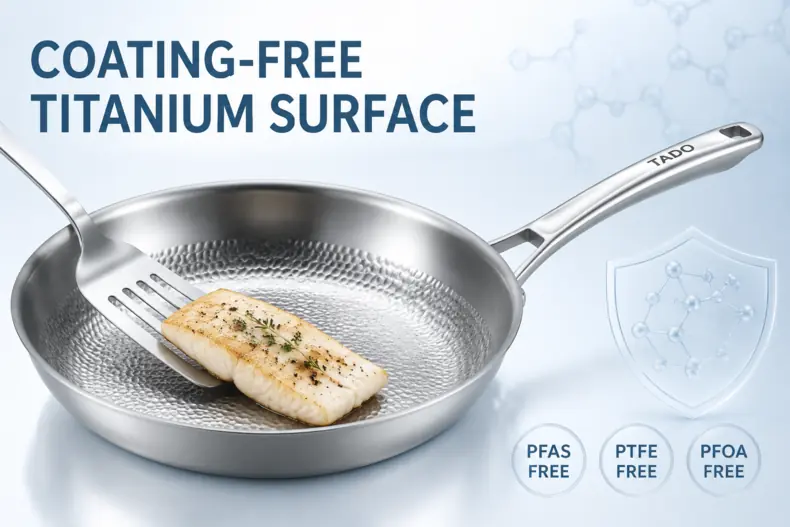
The Hammered Titanium Series uses an engineered three-dimensional texture. The surface interrupts broad, continuous contact between food and the pan while helping distribute a thin oil film across the cooking area.
This provides several advantages:
- Easier coating-free food release
- Greater cooking-surface rigidity
- Improved resistance to visible deformation
- More convenient cleaning with correct heat control
- A distinctive premium metallic appearance
Selected TADO hammered surfaces can reach 600 HV+ after surface strengthening. Applicable specifications and test conditions should accompany model-specific commercial claims.
TADO High-Temperature Reinforced Blue-Surface Series
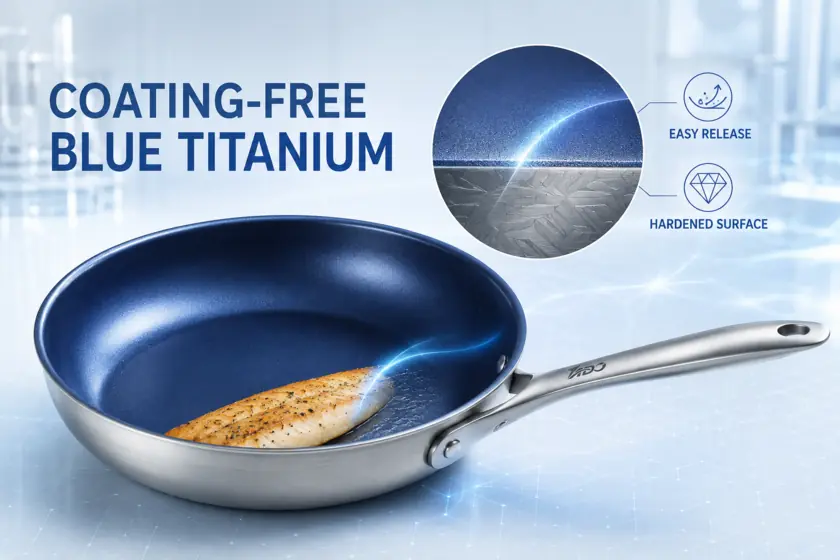
The Blue-Surface Series follows a separate technology route. A controlled high-temperature process engineers the titanium surface into a dense, hardened blue cooking face.
The process is designed to provide:
- Improved surface hardness
- Greater wear resistance
- Smoother coating-free food release
- Long-term surface stability
- A recognizable technology-led appearance
The blue cooking surface is not a conventional PTFE film applied over the pan. Its appearance and performance come from the engineered titanium surface.
Applicable TADO surface systems have undergone evaluations of up to 100,000 steel-brush cycles. Buyers can request the model-specific method and supporting documentation for commercial use.
The aluminum core prevents severe hot spots
Surface engineering is only part of food release. Uneven heat can cause one area of a pan to overcook and stick while another area remains underheated.
TADO’s 1050 aluminum core distributes energy through the pan body, making preheating more predictable. The result is a complete cooking system:
- Titanium manages food contact.
- Aluminum manages heat distribution.
- 430 stainless steel manages induction response.
This is how TADO makes a coating-free titanium surface practical for everyday cooking rather than limiting titanium to thin outdoor cookware.
TADO Titanium vs Conventional Fluoropolymer Nonstick Cookware
| Comparison | Conventional fluoropolymer nonstick | TADO coating-free titanium cookware |
| Food-contact material | Applied nonstick coating | Grade 1 commercially pure titanium |
| Main release mechanism | Low-friction polymer film | Engineered titanium surface, even heat and oil-film control |
| PTFE dependence | Common | Not required on the titanium cooking surface |
| Meaning of PFOA-free | May still use PTFE or other fluorinated chemistry | TADO’s advantage is a different metal-surface platform, not only a PFOA substitution |
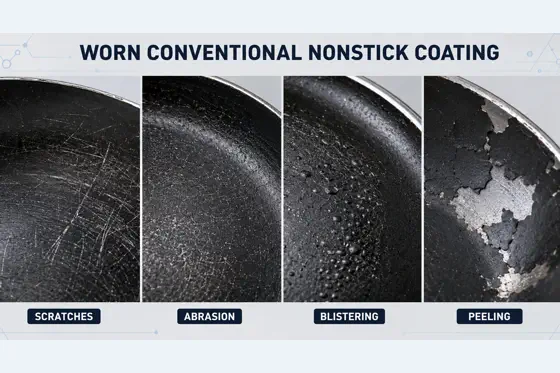
| Wear logic | Release performance depends strongly on coating condition | The food-contact layer remains titanium metal |
| Heat distribution | Depends on the underlying body | Full-body 1050 aluminum core |
| Induction | Depends on base construction | 430 stainless steel exterior on applicable models |
| Consumer story | Familiar but difficult to differentiate | Genuine titanium, coating-free and technology-driven |
| Premium value | Often based on coating grade | Based on material, construction and surface engineering |
Is PTFE Cookware Unsafe?
TADO does not need to claim that every PTFE-coated pan is unsafe in order to demonstrate the value of coating-free titanium.
The FDA states that authorized fluoropolymer nonstick coatings are polymerized into large molecules and bonded to cookware through a heating process. According to the agency, properly manufactured coatings contain a negligible amount of PFAS capable of migrating to food.
Consumers may nevertheless prefer a coating-free alternative because they want:
- A metal cooking surface rather than an applied polymer film
- No conventional PTFE nonstick coating
- A simpler PFAS-free product story
- Less concern about coating wear and replacement
- A durable product designed around long-term material performance
- Greater clarity than a narrow “PFOA-free” claim provides
That is where TADO stands apart. The brand’s value is not built on fear; it is built on a genuine titanium food-contact layer and a more durable surface-engineering strategy.
Why PFAS-Free Titanium Cookware Has Strong Market Potential
PFAS-related search interest and retailer attention are increasing as consumers become more aware of persistent fluorinated chemistry. In the United States, the EPA continues to manage PFAS through substance-specific programs, while the FDA evaluates authorized food-contact uses. In Europe, PFOA and several related substances are already controlled, and a broader PFAS restriction remains under scientific and regulatory review.
The exact regulatory path will continue to evolve. The commercial direction is already visible: consumers, retailers and cookware brands want clearer material declarations and fewer ambiguous coating claims.
TADO gives professional buyers a strong response to that demand.
A product difference consumers can understand
“Food touches Grade 1 commercially pure titanium” is clearer than explaining a multi-component fluoropolymer coating.
A credible premium-price foundation
TADO’s value can be demonstrated through genuine titanium content, tri-ply construction, surface hardness, wear evaluation and visible product design—not through branding alone.
Two independent product stories
The Hammered and Blue-Surface series allow retailers to present two distinct titanium collections without confusing the technologies.
Strong educational content
The difference between a titanium-reinforced coating and a genuine titanium surface creates useful material for product pages, retail training, videos, comparison graphics and social media.
More durable ownership positioning
The titanium interior remains the food-contact material throughout normal use. This supports a long-term cookware message rather than a product story centered on preserving a replaceable nonstick film.
What a Credible PFAS-Free Cookware Claim Should Show
For a professional buyer, a trustworthy product story should connect four things:
| Evidence | What it confirms | TADO value |
| Material specification | What directly contacts food | Grade 1 commercially pure titanium interior |
| Layer construction | How the cookware heats and works on induction | Titanium–aluminum–430 stainless tri-ply body |
| Surface description | How coating-free food release is developed | Separate Hammered or Blue-Surface engineering |
| Applicable declarations or testing | What the free-from claim covers | Model-specific documentation available for evaluation |
The strongest wording is precise:
- Grade 1 commercially pure titanium food-contact surface
- No conventional PTFE nonstick coating on the titanium cooking surface
- Made without intentionally added PFAS in the titanium cooking-surface system
- PFAS-free, PTFE-free and PFOA-free cooking surface, when supported by the relevant product documentation and declared scope
This protects the buyer while strengthening the brand. Precise claims are more credible than broad slogans and easier for retailers to defend.
How to Get the Best Results from Coating-Free Titanium Cookware
TADO’s engineered titanium cookware does not need to imitate a disposable coated pan. Correct heat control helps the metal surface deliver its best performance.
Preheat gradually
Use medium or medium-low heat for most cooking. The aluminum core helps distribute energy, so maximum power is rarely necessary.
Add a small amount of oil
Oil forms a controlled interface between food and the titanium surface. The Hammered Series also helps distribute the oil film across its textured cooking area.
Dry food before cooking
Removing excess moisture helps food sear instead of immediately steaming and adhering.
Allow proteins to release naturally
Eggs, fish and meat release more easily after the first surface has set. Turning too early can make any uncoated metal pan appear stickier.
Avoid prolonged empty overheating
Unnecessary maximum-power heating is not required. Controlled preheating improves cooking results and helps preserve the appearance and balance of the complete cookware item.
These instructions are part of good product education. They improve customer results, support coating-free performance and reduce misuse-related returns.
Frequently Asked Questions
Is titanium naturally free from PFAS?
Yes. Titanium metal does not naturally contain PFAS, PTFE or PFOA. However, a product using “titanium” in its name may still carry a separate fluoropolymer coating, so the food-contact surface must be identified.
Does titanium cookware contain PTFE?
Genuine uncoated titanium cookware does not need PTFE. Titanium-reinforced nonstick cookware may contain PTFE when titanium is only an additive or reinforcement inside the coating.
Is PFOA the same as PTFE?
No. PFOA is one specific PFAS historically used as a processing aid in some fluoropolymer manufacturing. PTFE is the fluoropolymer commonly used to create conventional nonstick cooking surfaces.
Does PFOA-free mean PFAS-free?
No. PFOA-free addresses one substance. A cookware item may be PFOA-free while still using PTFE or another fluorinated chemistry.
Does TADO use a PTFE nonstick coating?
The TADO titanium surfaces described in this guide do not rely on a conventional PTFE nonstick coating. Grade 1 commercially pure titanium forms the cooking surface.
How can TADO cookware release food without PTFE?
TADO uses two separate surface platforms: engineered Hammered Titanium and the High-Temperature Reinforced Blue Surface. Its aluminum core also promotes even heating, while correct preheating and oil-film control support food release.
Is the TADO blue surface a conventional coating?
No. The Blue-Surface series is produced through controlled high-temperature engineering of the titanium surface, rather than by applying a conventional fluoropolymer nonstick film.
Can TADO titanium cookware work on induction?
Yes. Applicable TADO tri-ply models use a magnetic 430 stainless steel exterior while retaining titanium as the food-contact surface.
Is TADO titanium cookware completely nonstick?
TADO provides durable coating-free food-release performance rather than making an unrealistic claim of zero sticking under every cooking condition. Gradual preheating, moderate heat, a small amount of oil and correct turning time provide the best results.
What should professional buyers request from TADO?
Buyers can request the relevant product specification, material structure, surface-series description, food-contact documentation and applicable PFAS/PTFE/PFOA declarations or test information for the selected model.
A Clearer Choice for the Future of Cookware
Titanium metal does not contain PFAS, PTFE or PFOA. The real issue is whether the product uses titanium as the actual cooking surface or uses the word titanium to market a conventional coating.
TADO makes that distinction clear:
- Grade 1 commercially pure titanium touches the food
- 1050 aluminum distributes heat through the pan body
- 430 stainless steel provides induction compatibility
- Hammered or Blue-Surface engineering improves food release without a conventional PTFE coating
For consumers, this means a stable, corrosion-resistant and coating-free titanium cooking surface.
For professional buyers, it means a credible PFAS-free product story, visible technical differentiation and a stronger foundation for premium retail positioning.
Contact TADO for product specifications, samples, material declarations, testing documentation or wholesale cooperation.
Xi ‘an Taidou Metal Products Technology Co., Ltd.
Room 1604, Block D, Baihualin Financial Innovation Center, No. 51 Fengcheng Second Road, Weiyang District, Xi’an City, Shaanxi Province, P.R.China
Email: overjunjun@gmail.com
WhatsApp: +64274075362
Tel: +86 18629501987