
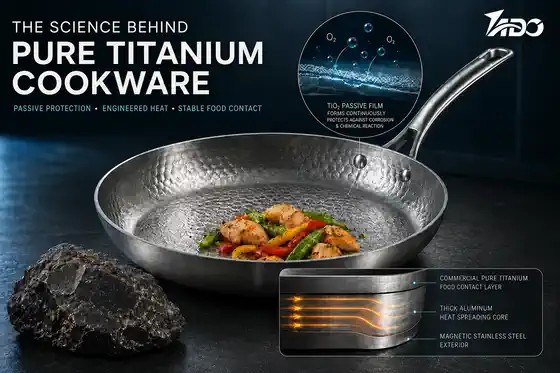
The Science Behind Pure Titanium Cookware
Cookware is a materials-engineering problem disguised as an everyday object.
A good pan must tolerate heat, moisture, salt, acidic ingredients, repeated washing and contact with metal utensils. It also needs to transfer heat efficiently, resist deformation and provide a dependable surface for cooking. No single material is naturally perfect at every one of these jobs.
That is what makes pure titanium cookware scientifically interesting. Titanium offers an unusually stable food-contact surface, excellent corrosion resistance and a high strength-to-weight ratio. But titanium alone is not an ideal heat spreader. The best cookware therefore does not rely on titanium as a marketing label; it uses titanium where its properties matter most and combines it with other materials where they perform better.
This article explains what pure titanium means, why its surface is so stable, how multilayer construction improves heating, and what consumers should realistically expect from a titanium pan.
What Does “Pure Titanium Cookware” Actually Mean?
The phrase can describe different products, so construction details matter.
Some lightweight camping pots are made almost entirely from commercially pure titanium. Other pans use titanium as a food-contact layer bonded to a heat-conductive core. Still others are conventional aluminum pans with a coating that contains titanium compounds. These are not the same.
In materials standards, “commercially pure titanium” does not mean mathematically 100.000% titanium. Grades 1 through 4 are classified as unalloyed titanium, with tightly controlled limits for elements such as oxygen, iron, carbon, nitrogen and hydrogen. ASTM B265 identifies Grade 1 as unalloyed titanium, while titanium alloys such as Grade 5 intentionally contain aluminum and vanadium.
For cookware, the most useful question is therefore not simply, “Does this pan contain titanium?” Ask instead:
- What material directly touches the food?
- Is that layer commercially pure titanium or a titanium-containing coating?
- Is the complete layer structure disclosed?
- Are material certificates and food-contact test reports available?
TADO cookware is engineered with a commercially pure titanium cooking surface, an aluminum heat-distribution core and a magnetic stainless-steel exterior. The titanium is the food-contact layer; the enclosed aluminum core does not touch the food; and the exterior enables strength and induction compatibility.
That is a functional material system, not a cosmetic use of the word “titanium.”
The Protective Science: Titanium’s Passive Oxide Layer
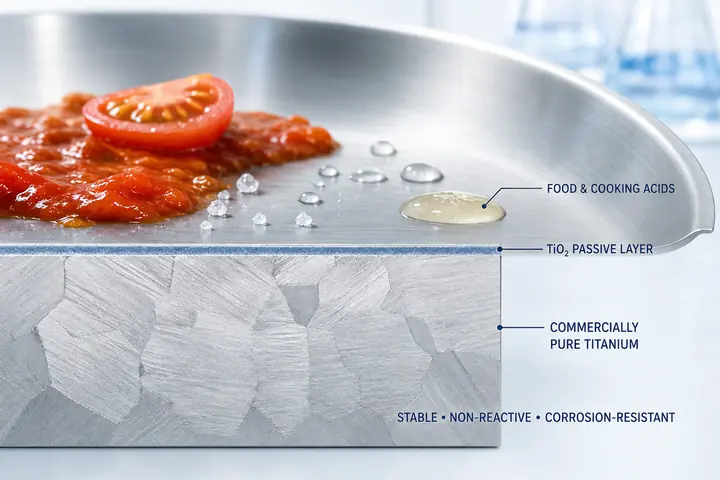
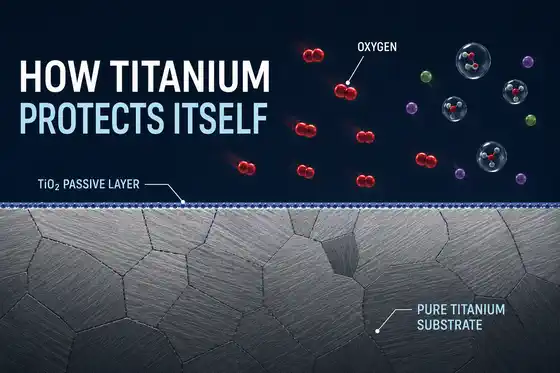
Titanium’s corrosion resistance begins at a microscopic scale.
When fresh titanium is exposed to oxygen, its surface rapidly develops a very thin, adherent oxide film composed mainly of titanium dioxide (TiO₂). This is called passivation. The passive film separates the underlying metal from its environment and greatly slows further chemical reaction.
Research published in Journal of Biomedical Materials Research attributes titanium’s strong corrosion resistance and biocompatibility largely to this thin passive film. The oxide layer is also self-forming: if minor surface damage exposes fresh titanium, oxygen in the surrounding environment can support repassivation under ordinary conditions. See the indexed study on titanium’s passive film.
In the kitchen, this matters for three reasons:
- Corrosion resistance: the stable surface helps titanium withstand water, salt and many weak organic acids encountered in normal cooking.
- Low reactivity: titanium is less likely to react noticeably with foods such as tomatoes, citrus-based sauces or vinegar under normal culinary conditions.
- Taste neutrality: limited surface reaction helps preserve the intended flavor and aroma of the ingredients rather than introducing a metallic taste.
No responsible materials claim should say that any metal is universally inert under every imaginable chemical and temperature condition. The accurate conclusion is that commercially pure titanium has excellent corrosion resistance in the range of conditions normally encountered during food preparation.
Pure Titanium Is Not the Same as a Titanium Coating
This distinction is essential when comparing cookware.
A pure titanium cooking surface is a continuous metallic layer. A titanium-reinforced nonstick coating is usually a polymer or sol-gel coating containing titanium-based particles. In the second case, the behavior of the surface depends on the entire coating formulation—not simply on the presence of titanium in its name.
| Product description | What touches food | What “titanium” means |
|---|---|---|
| Solid titanium pot | Commercially pure titanium | Most or all of the vessel body is titanium |
| Titanium-clad multilayer pan | Commercially pure titanium | Titanium is the bonded food-contact layer |
| Titanium-reinforced nonstick pan | A formulated coating | Titanium compound is an additive in the coating |
| “Titanium color” cookware | Varies | May refer only to appearance |
This is also why a coating migration study cannot automatically be applied to a sheet of metallic titanium. For example, research on quasi-ceramic nonstick coatings examined TiO₂ particles embedded in a silicone-based coating matrix—not a commercially pure titanium cooking surface. Read the study abstract.
The safest way to compare products is to examine the complete construction and the test documentation, not a single material word on the packaging.
Why Pure Titanium Alone Does Not Solve Heat Distribution
Titanium is strong, light and corrosion-resistant, but its thermal conductivity is relatively low for a metal. Published values for commercially pure titanium are generally around 16–22 W/m·K, depending on grade and condition. By comparison, aluminum conducts heat far more readily.
Low thermal conductivity is useful when a titanium camping mug needs to keep its handle cooler. In a frying pan, however, it can create uneven temperature zones if the body is very thin and made only from titanium.
This leads to one of the most important principles in modern cookware design:
The material best suited to touch food is not necessarily the material best suited to spread heat.
TADO addresses this through a bonded multilayer structure:
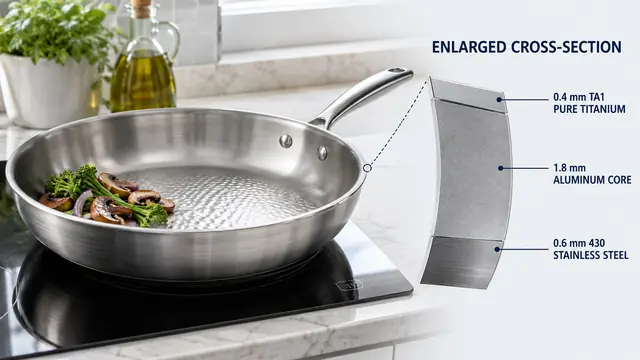
- Inner layer — commercially pure titanium: provides the non-reactive food-contact surface.
- Core layer — high-conductivity aluminum: spreads energy across the base and sidewalls more quickly and evenly.
- Outer layer — magnetic 430 stainless steel: adds structural support and makes the cookware compatible with induction cooktops.
The result is not “less pure” where it counts. Food still contacts titanium, while the hidden layers perform the thermal and magnetic work that titanium cannot do as efficiently by itself.
Does Pure Titanium Cookware Contain PFAS or PTFE?
Metallic titanium does not require PFAS or PTFE to exist as a cooking surface. A pan with an uncoated pure titanium interior can therefore be designed without a conventional fluoropolymer nonstick coating.
This has a practical durability advantage: there is no applied polymer film that must remain intact to keep the titanium food-contact layer in place. The cooking surface is the metal itself.
However, “coating-free” should not be confused with “friction-free.” Bare metal surfaces—including titanium—do not behave exactly like a new PTFE-coated pan. Food release depends on surface structure, temperature control, the amount of oil used and the food being cooked.
For consumers who prioritize a stable metallic cooking surface over the short-term slipperiness of a conventional coating, this is a deliberate trade-off rather than a flaw.
Is Pure Titanium Naturally Nonstick?
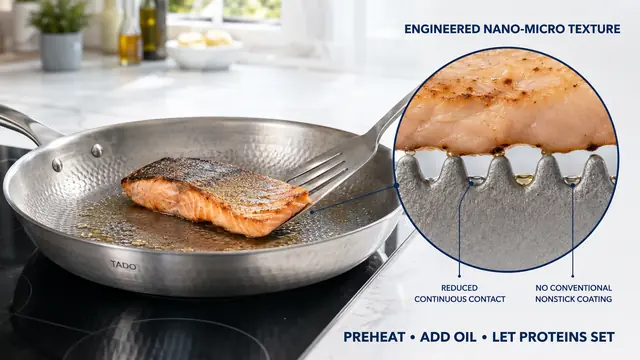
Not in the same way as a fluoropolymer coating.
Titanium has valuable chemical properties, but chemistry is only one part of food release. Surface roughness, contact area, moisture, protein behavior and cooking temperature all influence whether food sticks.
TADO combines the pure titanium interior with engineered surface treatment and nano-micro texture. The aim is to reinforce the surface and reduce continuous contact between food and the pan. This can support easier release without placing a conventional nonstick coating between the food and the titanium.
Technique still matters:
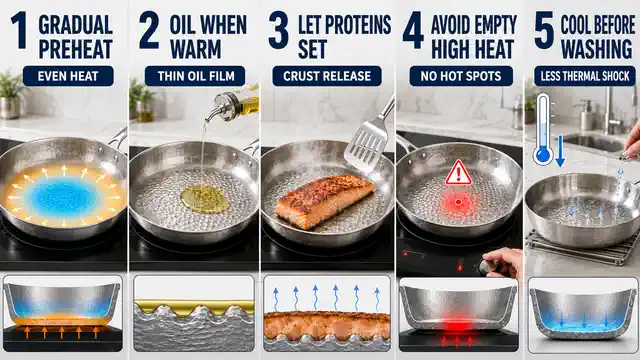
- Preheat the pan gradually over low to medium heat.
- Add a small amount of oil after the pan is warm.
- Allow proteins to sear before trying to turn them.
- Avoid overheating an empty pan.
- Let the cookware cool before washing.
This is a more credible promise than calling every titanium pan “naturally nonstick.” Good titanium cookware combines material science, surface engineering and correct use.
Why Titanium Performs Well With Acidic and Salty Foods
Tomatoes, wine, lemon juice and vinegar create a demanding environment for cookware because acids can accelerate reactions at a metal surface. Salt and moisture can also promote corrosion in susceptible materials.
Titanium’s passive oxide film gives it strong resistance across many oxidizing, neutral and mildly reducing environments. This is why commercially pure titanium is used not only in consumer products but also in marine and chemical-processing equipment.
For everyday cooking, the benefit is simple: a titanium food-contact surface can handle a wide range of recipes without requiring seasoning to protect it from rust. It is well suited to tomato sauces, braises, soups and other dishes that remain in contact with the pan for extended periods.
Normal care is still good engineering practice. Do not store highly concentrated brines or aggressive cleaning chemicals in any cookware for unnecessary periods, and follow the manufacturer’s cleaning guidance.
Strength, Weight and Long-Term Surface Stability
Titanium is valued in aerospace, medical and industrial applications because it combines low density with useful mechanical strength and corrosion resistance. NASA literature likewise describes titanium alloys as attractive for their strength-to-density ratio, fatigue properties and corrosion resistance. See NASA’s technical record.
In cookware, those properties help create a durable food-contact layer without excessive thickness. Titanium also does not form red iron oxide rust. Its surface can develop normal heat tint, polishing marks or fine scratches over time, but these cosmetic changes do not mean that a separate nonstick coating has peeled away.
Durability still depends on total construction. Bond quality, wall thickness, forming accuracy, handle attachment and quality control matter just as much as the headline material. A premium pan should be evaluated as a complete engineered product.
Is Titanium Cookware Safe?
Commercially pure titanium is widely recognized for corrosion resistance and biocompatibility, but cookware safety should be established through product-specific evidence—not by borrowing trust from medical implants or aerospace parts.
Look for three levels of proof:
- Material identification: the manufacturer should disclose the titanium grade and provide composition documentation when requested.
- Construction transparency: every layer should be named, including any aluminum core or stainless-steel exterior.
- Food-contact compliance testing: the finished cookware should be tested under the relevant requirements for its target market.
TADO uses a commercially pure titanium food-contact surface and supports its cookware program with quality control and food-contact testing. For buyers, distributors and private-label partners, documentation should be reviewed for the exact product model and destination market rather than assumed from a general brand statement.
This evidence-led approach is stronger than claims such as “zero risk,” “chemical-free” or “safe at any temperature.” Science rarely deals in absolutes; trustworthy manufacturers deal in defined materials, test conditions and traceable results.
Pure Titanium Cookware: Benefits and Trade-Offs
| Benefit | Scientific basis | Practical meaning |
| Corrosion resistance | Stable passive oxide film | Suitable for varied everyday ingredients |
| Low food reactivity | Limited reaction under normal cooking conditions | Helps avoid metallic flavors |
| Coating-free food-contact surface | Titanium layer is the surface itself | No conventional polymer coating is required |
| High strength-to-weight ratio | Useful strength at relatively low density | Durable performance without a very heavy titanium layer |
| Acid-friendly cooking | Resistance to many weak organic acids | Appropriate for tomato, citrus and vinegar-based recipes |
| Lower heat conductivity than aluminum | Titanium transfers heat relatively slowly | Benefits from a bonded conductive core |
| Different release behavior from PTFE | Metallic rather than fluoropolymer surface | Preheating and cooking technique remain important |
How to Identify Well-Engineered Titanium Cookware
Before buying or sourcing a titanium pan, check the following:
1. Confirm the Food-Contact Material
The product should state whether the interior is commercially pure titanium, titanium alloy or a titanium-containing coating.
2. Ask for the Full Layer Structure
If the pan is multilayer, the manufacturer should disclose the material and thickness of each layer. “Titanium cookware” alone is not a complete specification.
3. Review Test Reports
Check whether the report applies to the finished cookware, the relevant model and the intended market. A raw-material certificate and a finished-product food-contact report answer different questions.
4. Evaluate Heat Engineering
For a full-size frying pan or wok, look for a conductive core or another credible heat-spreading solution. Pure titanium’s low thermal conductivity should be addressed, not ignored.
5. Demand Realistic Performance Claims
Be cautious when a brand promises permanent nonstick performance with no technique, absolute zero migration under every condition, or natural antibacterial action without defined test methods.
The TADO Approach: Put Each Material Where It Works Best
The science behind pure titanium cookware is not that titanium magically does everything. It is that titanium performs one of the most important jobs exceptionally well: providing a stable, corrosion-resistant food-contact surface.
TADO builds outward from that principle. Commercially pure titanium faces the food. Aluminum spreads heat. Magnetic stainless steel supports the structure and induction performance. Surface engineering improves durability and food release without relying on a conventional fluoropolymer coating.
This material-specific design creates cookware that is not only premium in name, but rational in construction.
For brands, distributors and culinary partners developing next-generation cookware, TADO offers OEM and ODM support backed by titanium forming expertise, multilayer manufacturing and product testing.
Explore TADO pure titanium cookware or contact our team to discuss your product requirements.
Frequently Asked Questions About Pure Titanium Cookware
Is pure titanium cookware completely non-reactive?
Commercially pure titanium is highly corrosion-resistant and has low reactivity in normal cooking conditions because of its passive oxide film. “Completely non-reactive under every condition” would be too absolute, but it performs very well with common acidic and salty foods.
Is titanium cookware the same as titanium-reinforced nonstick cookware?
No. Pure titanium cookware uses metallic titanium as the food-contact surface. Titanium-reinforced cookware usually refers to a formulated coating containing titanium compounds. Always check the full construction.
Does pure titanium cookware have a coating?
An uncoated pure titanium interior does not require a conventional PTFE or PFAS-based nonstick coating. Some products sold as “titanium cookware,” however, do use coatings, so verify the specification.
Why add an aluminum core to a titanium pan?
Titanium conducts heat relatively slowly. A sealed aluminum core spreads heat more efficiently across the pan, while the pure titanium layer remains the surface in contact with food.
Can I cook tomatoes and other acidic foods in titanium cookware?
Yes. Titanium’s passive surface provides strong resistance to the weak organic acids normally found in tomatoes, citrus, vinegar and wine. Follow the manufacturer’s care instructions and avoid storing unusually concentrated chemicals in the pan.
Is pure titanium cookware naturally nonstick?
Bare titanium is not identical to PTFE. Engineered texture can improve release, but preheating, oil and timing still matter. “Coating-free easy release” is a more accurate description than universal natural nonstick performance.
How should I verify that a pan uses real pure titanium?
Ask for the titanium grade, complete layer structure, material certificate and finished-product food-contact test report. Independent composition methods such as XRF can also help verify metallic composition, although the correct test plan depends on the product construction.
Contact Us
for product specifications, samples, material declarations, testing documentation or wholesale cooperation.
Xi ‘an Taidou Metal Products Technology Co., Ltd.
Room 1604, Block D, Baihualin Financial Innovation Center, No. 51 Fengcheng Second Road, Weiyang District, Xi’an City, Shaanxi Province, P.R.China
Email: overjunjun@gmail.com
WhatsApp: +64274075362
Tel: +86 18629501987