
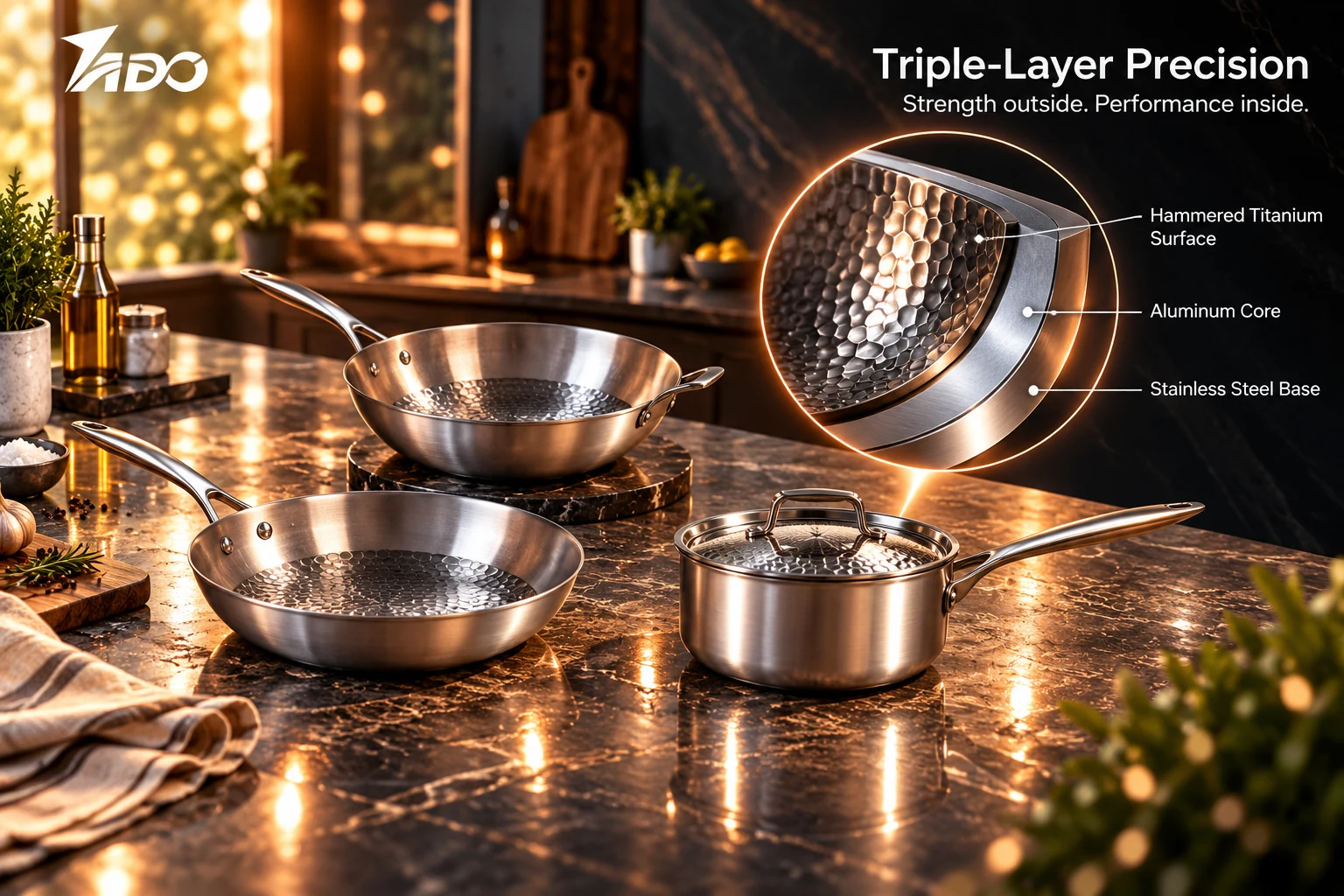
How to Source Hammered Titanium Cookware for a Premium Product Line
Hammered titanium cookware is becoming increasingly visible in premium cookware collections.
For brands, importers and distributors, the opportunity is not simply the visual appearance of the hammered surface.
The real value comes from combining:
a genuine titanium food-contact surface, engineered cookware construction, distinctive surface design and flexible OEM development.
Different titanium cookware products can use very different structures.
Some are made from solid titanium.
Others use titanium as the cooking surface in a multi-ply structure designed for better heat distribution and induction compatibility.
For residential cookware brands, understanding these differences makes it easier to select the right product platform for the target market.
1. Start With the Food-Contact Material
The term “titanium cookware” can describe several different product constructions.
For premium cookware positioned around titanium itself, one of the most important specifications is the material forming the actual cooking surface.
TADO uses:
TA1 / Grade 1 commercially pure titanium
as the direct food-contact layer in its tri-ply cookware.
This means the titanium is not simply a decorative feature or an ingredient added to another surface.
Food contacts the titanium itself.
For brands developing a coating-free cookware collection, this creates a simple and understandable product story:
Pure titanium where the food touches the pan.
Related guide:
Does Titanium Cookware Contain PFAS, PTFE or PFOA?
2. Why Grade 1 Titanium?
Commercially pure titanium is available in several grades.
Grade 1 is particularly suitable for cookware applications because it combines:
- excellent corrosion resistance;
- good formability;
- high ductility;
- low density;
- and commercially pure titanium composition.
Depending on the specification system, the same material may be described as:
Grade 1 Titanium
GR1 Titanium
Commercially Pure Titanium
CP-Ti Grade 1
TA1 Titanium
For cookware brands, clearly identifying the titanium grade creates a stronger product specification than simply describing a pan as “made with titanium.”
TADO uses TA1 / Grade 1 commercially pure titanium in the food-contact layer of its main titanium cookware platform.
3. Layer Thickness Is Part of the Product Design
For multi-ply cookware, total thickness alone does not tell the whole story.
Each layer has a specific function.
TADO uses different constructions according to cookware type.
TADO Wok Series
- Grade 1 / TA1 titanium: 0.4 mm
- 1050 aluminum: 1.1 mm
- 430 stainless steel: 0.5 mm
- Total thickness: approximately 2.0 mm
TADO Frying Pan Series
- Grade 1 / TA1 titanium: 0.4 mm
- 1050 aluminum: 1.9 mm
- 430 stainless steel: 0.5 mm
- Total thickness: approximately 2.8 mm
The thicker aluminum core used in the frying-pan platform helps support more even heat distribution across the broad cooking surface.
This illustrates an important point:
Cookware thickness should be designed according to the cooking application, not treated as a single universal number.
4. Why TADO Uses Titanium + Aluminum + Stainless Steel
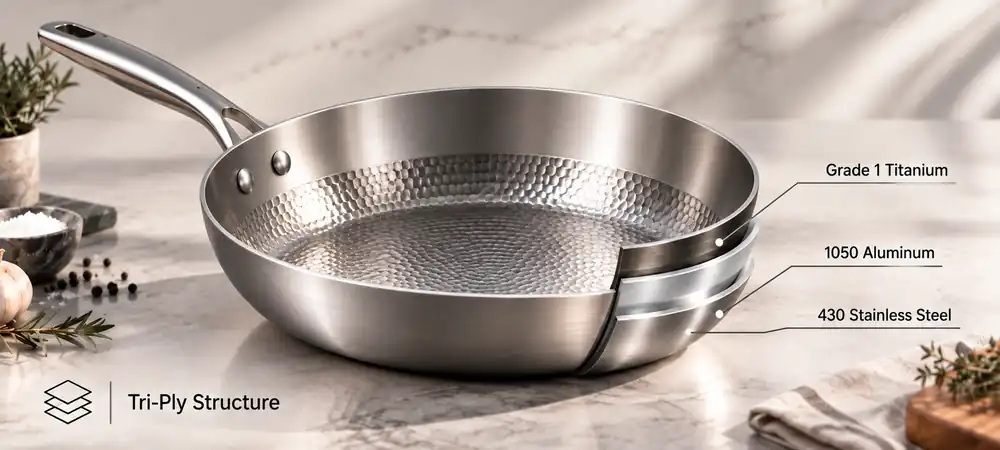
Different metals perform different jobs.
Instead of asking one material to solve every cookware requirement, a tri-ply structure combines the strengths of three materials.
Grade 1 Titanium Interior
Creates the food-contact surface.
1050 Aluminum Core
Helps distribute heat efficiently through the cookware body.
430 Magnetic Stainless-Steel Exterior
Supports induction compatibility and provides a durable exterior structure.
Together, the construction becomes:
Grade 1 Titanium + 1050 Aluminum + 430 Stainless Steel
This allows the product to retain a genuine titanium cooking surface while addressing the thermal and cooktop requirements expected from modern residential cookware.
For brands, this is a stronger proposition than simply offering a lightweight titanium pan.
Learn more:
Tri-Ply Titanium Cookware Buying Guide
3-Ply Titanium Cookware: Construction & Benefits
5. What Is a Hammered Titanium Surface?
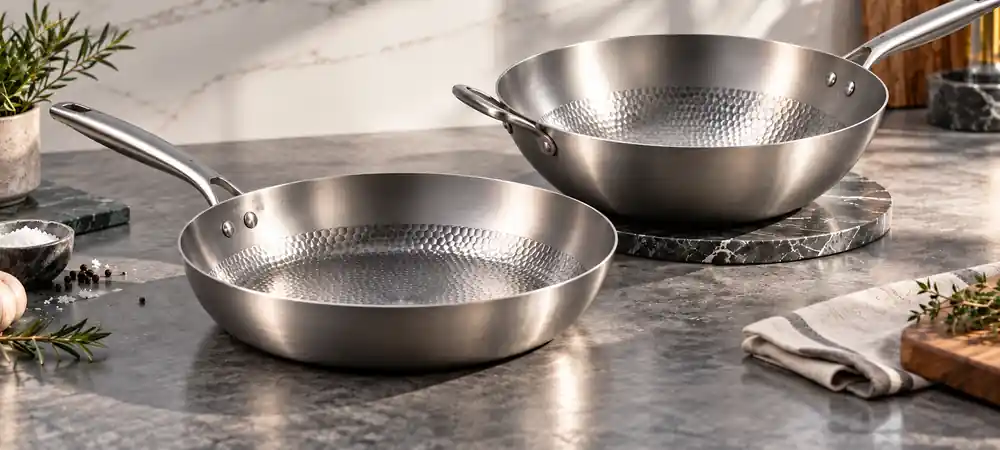
A hammered titanium cooking surface features a repeated three-dimensional pattern formed into the titanium surface.
This gives the cookware a distinctive appearance while also changing the geometry of the cooking area.
The resulting texture can influence:
- contact between food and the cooking surface;
- distribution of cooking oil;
- surface appearance;
- perceived product quality;
- and brand differentiation.
For premium cookware collections, the hammered pattern also creates a strong visual identity.
This is particularly useful for brands that want a coating-free cookware product to look visibly different from conventional stainless-steel or smooth-metal cookware.
6. Hammered Titanium Is Different From Conventional Nonstick
A hammered titanium cooking surface should not be presented as if it were identical to PTFE cookware.
They are fundamentally different product concepts.
Conventional nonstick cookware relies on a low-friction applied surface.
Hammered titanium cookware retains a metal cooking surface.
Food release therefore still depends on:
- preheating;
- temperature control;
- cooking oil;
- food moisture;
- and cooking technique.
For consumers looking specifically for a coating-free metal cooking surface, this difference is part of the product appeal rather than a disadvantage.
A balanced product description is:
Hammered titanium provides a coating-free titanium cooking surface with engineered texture and easy-release cooking characteristics when used with appropriate heat and cooking technique.
Related guide:
Is Titanium Cookware Really Nonstick? An Honest Guide
7. Surface Options Create More Room for Product Positioning
Not every titanium cookware collection needs to use the same surface.
Different brands may want different combinations of:
- appearance;
- price point;
- cooking feel;
- durability;
- and target customer.
TADO develops multiple titanium surface options for different cookware series.
These can include:
- clean titanium surfaces;
- hammered titanium surfaces;
- strengthened titanium surfaces;
- and other engineered titanium finishes.
This gives private-label buyers more flexibility when developing multiple product tiers.
For example:
Entry premium: clean titanium surface
Core premium: hammered titanium surface
Higher-tier series: advanced strengthened titanium surface
This makes it possible to create a broader product range around the same titanium cookware platform.
8. Surface Durability Matters in Premium Cookware
Premium cookware is expected to maintain its appearance and functionality through repeated use.
For selected TADO hammered titanium products, surface hardness can reach:
600 HV+
depending on the product specification and test conditions.
For buyers, the important point is that different titanium cookware series can be developed around different durability and positioning requirements.
This allows surface selection to become part of product strategy rather than simply a cosmetic decision.
9. Hammered Titanium Helps Create Strong Product Differentiation
From a brand perspective, hammered titanium has another important advantage:
it is immediately recognizable.
A smooth silver pan can visually resemble stainless steel.
A hammered titanium cooking surface looks much more distinctive.
That can help brands create:
- stronger product photography;
- more recognizable marketplace listings;
- clearer premium positioning;
- better social-media content;
- and a stronger visual difference from conventional cookware.
For B2C-facing cookware brands, this visual identity can be almost as important as the material specification itself.
10. Induction Compatibility Without Changing the Titanium Cooking Surface
Titanium itself is not strongly magnetic.
TADO solves induction compatibility through the outer layer of the tri-ply structure.
The exterior uses:
430 magnetic stainless steel
while the food-contact surface remains Grade 1 titanium.
This allows the same cookware platform to support:
- induction;
- gas;
- electric;
- ceramic cooktops.
For brands selling internationally, broad cooktop compatibility simplifies product positioning across multiple markets.
11. Dishwasher-Oriented Product Options
Dishwasher compatibility is increasingly important in mainstream residential cookware.
For applicable TADO cookware models, additional edge finishing can be incorporated for dishwasher-oriented product requirements.
This allows brands to combine:
- titanium food-contact surfaces;
- multi-ply construction;
- induction compatibility;
- and convenient cleaning positioning
within the same product platform.
For OEM projects, dishwasher-related requirements can be defined during product selection and sampling.
12. Product Testing and Documentation
For international B2B projects, material performance is only one part of the sourcing decision.
Documentation also matters.
Depending on project requirements, TADO can provide supporting information including:
- ISO 9001 quality-management certification;
- SGS food-contact testing;
- material information;
- cookware construction specifications;
- product documentation;
- and order-specific supporting documents.
This helps importers and brands prepare product information for their own market, distribution channels and compliance requirements.
13. OEM and Private-Label Development
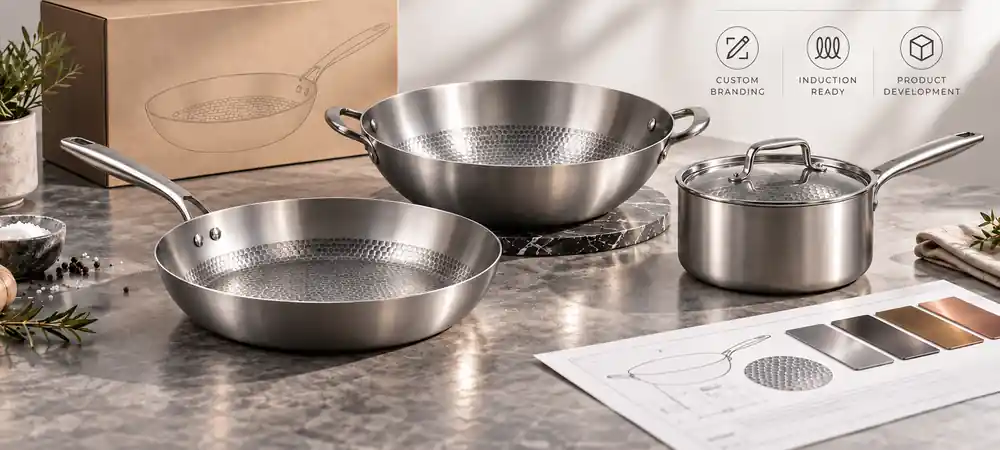
Hammered titanium cookware is particularly suitable for private-label development because both the cookware body and visual design can be differentiated.
TADO supports OEM and ODM projects based on existing product platforms as well as deeper product customization.
Available customization can include:
- cookware diameter;
- cookware depth;
- hammered appearance;
- selected titanium surface options;
- handle design;
- lid design;
- logo;
- packaging;
- labels;
- carton configuration;
- rim finishing;
- and product documentation.
For buyers wanting a faster market entry, existing-model customization can reduce development work.
For brands developing a more differentiated product line, deeper OEM or ODM development can also be discussed.
14. Existing Models vs Customized Development
For a new cookware brand or a first titanium product line, using an existing platform can often be the more efficient starting point.
Advantages can include:
- lower development cost;
- faster sampling;
- established cookware dimensions;
- existing manufacturing experience;
- shorter path to commercial testing.
Once the market response is validated, brands can then expand into more customized designs.
A typical development path may therefore look like:
Existing Model → Sample Evaluation → Initial Order → Market Feedback → Customized Series
This reduces the need to develop every component from zero before the product has been tested in the market.
15. Why Similar Titanium Cookware Can Have Different Prices
Two hammered titanium pans may look similar in a photograph while using different product specifications.
Cost can vary according to:
- titanium grade;
- titanium thickness;
- aluminum-core thickness;
- total body thickness;
- cookware size;
- surface option;
- handle construction;
- lid specification;
- rim finishing;
- packaging;
- order quantity;
- and customization requirements.
For B2B buyers, this means quotations are most useful when compared against the same product specification.
A lower unit price does not necessarily mean the same cookware is being offered at a lower cost.
It may simply represent a different product configuration.
Solid Titanium vs Tri-Ply Titanium: Which Fits Your Market?
Both constructions have legitimate uses.
The best choice depends on the intended application.
| Feature | Solid Titanium | TADO-Style Tri-Ply Titanium |
|---|---|---|
| Titanium food-contact surface | Yes | Yes |
| Weight | Very light | Moderate |
| Heat distribution | More limited | Improved through aluminum core |
| Induction compatibility | Requires additional design | Built into magnetic exterior |
| Outdoor cookware | Excellent | Usually unnecessary |
| Frying pans | Suitable for specific uses | Strong residential application |
| Woks | Possible | Strong residential application |
| Saucepan / stockpot | Possible | Well suited |
| OEM differentiation | Moderate | High |
| Premium residential range | Niche | Strong potential |
Solid titanium is especially attractive for camping and lightweight outdoor products.
Tri-ply titanium is particularly attractive for brands developing residential:
- frying pans;
- woks;
- saucepans;
- stockpots;
- and cookware sets.
The question is therefore not simply:
Which product contains more titanium?
The better question is:
Which construction fits the intended user and cooking environment?
TADO Hammered Titanium Cookware Platform
TADO focuses on titanium cookware development for:
- cookware brands;
- importers;
- distributors;
- wholesalers;
- and private-label partners.
Our core residential cookware platform combines:
Food-Contact Layer
TA1 / Grade 1 commercially pure titanium
Thermal Core
1050 aluminum
Exterior Layer
430 magnetic stainless steel
Representative Thickness
Wok: approximately 2.0 mm
Frying pan: approximately 2.8 mm
Surface Options
Including hammered titanium and other titanium surface solutions according to product requirements.
Cooktop Compatibility
Suitable for:
- induction;
- gas;
- electric;
- ceramic.
OEM / ODM Options
Available for selected:
- dimensions;
- handles;
- lids;
- surface designs;
- branding;
- packaging;
- edge finishing;
- and new product development.
The objective is to provide a titanium cookware platform that brands can develop from:
sample → product validation → commercial order → expanded collection
What Should a Brand Consider When Selecting a Hammered Titanium Product?
A practical product-selection process can focus on six areas:
1. Target Customer
Is the cookware positioned for premium home kitchens, health-conscious consumers, professional-style cooking or another audience?
2. Product Type
Frying pan, wok, saucepan and stockpot may require different body thicknesses and thermal characteristics.
3. Surface Positioning
Should the product emphasize a clean titanium appearance, hammered texture or another premium titanium finish?
4. Market Requirements
Consider induction usage, dishwasher expectations, packaging language and local food-contact requirements.
5. Price Positioning
Define the intended retail range before selecting the final specification.
6. Degree of Customization
Decide whether an existing model or deeper OEM/ODM project better fits the launch strategy.
These six decisions are usually enough to begin an effective sourcing discussion.
B2B Product Development Checklist
Before requesting a quotation, it helps to define:
Product
☐ Frying pan
☐ Wok
☐ Saucepan
☐ Stockpot
☐ Cookware set
Size
☐ Required diameter
☐ Required depth
Surface
☐ Hammered titanium
☐ Smooth titanium
☐ Other titanium surface option
Market
☐ North America
☐ Europe
☐ Middle East
☐ Asia-Pacific
☐ Other
Commercial Requirements
☐ Estimated quantity
☐ Target price range
☐ OEM / ODM requirement
☐ Logo
☐ Packaging
☐ Sample requirement
With this information, a manufacturer can recommend a much more appropriate product configuration.
FAQ
What is hammered titanium cookware?
Hammered titanium cookware uses a titanium cooking surface with a repeated three-dimensional texture.
The titanium may form the whole cookware body or, as in TADO’s main residential platform, the food-contact layer of a multi-ply structure.
What titanium grade does TADO use?
TADO uses TA1 / Grade 1 commercially pure titanium as the food-contact layer in its main tri-ply cookware platform.
What is the thickness of TADO frying pans?
Representative TADO frying pans use:
- 0.4 mm Grade 1 titanium
- 1.9 mm 1050 aluminum
- 0.5 mm 430 stainless steel
for a total body thickness of approximately:
2.8 mm
What is the thickness of TADO woks?
Representative TADO wok construction uses:
- 0.4 mm Grade 1 titanium
- 1.1 mm 1050 aluminum
- 0.5 mm 430 stainless steel
for a total thickness of approximately:
2.0 mm
Is TADO hammered titanium cookware coating-free?
TADO’s coating-free hammered titanium series uses titanium itself as the food-contact surface rather than relying on a conventional PTFE nonstick layer.
Can TADO titanium cookware work on induction?
Yes.
The 430 magnetic stainless-steel exterior makes the tri-ply structure suitable for induction cooking while maintaining Grade 1 titanium on the food-contact side.
Can TADO customize hammered titanium cookware?
Yes.
Depending on the project, OEM and ODM options can include:
- dimensions;
- surface design;
- handles;
- lids;
- logos;
- packaging;
- and other product details.
Can I order samples before placing a bulk order?
Yes.
Samples allow buyers to evaluate the product’s:
- appearance;
- construction;
- weight;
- surface;
- cooking characteristics;
- and finishing
before moving into commercial production.
Final Takeaway
Hammered titanium cookware combines two important elements for premium cookware brands:
material differentiation and visual differentiation.
The titanium food-contact surface provides a clear product story.
The hammered finish creates a recognizable premium appearance.
And when combined with an aluminum thermal core and magnetic stainless-steel exterior, the result is a cookware platform designed for the practical requirements of modern residential kitchens.
For brands, importers and distributors, the goal is therefore not simply to source a “titanium pan.”
It is to select the right combination of:
titanium surface + cookware structure + product design + market positioning
for the intended customer.
That is the approach behind TADO’s titanium cookware platform.
Related Titanium Cookware Guides
Tri-Ply Titanium Cookware Buying Guide
https://tieedo.com/news/tri-ply-titanium-cookware-buying-guide/
Does Titanium Cookware Contain PFAS, PTFE or PFOA?
https://tieedo.com/news/does-titanium-cookware-contain-pfas-ptfe-or-pfoa/
Is Titanium Cookware Really Nonstick? An Honest Guide
https://tieedo.com/news/is-titanium-cookware-really-nonstick-an-honest-guide/
Titanium Cookware Explained: 3-Layer Construction, Benefits & What Buyers Should Know
https://tieedo.com/news/titanium-cookware-explained-3-layer-construction-benefits-what-buyers-should-know/
How to Use and Care for Titanium Cookware
https://tieedo.com/news/how-to-use-and-care-for-titanium-cookware-first-use-cooking-cleaning-long-term-care/
How Long Does Titanium Cookware Last?
https://tieedo.com/news/how-long-does-titanium-cookware-last-coating-free-vs-coated-pans/
Developing a Hammered Titanium Cookware Line?
TADO works with cookware brands, importers, wholesalers and distributors on titanium cookware projects for international markets.
Contact us for:
- current product models;
- technical specifications;
- sample quotations;
- OEM / ODM development;
- private-label projects;
- titanium surface options;
- material information;
- food-contact documentation;
- and wholesale quotations.
For an initial recommendation, simply send us:
Cookware type + size + estimated quantity + target market
We can then suggest an existing TADO product platform or discuss a customized solution.
Ava
Foreign Trade Manager
TADO | Xi’an TADO Metal Products Technology Co., Ltd.
Email: overjunjun@gmail.com
WhatsApp: +64 274 075 362
Tel: +86 186 2950 1987
Website: https://tieedo.com/
Contact TADO:
https://tieedo.com/contact-us/
Pure Titanium. Zero Coating. Built for Better Cookware.