
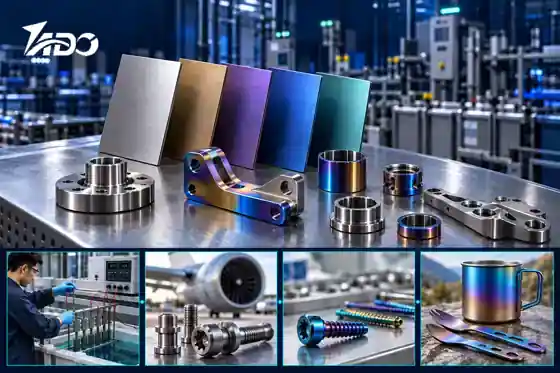
Titanium Anodizing Explained: Process, Types, Colors and B2B Buyer Guide
Titanium anodizing is an electrochemical surface-treatment process that increases the thickness of titanium’s naturally occurring oxide layer. Depending on the specified process, anodizing can support wear and galling control, visual identification, appearance, or other application-specific surface requirements. It is not paint, plating, or a conventional dyed coating.
For engineering buyers, “anodized titanium” is not a complete specification. Purchasing documents should identify the grade, surface condition, treatment standard, performance, masking, inspection method, and acceptance criteria.
This guide explains how anodizing works, how functional and color treatments differ, why colors vary, and what buyers should confirm before production.
What is titanium anodizing?
Titanium naturally develops a protective oxide film when exposed to oxygen. This helps titanium perform in many corrosive environments. Anodizing uses an electrolytic cell and controlled potential to modify that layer.
During processing, the titanium workpiece is connected as the anode. It is placed in a suitable electrolyte with a counter-electrode, and direct current is applied. The resulting electrochemical reaction changes the oxide film at the titanium surface.
The result depends on more than voltage. Alloy, surface finish, cleaning, electrolyte, temperature, electrical contact, time, rinsing, and geometry can all influence the surface. Anodizing should therefore be treated as a controlled manufacturing process rather than a decorative color selection alone.
How does titanium anodizing work?
As anodizing begins, oxygen-containing species contribute to oxide growth at the titanium surface. Increasing electrical potential can increase oxide thickness, although the relationship depends on the electrolyte and process regime.
For thin-film color anodizing, the oxide remains largely transparent. Light reflects from both the outer oxide surface and the titanium below it. These reflected waves interfere with one another, so certain wavelengths are reinforced while others are reduced. The observer perceives the remaining light as color.
This is known as interference color or structural color. Conventional titanium color anodizing does not require a colored dye. The perceived hue comes from the optical behavior of the oxide film.
The appearance is also angle-dependent. Research describes colored anodized titanium as gonioapparent: its color can shift with viewing and illumination angle. Therefore, a color chip, photograph, and three-dimensional part may not look identical.
Type 2 vs. Type 3 titanium anodizing
The titanium finishing industry commonly discusses Type 2 and Type 3 anodizing. However, buyers should not assume that the terminology alone defines every process requirement.
Type 2 titanium anodizing
Type 2 generally refers to a functional, gray anodic treatment used where wear, friction, galling, or corrosion-related performance is important. It is associated with SAE AMS 2488, which establishes requirements for an anodic coating on titanium and titanium alloys in a high-pH solution.
As of 2026, the current SAE publication is AMS2488F, issued in July 2025. The drawing or purchase specification should state the required revision rather than relying on the phrase “Type 2” alone.
Potential applications include aerospace hardware, mating titanium surfaces, and selected medical or industrial components. Suitability must still be verified for the actual alloy, contact condition, environment, and qualification plan.
Type 2 processing is not selected primarily for bright decorative color. Its characteristic appearance is commonly gray, but appearance should not be used as the only acceptance test for a functional coating.
Type 3 color anodizing
“Type 3” is widely used as a commercial term for thin-film color anodizing of titanium. It is used for visual identification, product differentiation, instrument organization, jewelry, sporting goods, and selected medical or aerospace components.
Unlike AMS 2488 functional anodizing, there is no single universal industry specification that assigns one exact color to every voltage, alloy, surface finish, and supplier process. A purchase order that says only “Type 3 blue” leaves too much open to interpretation.
For repeat production, buyers should approve a physical reference sample or defined color-measurement method, including lighting, viewing geometry, and acceptable variation.
| Decision point | Functional / Type 2 | Color / commonly called Type 3 |
|---|---|---|
| Primary objective | Defined functional surface performance | Identification or appearance |
| Typical appearance | Gray | Bronze, gold, purple, blue, green and related hues |
| Common specification approach | Drawing-controlled process such as the applicable AMS 2488 revision | Buyer-approved sample or validated supplier work instruction |
| Main qualification concern | Coating performance and process compliance | Color consistency, contact marks and visual acceptance |
| Critical buyer action | Confirm standard, revision and required tests | Define approved master color and inspection conditions |
Why does anodized titanium change color?
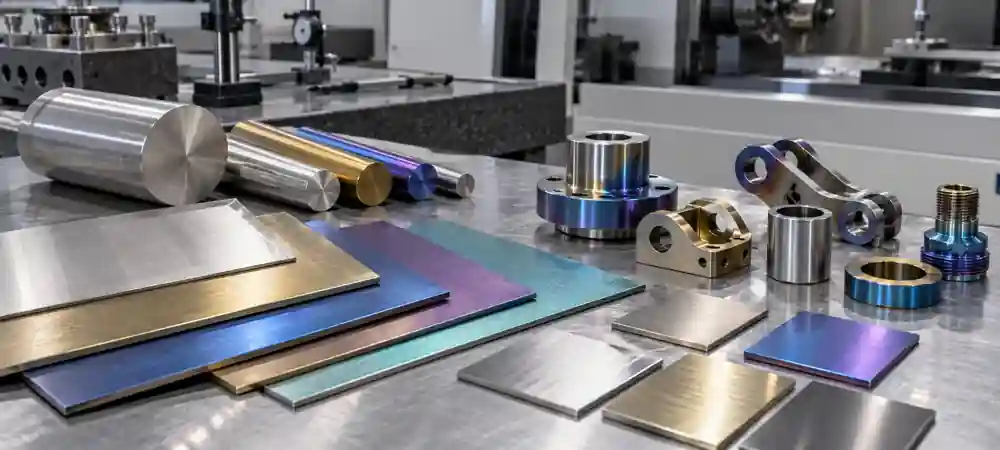
Applied voltage is an important control variable because it influences oxide growth. In a stable, validated process, different oxide thicknesses produce different interference colors.
However, a universal voltage-to-color chart should be treated cautiously. The same nominal voltage can produce a different visual result when the titanium grade, electrolyte, surface roughness, cleaning condition, temperature, rack contact, or part geometry changes.
Commercially pure titanium and Ti-6Al-4V may not match under the same settings. Machined, polished, etched, and blasted surfaces also reflect light differently. A matte starting finish generally remains matte, while a smoother surface can appear brighter.
The interference palette includes bronze, gold, purple, blue, turquoise, green, and related transitions. A saturated “true red” is generally unavailable. Magenta or red-purple may be possible, but buyers should approve a physical reference.
A high-level titanium anodizing process
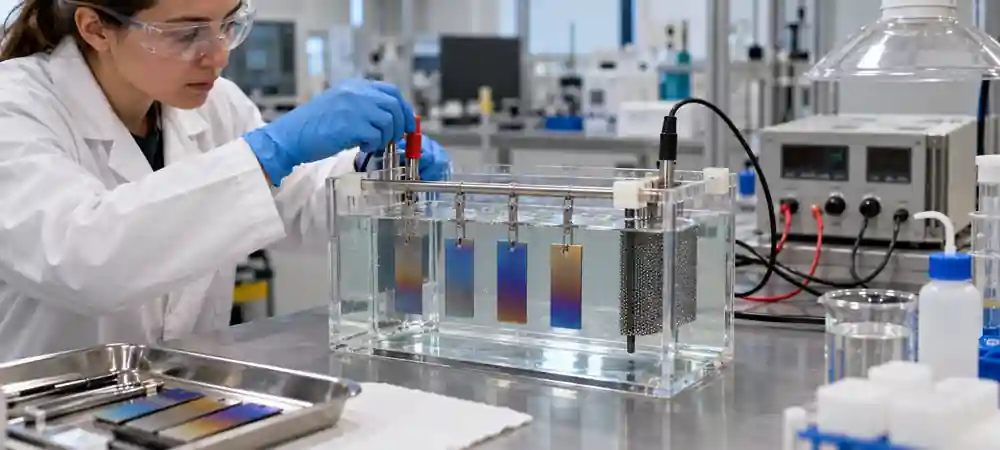
An industrial anodizing line may include the following controlled stages. The exact chemistry and parameters must come from the approved process specification and supplier work instructions.
1. Incoming review
Confirm the titanium grade, lot identity, drawing revision, finish, masking areas, cosmetic zones, and applicable standard.
2. Cleaning and degreasing
Remove oil, polishing compound, fingerprints, shop soil, and machining residue. Incomplete cleaning can cause spotting and uneven appearance.
3. Surface preparation
Prepare the surface with an approved method compatible with the titanium grade and final finish. Uncontrolled preparation can change dimensions, roughness, or appearance.
4. Rinsing and water-break inspection
Rinse to prevent chemical carryover. The processor may use a validated water-break inspection to check cleanliness.
5. Electrical fixturing and masking
Provide reliable electrical contact and define acceptable rack-mark locations. Threads, sealing faces, bearing surfaces, or tight-tolerance areas may require masking.
6. Anodizing
Treat the component under controlled electrical and chemical conditions. Repeatability depends on preparation, bath condition, electrical control, time, temperature, and load configuration.
7. Final rinsing and drying
Rinse and dry parts to minimize water spots, contamination, and handling marks.
8. Inspection and documentation
Inspect to the drawing using visual comparison, color measurement, functional tests, dimensional checks, and batch records as required.
Safety note: Titanium anodizing can involve electricity, aggressive cleaning or etching chemicals, ventilation requirements, and regulated wastewater. It should be performed by qualified personnel using validated equipment, PPE, environmental controls, and approved chemical-management procedures.
What controls titanium anodizing color consistency?
Color variation is one of the most common sourcing challenges. A supplier may hold the electrical setting constant and still produce visible differences if upstream or downstream conditions change.
Titanium grade and material condition
Commercially pure grades and alpha-beta alloys such as Ti-6Al-4V have different compositions and microstructures. Heat treatment, previous forming, welding, machining, and local work hardening can also affect surface response.
Starting surface finish
Roughness changes how light scatters. A polished component, a turned surface, and a bead-blasted surface can show different brightness and apparent hue even when the oxide films are similar.
Cleaning and preparation
Residual oil, oxide, scale, fingerprints, embedded media, or inconsistent etching can create stains and mixed colors. Long delays after preparation can also allow the native oxide and contamination state to change.
Electrical contact and part geometry
Poor contacts can interrupt current flow. Recesses, sharp edges, internal features, trapped gas, and different surface areas can complicate uniform processing. The rack design must match the component.
Bath and process control
Electrolyte concentration, contamination, temperature, agitation, loading, voltage ramp, current response, and treatment time should be monitored according to the approved process. A voltage number copied from an online chart is not a substitute for validation.
Inspection lighting
Because interference color changes with viewing conditions, inspection should use agreed lighting and geometry. Buyers comparing parts under office LEDs, daylight, and warm warehouse lighting may reach different conclusions.
Common defects and what they may indicate
- Spotted or patchy color: contamination, incomplete cleaning, trapped air, mixed finishes, or unstable contact.
- Color gradient: geometry, current distribution, bath movement, rack position, or starting-surface variation.
- Rack marks: unavoidable electrical contact placed in an unacceptable cosmetic area.
- Wrong hue or batch mismatch: alloy, preparation, bath, voltage, finish, or reference-standard variation.
- Scratches: inadequate handling, separators, packaging, transport protection, or assembly control.
Some color-anodized parts can be reworked, but stripping and reprocessing may affect dimensions, finish, and qualification status. Rework must be authorized.
Aerospace, medical and industrial applications
Aerospace components
Functional anodizing may be specified for selected titanium hardware where the drawing requires a defined anodic treatment. Color may also help identify parts during assembly or maintenance. Aerospace buyers should control the process specification, revision, approved processor status, lot traceability, and required test records.
Medical and dental components
Color anodizing can support visual identification of screws, instruments, implant-system components, and dental abutments. Research also evaluates anodized titanium for optical and surface effects in dental applications.
However, anodizing does not automatically make a component medically approved or biocompatible. The base alloy, manufacturing process, cleanliness, sterilization, packaging, risk management, and applicable device regulations must all be validated. For example, FDA recognizes ISO 5832-3 for wrought Ti-6Al-4V used in surgical implants, but material compliance is only one part of finished-device approval.
Industrial components

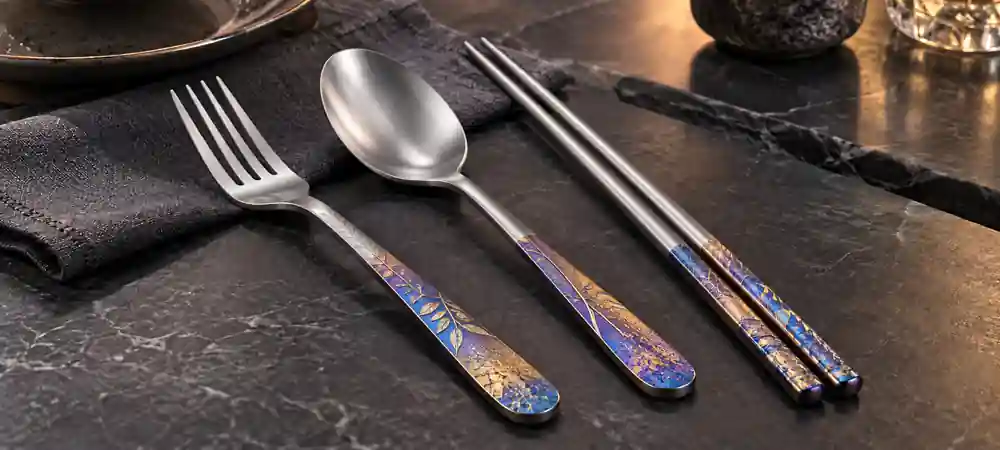
Anodized titanium appears in precision instruments, hardware, electronics, and identification systems. Buyers should define whether appearance or functional performance controls acceptance.
What B2B buyers should specify
Before requesting a quotation, provide enough information for the supplier to evaluate the process correctly:
- Titanium grade and applicable material standard
- Lot traceability requirements
- Drawing, revision, tolerances, and quantity
- Starting finish and required final roughness
- Functional Type 2 or color-anodizing requirement
- Applicable standard and exact revision, when relevant
- Target color and physical master sample
- Cosmetic zones and permitted rack marks
- Masking and electrical-contact areas
- Inspection lighting and color-measurement method
- Functional and dimensional test requirements
- First article and production-lot documents
- Packaging and contamination controls
- End-use industry and regulatory requirements
If a color must match an existing product family, send an approved physical part rather than relying only on a photograph or monitor value. Digital images are affected by camera settings, lighting, compression, display calibration, and viewing angle.
Frequently asked questions
Does titanium anodizing use dye?
Conventional color anodizing of titanium generally does not require dye. The visible color is produced by optical interference within the transparent anodic oxide film.
Is anodized titanium a coating?
It is more accurately described as an electrochemically grown conversion or oxide layer. It is not an added polymer paint or conventional electroplated metal layer.
Does higher voltage always produce the same color?
No. Voltage is important, but alloy, electrolyte, preparation, temperature, surface finish, geometry, bath condition, and inspection lighting also affect the result.
Is Type 2 the same as color anodizing?
No. Type 2 commonly refers to a functional gray treatment associated with requirements such as AMS 2488. Color anodizing is commonly called Type 3 in commercial practice and normally requires a supplier-specific validated color process.
Can anodized titanium be perfectly color-matched between batches?
Very tight consistency is possible only with controlled material, preparation, fixtures, process parameters, lighting, and acceptance standards. Buyers should expect an agreed tolerance rather than assume absolute visual identity.
Can titanium be anodized red or black?
Conventional interference anodizing does not normally provide a saturated true red or deep black comparable with paint or PVD. Pink, magenta, purple, gray, or other nearby appearances may be available depending on the process. Confirm with physical samples.
Is anodized titanium automatically suitable for implants?
No. A surface color or oxide layer does not establish finished-device safety. Medical applications require material, process, biological, cleaning, sterilization, packaging, and regulatory validation for the specific device.
Final takeaway
Titanium anodizing is a versatile electrochemical process, but its value depends on specification and control. Functional anodizing and color anodizing solve different problems. Voltage matters, yet it is only one variable within a larger system that includes alloy grade, surface preparation, geometry, electrolyte, fixturing, inspection, and end-use requirements.
For B2B buyers, the best results begin with a complete drawing, an approved standard or master sample, realistic tolerance, and a supplier capable of documenting repeatable production.
TADO supports international buyers with titanium materials, custom titanium components, OEM manufacturing coordination, samples, material declarations, and quality documentation. Contact us with your titanium grade, drawings, target finish, quantity, and application requirements so our team can evaluate the appropriate manufacturing route.
Related TADO Resources
- Explore titanium materials and custom manufacturing
- Review TADO production capabilities
- View quality certifications and testing credentials
- Read more titanium technical articles
- Contact TADO about samples, drawings or OEM cooperation
Sources and further reading
- SAE International — AMS2488F: Anodic Treatment, Titanium and Titanium Alloys
- Royal Society of Chemistry — Titanium properties and protective oxide behavior
- PubMed — Morphological and Optical Characterization of Colored Nanotubular Anodic Titanium Oxide
- Color Research & Application — Gonioapparent character of colored anodized titanium
- FDA — ISO 5832-3 recognized consensus standard for wrought Ti-6Al-4V surgical implant material
- PubMed — Evaluation of anodization-colored titanium abutments
Contact Us
for product specifications, samples, material declarations, testing documentation or wholesale cooperation.
Xi ‘an Taidou Metal Products Technology Co., Ltd.
Room 1604, Block D, Baihualin Financial Innovation Center, No. 51 Fengcheng Second Road, Weiyang District, Xi’an City, Shaanxi Province, P.R.China
Email: overjunjun@gmail.com
WhatsApp: +64274075362
Tel: +86 18629501987