
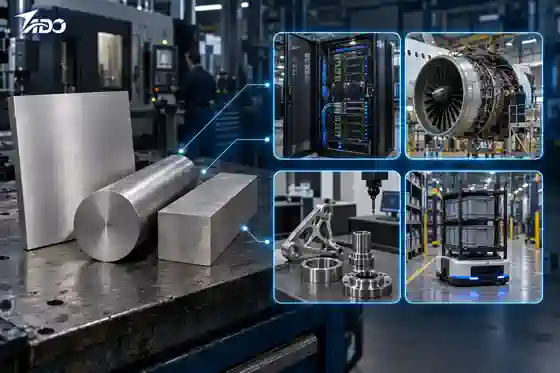
Titanium Supply Chain Security: Why Sponge Titanium Matters Across Advanced Industries
Titanium supply chain security means more than having enough metal in stock. It requires reliable access to the right titanium grade, consistent quality, qualified processing capacity and traceable material at every stage of production.
That distinction matters because titanium serves very different markets. Aerospace manufacturers need certified high-performance alloys. Marine engineers rely on corrosion-resistant grades. Medical and consumer-product manufacturers may need commercially pure titanium with controlled chemistry and dependable food-contact documentation.
Sponge titanium sits near the beginning of this value chain. It is a primary feedstock used to make titanium ingots, alloys and mill products. However, sponge availability alone does not guarantee that a downstream manufacturer can obtain the correct sheet, bar, tube or bonded material on time.
This article explains the strategic value of titanium without overstating its role. It looks at AI-related infrastructure, robotics, industrial equipment, marine engineering and consumer products. It also shows why buyers must evaluate the whole supply chain rather than one headline production number.
What Is Sponge Titanium?
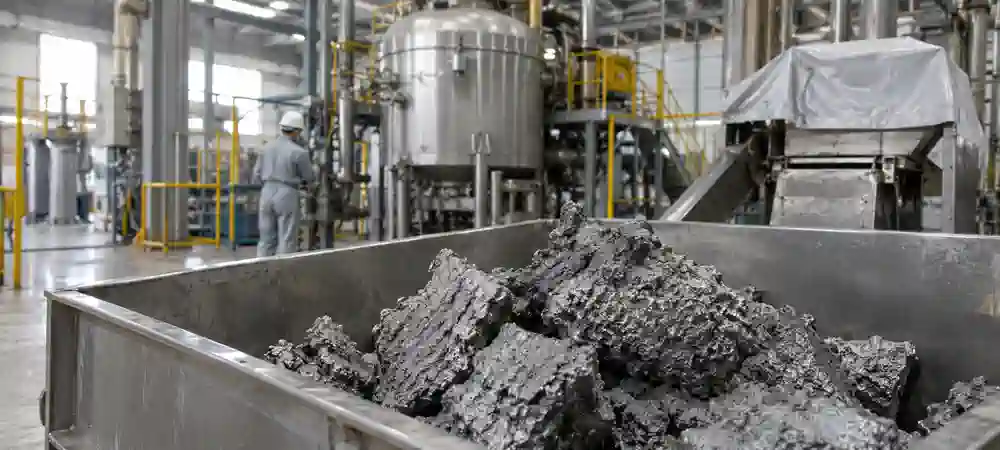
Sponge titanium is a porous form of metallic titanium produced during primary titanium extraction. In the widely used Kroll process, titanium tetrachloride is reduced with magnesium. The resulting sponge is then processed, blended and melted—often with alloying elements or qualified titanium scrap—to produce ingots.
Those ingots become semi-finished materials such as:
- Sheet and plate
- Bar and billet
- Tube and pipe
- Wire and foil
- Forgings and castings
- Powder for selected additive-manufacturing processes
Sponge titanium is therefore a foundation of primary titanium production, but it is not the entire supply chain. Melting, alloy control, rolling, forging, surface treatment, bonding, machining, inspection and certification all affect the suitability of the final product.
From ore to finished titanium product

| Supply-chain stage | Typical output | Why it matters |
|---|---|---|
| Mineral extraction and beneficiation | Ilmenite or rutile feedstock | Determines upstream resource availability |
| Chemical processing | Titanium tetrachloride | Requires controlled purification |
| Reduction | Sponge titanium | Establishes primary metallic feedstock |
| Melting and alloying | Titanium ingot or alloy billet | Controls chemistry and alloy consistency |
| Mill processing | Sheet, plate, bar, tube or foil | Creates the form and mechanical properties required by manufacturers |
| Component manufacturing | Forged, machined, formed or bonded parts | Converts material performance into usable products |
| Inspection and documentation | Test reports and traceability records | Helps buyers verify grade, process and compliance |
Why Is Titanium Considered a Strategic Material?
Titanium combines low density, high specific strength and strong corrosion resistance. This combination makes it valuable where designers must reduce mass, resist aggressive environments or maintain performance over a long service life.
Its strategic status is not only an industry opinion. The European Union’s Critical Raw Materials Act lists titanium metal as both a strategic and a critical raw material. The regulation links strategic materials to the green and digital transitions as well as defence and aerospace applications. It also calls for supply-chain risk assessments by large companies in fields that include robotics, advanced chips, data transmission and storage, additive manufacturing, drones and aircraft. (Regulation (EU) 2024/1252)
The practical lesson is important: titanium security is not simply a question of national output. Buyers also need access to suitable grades, processing routes, qualified suppliers and verifiable documentation.
Does AI Hardware Depend on Titanium?
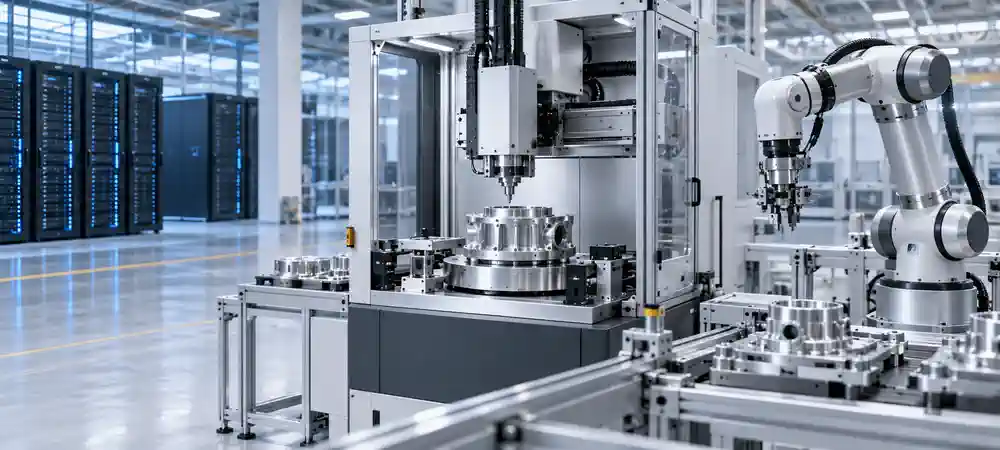
AI systems depend directly on semiconductors, power systems, cooling infrastructure, networking equipment and data storage. Titanium is not the standard material for semiconductor logic or common heat sinks, and it should not be presented as the material that makes AI computation possible.
Its connection to AI is mainly indirect.
AI expands demand for data infrastructure, automated equipment, precision manufacturing and robotics. Within those systems, titanium may be selected for specialised structural parts, corrosion-resistant components, lightweight mechanisms, mobile devices or additive-manufactured parts when its engineering advantages justify the cost.
This distinction prevents two common mistakes:
- Treating titanium as a direct substitute for silicon, copper or aluminium in computing hardware.
- Assuming that every increase in AI investment creates an equivalent increase in sponge titanium demand.
The more defensible conclusion is that AI accelerates investment in advanced hardware ecosystems. Titanium participates selectively in those ecosystems, especially where strength-to-weight ratio, fatigue performance, biocompatibility or corrosion resistance matters.
Why Robotics Can Benefit From Titanium Alloys
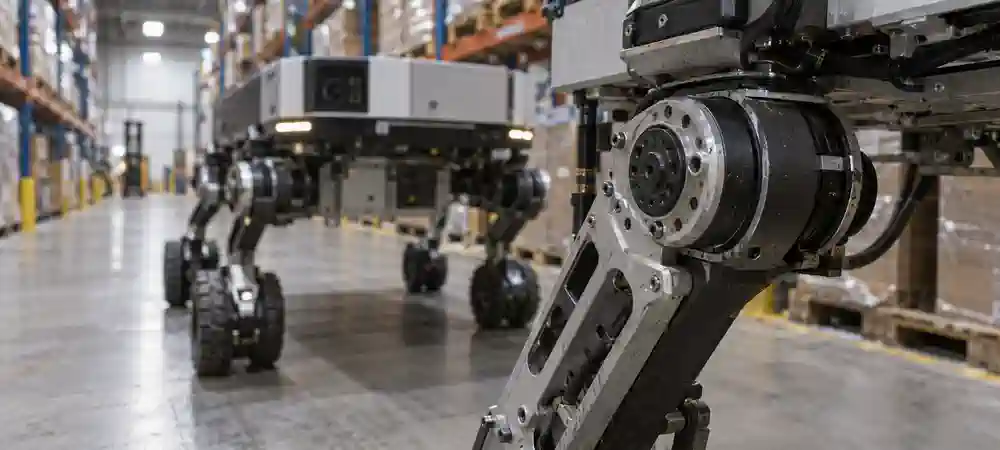
Robots must balance payload, speed, energy use, stiffness, fatigue life and cost. Titanium alloys can help when reducing the mass of a moving component improves the performance of the complete system.
Potential applications include:
- High-load joints and compact structural components
- Fasteners, shafts and selected transmission parts
- End effectors used in corrosive or hygienic environments
- Lightweight parts for mobile, aerospace or underwater robots
- Additive-manufactured components with complex geometry
However, titanium is not automatically the best choice for every robot. Steel often offers lower cost and high stiffness. Aluminium can provide economical lightweight structures. Polymers and composites may be preferable for covers or low-load parts.
For that reason, claims that named humanoid robots use a specific titanium alloy should be made only when the manufacturer or a reliable technical source has confirmed it. A sound material-selection process compares the complete requirements rather than using titanium as a marketing label.
When titanium is more likely to be considered
| Design requirement | Potential titanium advantage | Practical limitation |
|---|---|---|
| Lower moving mass | High strength relative to density | Higher material and processing cost |
| Repeated cyclic loading | Useful fatigue performance in a suitable design | Fatigue depends on alloy, surface and geometry |
| Corrosive operation | Stable passive oxide film | Grade and environment still require evaluation |
| Compact, high-load components | High specific strength | Titanium has a lower elastic modulus than steel |
| Complex low-volume parts | Compatible with selected additive processes | Qualification and finishing can be demanding |
Titanium in Industrial Machines and Advanced Manufacturing

Titanium is used selectively in chemical processing, energy equipment, aerospace manufacturing, medical devices and other demanding industrial applications. Its value is highest where corrosion, weight or lifecycle performance makes conventional materials less suitable.
Typical industrial applications include heat exchangers, pressure equipment, pumps, valves, fasteners and corrosion-resistant process components. Titanium alloys also appear in aerospace structures and rotating equipment, while commercially pure grades are widely associated with corrosion-resistant service.
Yet titanium is not a universal material for machine tools or factory equipment. Most industrial machinery continues to rely on steels, cast irons and aluminium alloys. Titanium is usually chosen for a defined engineering reason—not because it is intrinsically “more advanced.”
Supply security in this sector therefore has two dimensions:
- Volume security: Is enough suitable material available?
- Capability security: Can suppliers melt, process, inspect and certify the required grade and product form?
For critical components, capability security may be more important than total sponge output.
Why Titanium Matters in Marine Engineering
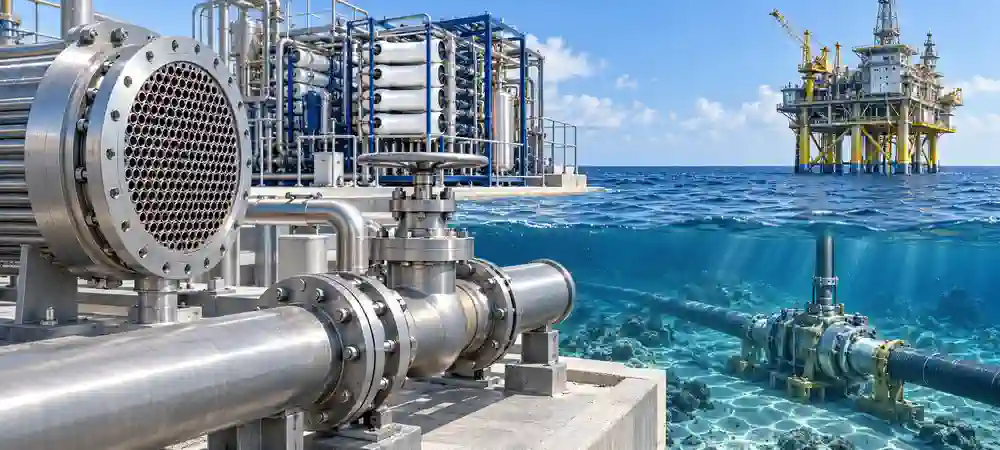
Marine environments expose materials to chlorides, erosion, pressure and difficult maintenance conditions. Titanium’s protective oxide film gives many titanium grades strong resistance to seawater corrosion, which is why the metal is used in desalination, offshore systems, heat exchangers and other seawater-handling equipment.
The International Titanium Association identifies seawater resistance, high strength and low density as important reasons for industrial use of titanium. It also documents long service histories in power generation and desalination equipment. (International Titanium Association)
Common marine and seawater-related uses include:
- Heat-exchanger tubing and plates
- Desalination equipment
- Pumps, valves and piping components
- Offshore and subsea hardware
- Selected pressure housings and underwater systems
The material still has to be engineered correctly. Designers must consider grade selection, crevice conditions, galvanic couples, fabrication quality, stress and operating temperature. “Corrosion resistant” should never be interpreted as “immune to every environment.”
What Do Current Production Data Say About China’s Titanium Supply?
China has developed a large and increasingly integrated titanium industry. According to a 2025 report citing the China Nonferrous Metals Industry Association, China produced approximately 256,000 metric tons of sponge titanium in 2024, an increase of about 17.6% from the previous year. The same report placed Chinese titanium mill-product output at about 170,000 metric tons. (Xinhua report on China’s titanium industry)
The peer-reviewed 2024 China Titanium Industry Development Report estimated global sponge titanium production at approximately 380,000 metric tons in 2024 and also recorded strong growth in Chinese output. (2024 China Titanium Industry Development Report)
These figures show scale, but scale should not be confused with unlimited supply of every specification. Titanium markets remain segmented by grade, product form, certification and end-use qualification. Rapid capacity growth can also create price pressure and uneven utilisation rather than automatic improvement in high-end supply.
International supply chains remain concentrated in different ways. The U.S. Geological Survey reported in 2025 that idled domestic sponge capacity had increased U.S. reliance on imports from Japan. This illustrates why production capability, trade relationships and qualified sources matter even when titanium minerals are geologically abundant. (U.S. Geological Survey)
The Main Risks in the Titanium Supply Chain
Titanium supply disruptions can begin at several points. A buyer should therefore look beyond sponge production alone.
1. Concentrated processing capacity
Mining, sponge production, melting and mill processing do not always occur in the same country. A disruption at one processing stage can affect the availability of a specific product form.
2. Grade and qualification constraints
Commercially pure titanium, aerospace alloys and medical grades have different requirements. Material available in the general market may not meet a regulated or highly qualified application.
3. Energy and production costs
Primary titanium production and subsequent melting are energy-intensive. Energy prices and environmental requirements can influence operating costs and expansion decisions.
4. Geopolitical and logistics exposure
Trade restrictions, sanctions, transport disruption and longer delivery routes can affect lead times. These risks should be assessed with scenario planning rather than unsupported claims about wartime demand percentages.
5. Traceability gaps
An attractive price does not confirm grade, chemistry or production history. Material certificates, batch records and supplier controls become especially important in food-contact, medical, aerospace and industrial applications.
6. A mismatch between capacity and qualified demand
A country may have high total production but limited capacity for a particular certified sheet, tube, forging or precision component. Buyers must verify the exact manufacturing route required by their product.
From Strategic Titanium to Consumer Products
The titanium value chain does not end with aircraft, robots or offshore equipment. Commercially pure titanium also appears in consumer products where corrosion resistance, low density and surface stability are valuable.
Examples include drinkware, tableware, outdoor equipment and cookware. These products do not require the same alloy or qualification system as an aerospace component, but they still depend on controlled raw materials and repeatable manufacturing.
For cookware buyers, the strategic story becomes practical:
- Is the food-contact surface made from the declared titanium grade?
- Can the supplier trace the material and provide relevant test documentation?
- Is the product pure titanium, titanium alloy or a multilayer construction?
- How are the layers bonded and inspected?
- Can the factory maintain consistent thickness, forming and surface treatment?
- Does the structure provide the heating performance required by the target market?
These questions are more useful than a broad claim that “titanium is safe” or “titanium is strategic.”
How Titanium Supply Security Affects Cookware Buyers
Cookware brands rarely buy sponge titanium directly. They depend on downstream manufacturers that can source appropriate mill material and convert it into a consistent finished product.
For a tri-ply titanium pan, supply security extends across all three functional layers. TADO’s standard construction uses a GR1 commercially pure titanium interior, a 1050 aluminium heat-distribution core and a 430 magnetic stainless-steel exterior for induction compatibility. Each layer has a different purpose, and the finished cookware depends on their combined structure—not on titanium alone.
Procurement teams should therefore assess:
- Material specification and incoming inspection
- Layer structure and nominal thickness
- Bonding and forming capability
- Surface-treatment controls
- Food-contact testing and quality records
- Batch consistency and production capacity
- Customisation, sampling and lead-time management
Buyers can review the manufacturer’s company background, production base, available testing and quality-control information before discussing a project. Relevant TADO resources are collected at the end of this article.
FAQ
Is sponge titanium the same as titanium metal used in finished products?
No. Sponge titanium is a porous primary feedstock. It normally undergoes melting, alloying and mill processing before it becomes sheet, bar, tube or another usable titanium product.
Why is titanium metal considered strategic?
Titanium supports aerospace, defence, marine, industrial and selected digital-transition technologies. Its combination of low density, high specific strength and corrosion resistance can be difficult to replace in demanding applications. The EU officially lists titanium metal as both a strategic and critical raw material.
Is titanium widely used in AI servers?
Not as a primary semiconductor or common heat-sink material. Titanium’s relationship with AI is mainly through the wider ecosystem of advanced hardware, robotics, precision manufacturing and specialised components.
Do humanoid robots require titanium?
Not necessarily. Titanium can benefit selected high-load or lightweight components, but aluminium, steel, polymers and composites remain important. Material selection depends on performance, manufacturing and cost requirements.
Why is titanium used in marine engineering?
Many titanium grades resist seawater corrosion through a stable passive oxide film. This makes titanium useful for heat exchangers, desalination systems, piping and selected offshore or subsea components.
Does high sponge titanium output guarantee a secure supply?
No. Buyers also need the correct grade, product form, processing capacity, certification and logistics. Total output does not measure the availability of every qualified titanium product.
What should titanium cookware buyers verify?
They should verify the food-contact material, cookware structure, material traceability, manufacturing controls, test documentation, customisation capability, lead time and batch consistency.
Conclusion: Titanium Security Is a Value-Chain Issue
Titanium supports many advanced industries, but its role must be described accurately. It is not the computing core of AI, and it is not automatically the best material for every robot or machine. Its strategic value comes from a distinctive combination of properties that becomes critical in selected high-performance and corrosion-resistant applications.
Sponge titanium is the foundation of much primary titanium production. Real supply security, however, extends from raw materials through melting, mill processing, component manufacturing, inspection and documentation.
The same principle applies to titanium cookware. Buyers need more than a titanium claim. They need a supplier that can explain the grade, structure, manufacturing process and quality evidence behind the finished product.
TADO works with brands, importers and wholesale buyers on titanium cookware development, OEM/ODM projects and private-label production. Contact the team to discuss material specifications, cookware structures, samples and custom requirements.
Related TADO Resources
- Explore the TADO titanium cookware range.
- Learn more about TADO.
- Review the TADO production base.
- View available certifications and quality-control information.
- Read more titanium cookware guides and industry insights.
- Contact TADO to discuss OEM/ODM, wholesale or private-label requirements.
Contact Us
for product specifications, samples, material declarations, testing documentation or wholesale cooperation.
Xi ‘an Taidou Metal Products Technology Co., Ltd.
Room 1604, Block D, Baihualin Financial Innovation Center, No. 51 Fengcheng Second Road, Weiyang District, Xi’an City, Shaanxi Province, P.R.China
Email: overjunjun@gmail.com
WhatsApp: +64274075362
Tel: +86 18629501987