
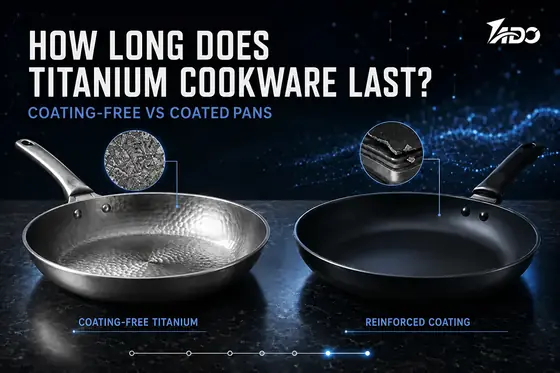
How Long Does Titanium Cookware Last? Coating-Free vs Coated Pans
Titanium is associated with strength, corrosion resistance, and premium performance, so many shoppers assume every pan labeled “titanium” should last a lifetime. The reality is more complicated.
One titanium pan may have a genuine titanium cooking surface with no conventional nonstick film. Another may be an aluminum pan covered with a PTFE coating reinforced by titanium particles. A third may use a PFAS-free sol-gel ceramic coating marketed as “titanium enhanced.” These products can have very different service lives even though the same word appears on the packaging.
So, how long does titanium cookware last?
A well-built coating-free titanium pan can potentially remain structurally usable for decades. A coated titanium-branded pan may deliver good service for several years, but its practical lifespan is usually determined by the coating—not by the titanium in its name.
The most accurate way to judge lifespan is to separate three questions:
- Is the pan body still structurally sound?
- Is the food-contact surface intact and suitable for continued use?
- Does the surface still provide the cooking performance you bought it for?
This guide explains how coating-free and coated titanium cookware age, what shortens their life, and when replacement is actually necessary.
The Short Answer: Titanium Cookware Lifespan at a Glance
| Cookware type | What touches the food? | What usually limits its useful life? | Practical lifespan outlook |
|---|---|---|---|
| Solid titanium cookware | Bare titanium | Severe deformation, damaged handles, cracks, or unacceptable cooking performance | Potentially decades with normal care |
| Titanium-lined tri-ply cookware | Coating-free titanium over an aluminum core and stainless exterior | Structural damage, delamination, severe warping, or damage to the food-contact layer | Potentially decades when well constructed and properly used |
| Titanium-treated or engineered metal surface | Modified metal surface without a conventional polymer film | Surface wear, heavy contamination, structural failure, or loss of acceptable release | Often much longer-lived than conventional coated nonstick, but model-specific |
| Titanium-reinforced PTFE nonstick | PTFE-based coating containing titanium reinforcement | Scratches, peeling, loss of release, overheating, or coating separation | Usually several years; replace according to condition and performance |
| Titanium-reinforced ceramic nonstick | Sol-gel ceramic-style coating | Gradual loss of food release, carbonized oil buildup, chips, or coating wear | Frequently shorter-lived than the metal body; actual life varies widely |
These are not warranties. Cooking frequency, heat level, utensils, cleaning, storage, thickness, bonding quality, and manufacturing control can all change the result.
First, What Does “Titanium Cookware” Actually Mean?
The word titanium does not identify a single construction. Before estimating lifespan, determine where the titanium is and whether the food-contact surface is a coating.
1. Solid or commercially pure titanium cookware

The vessel is formed primarily from titanium sheet. This design is common in outdoor cookware because titanium combines low density with good corrosion resistance.
There is no applied nonstick film to peel away. However, bare titanium should not be confused with conventional nonstick. Thin outdoor pans may develop hot spots or deform if misused, and cooking technique still affects sticking.
2. Titanium-lined multi-ply cookware
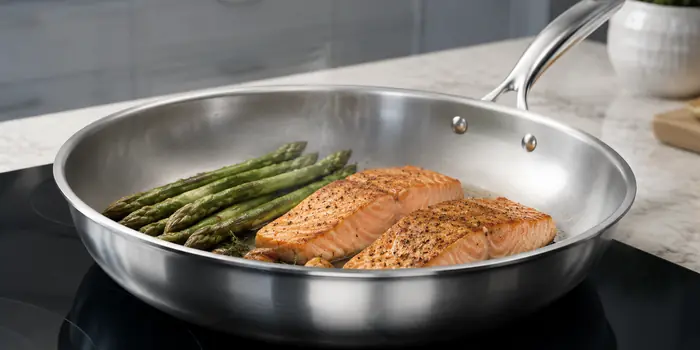
In this construction, titanium forms the food-contact layer while another metal manages heat distribution. A typical configuration may combine:
- A commercially pure titanium interior
- An aluminum core for faster, more even heating
- A magnetic stainless steel exterior for induction compatibility
The titanium layer is not expected to conduct all the heat by itself. The full bonded structure determines heating performance and resistance to warping.
3. Titanium-treated or surface-engineered cookware
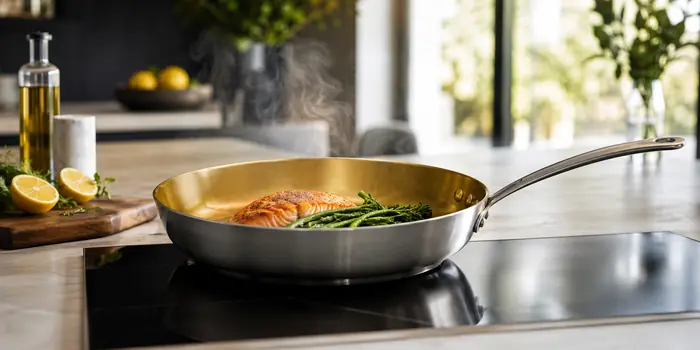
Some cookware uses oxidation, nitriding, texturing, hardening, deposition, or another controlled surface process. This may increase hardness, reduce effective food contact, or improve release without adding a conventional PTFE film.
These technologies cannot be judged from the word titanium alone. Buyers should ask what the food actually touches, how the surface is created, and which durability tests support the claim.
4. Titanium-reinforced coated cookware
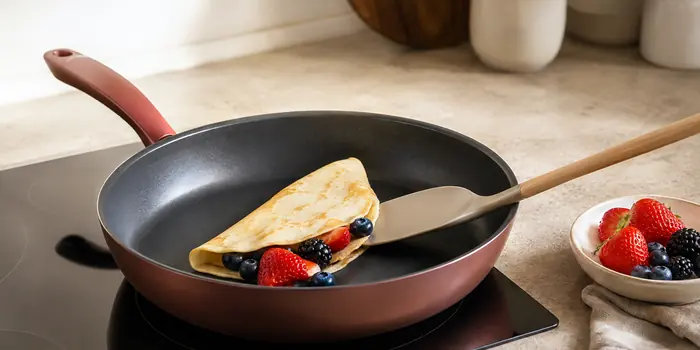
Here, titanium is an additive or reinforcement inside a conventional nonstick system. The substrate may be aluminum or stainless steel, while the food-contact layer is PTFE or sol-gel ceramic.
Titanium reinforcement may improve scratch or wear resistance, but it does not make a finite coating permanent. Once the coating reaches the end of its functional life, the pan has effectively reached the end of its intended nonstick life even if the metal body still looks strong.
Why Coating-Free Titanium Can Last Longer
The main durability advantage is simple: there is no conventional nonstick film that must remain bonded to the pan.
Titanium naturally forms a thin, stable oxide film when exposed to oxygen. Materials research identifies this passive layer as central to titanium’s corrosion resistance. If the outermost film is disturbed under ordinary conditions, titanium can repassivate when oxygen is available. This does not make the material indestructible, but it helps explain why titanium performs well in demanding corrosive environments.
In cookware, a genuine titanium food-contact layer therefore fails differently from a PTFE or sol-gel coating. Normal cosmetic changes do not automatically mean that the cooking surface has peeled away, because there may be no applied release film to peel.
The pan can still reach the end of its life. Possible failure modes include:
- Severe warping that prevents stable contact with the cooktop
- Delamination in poorly bonded multi-ply construction
- Cracks, deep gouges, or exposed underlying layers
- Loose handles, damaged rivets, or failed welds
- Permanent contamination that cannot be removed safely
- Impact damage that affects stability or heating
But when the construction is sound, the useful life is not tied to the gradual consumption of a conventional nonstick coating.
Why Coated Titanium Pans Usually Have a Shorter Functional Life
A coated pan has two lifespans:
- The structural lifespan of the metal body
- The functional lifespan of the nonstick coating
The aluminum or stainless steel body may remain usable for many years, but consumers generally buy the product for low-friction food release. When that performance disappears, the pan no longer fulfills its intended purpose.
Tefal’s official care guidance makes this distinction clear: scratches, distortion, or cracking reduce nonstick performance, and the brand recommends replacement when the coating is damaged or when the pan can no longer be used without added fat. Tefal also states that a scratched nonstick pan cannot simply be recoated at home because the system is applied during manufacturing.
PTFE-based titanium-reinforced coatings
PTFE is valued for very low surface energy and excellent initial release. High-quality multilayer systems can provide years of household use when owners avoid overheating, metal utensils, abrasive cleaning, and careless stacking.
However, the coating remains the life-limiting component. Common failure mechanisms include:
- Mechanical scratching and abrasion
- Overheating an empty pan
- Repeated use above the recommended temperature
- Dishwasher chemicals and abrasive cleaning
- Thermal shock from placing a hot pan in cold water
- Loss of adhesion at damaged areas
- Gradual decline in release performance
There is no honest universal replacement date. A lightly used pan may last far longer than a pan used twice every day. Condition is more useful than age.
Sol-gel ceramic titanium-reinforced coatings
Ceramic-style nonstick surfaces are often selected by consumers looking for cookware made without intentionally added PFAS. They can offer excellent initial release and greater tolerance for short-term heat exposure, but nonstick performance is still finite.
A 2024 study comparing commercial nonstick coatings found that PTFE systems outperformed the tested sol-gel coatings in durability and retained nonstick capability better under the study conditions. Warranty terms also show why buyers should separate the pan body from the coating: GreenPan, for example, offers a two-year warranty period for its Thermolon ceramic nonstick coating while providing different coverage for other product components.
This does not mean every ceramic pan fails after two years. A warranty is not a countdown clock. It does show that even a reputable ceramic coating is treated as a component with a different durability profile from the underlying cookware body.
Coating-Free Does Not Mean Maintenance-Free
A coating-free titanium surface can last a long time and still appear to lose release performance. Often, the problem is not that the titanium has worn out. It may be a layer of polymerized oil, carbonized food, mineral deposits, or cleaner residue.
Microtextured surfaces require especially thorough cleaning because residue can collect in recessed areas and increase food contact. Before assuming the pan has failed:
- Let the pan cool completely.
- Wash it according to the manufacturer’s instructions.
- Remove carbonized oil using only an approved deep-cleaning method.
- Check that the surface is free from sticky or glossy residue.
- Repeat the manufacturer’s recommended preheat-and-oil procedure.
If performance returns, the surface was contaminated rather than worn out.
Seven Factors That Decide How Long a Titanium Pan Lasts
1. The real food-contact material
A bare GR1 titanium surface and a titanium-reinforced PTFE film should never be given the same lifespan claim. The material disclosure is more important than the marketing name.
2. Construction and layer bonding
In multi-ply cookware, lifespan depends on the integrity of the entire composite. Bond strength, layer thickness, forming control, rim sealing, and residual stress all influence whether the pan remains flat and stable after repeated heating cycles.
3. Cooking temperature
More heat does not automatically improve cooking. Repeated overheating can distort thinner pans, carbonize oil, damage handles, discolor surfaces, and accelerate the decline of coated nonstick systems.
Government food-safety guidance generally treats PTFE cookware as safe when correctly used, while warning against severe empty-pan overheating. Germany’s Federal Institute for Risk Assessment notes that strongly heating an empty PTFE-coated pan to around 360°C can generate hazardous gases. The practical lesson is straightforward: use coated pans within their stated temperature range and never leave them empty over high heat.
4. Utensils
Even when a surface is advertised as metal-utensil compatible, aggressive chopping, knife use, or repeated high-force scraping can shorten its attractive and functional life. Metal-utensil tolerance is not permission to treat a pan like a cutting board.
For coated cookware, silicone, wood, or other manufacturer-approved utensils remain the safer choice.
5. Cleaning method
Abrasive pads can scratch coatings. Harsh dishwasher cycles may dull surfaces or accelerate deterioration in products not designed for machine washing. At the other extreme, inadequate cleaning allows carbonized oil to build up and imitate coating failure.
6. Storage
Stacking unprotected cookware concentrates pressure on the food-contact surface. Pan protectors, cloth dividers, or hanging storage can prevent unnecessary scratches and rim damage.
7. Cooking frequency
“Five years” means little without a usage rate. A pan used once a week experiences about 260 cooking cycles in five years. A pan used twice daily experiences roughly 3,650 cycles over the same period. Lifespan claims are more meaningful when expressed in test cycles and conditions rather than calendar years alone.
When Should You Replace Coating-Free Titanium Cookware?
Do not replace a coating-free titanium pan simply because it has developed normal color variation, fine utensil marks, or a less-polished appearance. Cosmetic aging is not the same as structural failure.
Consider repair, professional inspection, or replacement when:
- The pan rocks because the base is severely warped
- Bonded layers are separating
- A crack has developed
- Deep damage exposes a different underlying metal on the cooking surface
- The handle or attachment cannot be secured safely
- The rim has split or developed a sharp edge
- Cleaning can no longer restore a hygienic food-contact surface
- The manufacturer confirms that the surface has exceeded its service limit
For a bonded pan, visible layer separation is more important than superficial discoloration.
When Should You Replace Coated Titanium Cookware?
Follow the coating manufacturer’s instructions, but common replacement signals include:
- Peeling, blistering, flaking, or chipping
- Deep scratches that expose the substrate
- A rough or uneven cooking surface
- Persistent sticking after proper cleaning
- Dark damage that is not removable residue
- Loss of adhesion around the rim or rivets
- Severe warping or cracking
A single faint cosmetic mark is not the same as widespread coating failure. When uncertain, stop using the pan and ask the manufacturer to assess clear photographs and the product history.
Does a Lifetime Warranty Mean the Pan Will Never Wear Out?
No.
A lifetime warranty is a contractual promise defined by its written terms. It may cover defects in materials or construction while excluding normal wear, misuse, overheating, commercial use, accidental damage, or changes in cooking performance.
For example, Some renowned brands offer limited lifetime coverage for qualifying titanium products, but its warranty is still governed by coverage conditions and exclusions. The existence of a warranty is useful evidence of manufacturer confidence; it is not proof that every type of wear will be replaced forever.
Always compare:
- Duration of coverage
- Whether the coating and body have different terms
- Household versus commercial-use exclusions
- Normal-wear exclusions
- Required care procedures
- Proof-of-purchase requirements
How TADO Designs for Long-Term Cookware Value
TADO does not use “titanium cookware” as a vague synonym for titanium-infused nonstick coating. Its standard multi-ply architecture is built around three clearly defined functions:
- GR1 commercially pure titanium food-contact layer for a coating-free cooking surface and corrosion resistance
- 1050 aluminum core to distribute heat across the pan
- 430 magnetic stainless steel exterior for structural support and induction compatibility
Depending on the product series, the titanium interior may use a Hammered Titanium platform or a separate engineered surface system. These technologies should be evaluated by the applicable model, surface specification, and test conditions rather than combined into one generalized claim.
Because there is no conventional PTFE film on the titanium food-contact surface, long-term value is not based on preserving a consumable polymer coating. The product should instead be assessed through structural integrity, surface condition, release performance, corrosion testing, abrasion testing, handle durability, and repeated heating cycles.
For brands and distributors, this changes the product-development question from “How long before the coating wears out?” to “How does the complete cookware structure perform over its intended service life?”
Coating-Free vs Coated Titanium: Which Is the Better Long-Term Buy?
| Priority | Better fit | Why |
|---|---|---|
| Maximum out-of-box slipperiness | High-quality coated nonstick | Conventional coatings generally require the least technique at the beginning of use |
| No conventional film to peel | Coating-free titanium surface | Food contacts engineered titanium rather than an applied PTFE or sol-gel release layer |
| Lowest learning curve | Coated nonstick | Easier for eggs and delicate foods under normal low-to-medium heat |
| Long structural service potential | Well-built coating-free titanium or titanium-lined tri-ply | Useful life is not automatically limited by a consumable nonstick film |
| High-heat searing | Follow model-specific guidance; usually uncoated cookware | Conventional coatings have tighter heat limits |
| Reduced replacement frequency | Coating-free titanium, if construction and use are appropriate | The pan is judged mainly by structural condition rather than coating decline |
The best choice depends on what the user values. Coated pans can be excellent specialized tools for eggs, crepes, and delicate fish. Coating-free titanium is better positioned as a durable everyday cooking surface for buyers willing to learn heat control and use a small amount of fat when necessary.
How to Make Titanium Cookware Last Longer
For coating-free titanium cookware
- Begin with low-to-medium heat until you understand the pan’s response.
- Avoid prolonged empty heating.
- Use the oil and preheating method specified for the exact surface.
- Remove food residue before it carbonizes through repeated cooking.
- Do not cut food directly in the pan.
- Let the pan cool before washing.
- Check handles and attachments periodically.
For titanium-reinforced coated cookware
- Stay within the manufacturer’s temperature limits.
- Use silicone or wooden utensils unless instructed otherwise.
- Hand wash with a soft sponge when possible.
- Avoid aerosol cooking sprays if the manufacturer warns against them.
- Use pan protectors when stacking.
- Never use abrasive powders or steel wool unless explicitly approved.
- Replace the pan when the coating is peeling, deeply scratched, or no longer performs after proper cleaning.
Final Verdict
Titanium cookware does not have one universal lifespan because “titanium cookware” is not one universal product.
A genuine coating-free titanium cooking surface can potentially remain useful for decades because there is no conventional nonstick film that must stay attached. Its service life depends on the quality of the titanium layer, the bonded structure, resistance to warping, handle integrity, cleaning, and cooking habits.
A titanium-reinforced coated pan can also be a good performer, but the nonstick coating is usually the life-limiting component. The pan body may still look solid when the reason for buying it—easy release—has already declined.
The simplest buying rule is this:
If long service life is your priority, ask what touches the food and what can actually wear away.
Do not rely on the word titanium. Ask for the complete layer structure, coating chemistry, care limits, test method, warranty terms, and replacement criteria.
For cookware brands, importers, and distributors developing a durable coating-free line, TADO can provide model-specific construction options, samples, and agreed durability-testing plans for target-market evaluation.
Contact TADO to discuss coating-free titanium cookware development, OEM/ODM requirements, and private-label specifications.
Frequently Asked Questions
Can titanium cookware last a lifetime?
Well-built coating-free titanium cookware may provide decades of service, but “lifetime” is not automatic. Warping, impact damage, layer separation, failed handles, and improper use can still end a pan’s useful life.
How long does titanium nonstick coating last?
There is no universal number. Titanium-reinforced PTFE or ceramic coatings are still finite coatings. Their life depends on coating quality, frequency of use, heat, utensils, washing, and storage. Replace according to surface condition and performance rather than age alone.
Does titanium coating peel off?
It depends on what “titanium coating” means. A PTFE or ceramic coating reinforced with titanium can scratch, chip, or lose adhesion. A genuine titanium food-contact layer or engineered titanium surface is a different construction and should not be described as the same type of nonstick coating.
Is scratched titanium cookware safe to use?
Fine cosmetic marks on a coating-free titanium surface are different from deep damage that exposes another layer. If a coated pan is peeling or deeply scratched, follow the manufacturer’s replacement guidance. For any pan with cracks, sharp edges, delamination, or an exposed substrate, stop using it and seek assessment.
Why is my titanium pan starting to stick?
Possible causes include excessive heat, insufficient oil, moving food before it releases, or polymerized oil and residue on the surface. Clean the pan using the approved method and repeat the recommended cooking procedure before concluding that the surface has worn out.
Is coating-free titanium better than ceramic nonstick?
It is better for some priorities, not all. Coating-free titanium offers longer structural-life potential and no conventional nonstick film to peel. Ceramic nonstick generally provides a lower learning curve and stronger initial release but has a finite coating life.
Contact Us
for product specifications, samples, material declarations, testing documentation or wholesale cooperation.
Xi ‘an Taidou Metal Products Technology Co., Ltd.
Room 1604, Block D, Baihualin Financial Innovation Center, No. 51 Fengcheng Second Road, Weiyang District, Xi’an City, Shaanxi Province, P.R.China
Email: overjunjun@gmail.com
WhatsApp: +64274075362
Tel: +86 18629501987