
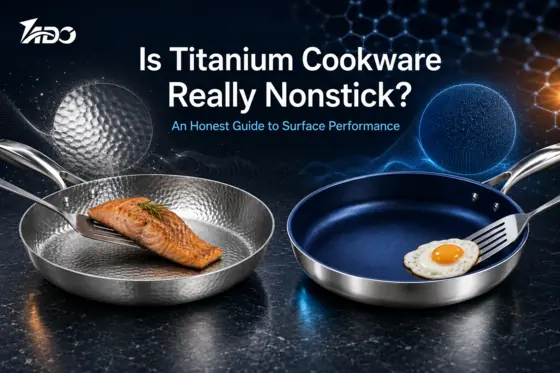
Is Titanium Cookware Really Nonstick? An Honest Guide
Yes—properly engineered titanium cookware can deliver reliable nonstick and easy-release performance without a conventional nonstick coating. The result depends on more than titanium alone: the food-contact surface, surface technology and heat distribution must work as one cooking system.
TADO develops coating-free titanium cookware through two distinct product routes. Its Hammered Titanium Series uses a reinforced three-dimensional texture to reduce continuous food contact and support oil distribution. Its separate Nano-Core Technology Series uses proprietary nano-micro surface engineering to optimize contact angle and reduce adhesion. The two technologies are applied to different product series rather than stacked on the same surface.
For consumers, this means easier everyday cooking without a conventional coating that can peel or flake. For cookware brands, importers and distributors, it creates a differentiated premium product with a clear material story, strong retail appeal and OEM/ODM potential.
Quick Answer: What Makes Titanium Cookware Nonstick?
Titanium itself provides a stable, corrosion-resistant food-contact surface. TADO enhances food release through one of two independently engineered surface technologies:
- Advanced Hammered Surface Technology: a functional hammered texture that reduces continuous food-to-pan contact, supports oil distribution and reinforces the cooking surface.
- Superfluid Condensation Nano-Micro Reinforcement Technology: a separate nano-core surface solution that optimizes contact angle and nano-micro topography to reduce food adhesion.
Both product series use a fully clad tri-ply body to distribute heat more evenly. This matters because local overheating is one of the main causes of burning and sticking.
The result is a form of coating-free nonstick performance built into the titanium cooking surface, rather than supplied by a conventional PTFE or ceramic film.
Not All “Titanium Cookware” Is the Same
The term titanium cookware is used broadly in the market, but it can refer to very different products.
Pure or commercially pure titanium cookware
The body or food-contact surface is made from commercially pure titanium. It offers excellent corrosion resistance and avoids the need for a conventional nonstick coating. Very thin solid-titanium cookware is common in outdoor applications, where low weight matters more than perfectly even frying performance.
Titanium-reinforced coated cookware
These products normally use an aluminum body covered by a conventional nonstick coating containing titanium particles or compounds. Titanium may improve the strength of the coating, but the food still contacts the coating rather than a solid titanium sheet.
Titanium-coated or titanium-bonded cookware
A titanium-based layer is deposited or bonded onto another metal. Its performance depends on the composition, thickness and bonding process.
Tri-ply cookware with a pure titanium interior
This construction uses commercially pure titanium as the food-contact layer, aluminum as the heat-conducting core and magnetic stainless steel as the exterior. Each material performs a specific function: titanium contacts the food, aluminum distributes heat and stainless steel provides structural support and induction compatibility.
This is the foundation used in TADO tri-ply titanium cookware. It gives consumers the benefits of a real titanium interior while delivering the heating performance expected from premium domestic cookware.
TADO Hammered Titanium Series: How the Texture Improves Food Release
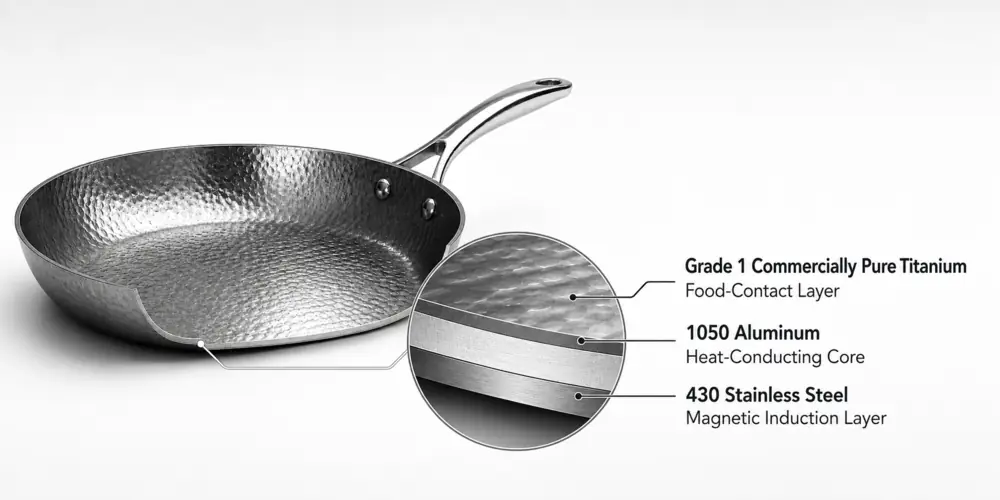
TADO’s Advanced Hammered Surface Technology is more than a visual finish. It creates a functional three-dimensional cooking surface with several practical benefits.
1. Reduced continuous food contact
The raised and recessed hammered geometry reduces the continuous area where food touches the pan. Less uninterrupted contact helps reduce adhesion and supports easier release during frying and sautéing.
2. More effective oil distribution
The textured surface helps a thin layer of cooking oil spread across the cooking zone instead of moving immediately to one side. This supports more consistent release and browning with a modest amount of oil.
3. A reinforced cooking surface
The hammered structure increases surface rigidity and improves resistance to everyday deformation. TADO further strengthens selected hammered surfaces through oxidation reinforcement, reaching 600 HV+ surface hardness.
4. Long-term durability
Because the easy-release effect is created by the metal surface rather than a soft film, there is no conventional nonstick layer that must remain intact. TADO evaluates surface durability through hardness measurement and 100,000-cycle steel-brush abrasion testing, helping confirm that the functional surface can withstand repeated use and cleaning.
5. A distinctive premium appearance
The metallic hammered pattern gives the cookware an immediately recognizable, crafted appearance. For retail brands, that visual identity helps communicate premium material value before the consumer even handles the pan.
In this series, the hammered structure is the principal surface technology supporting nonstick performance. It is not combined with TADO’s separate Nano-Core Technology.
TADO Nano-Core Technology Series: A Different Route to Coating-Free Nonstick Performance
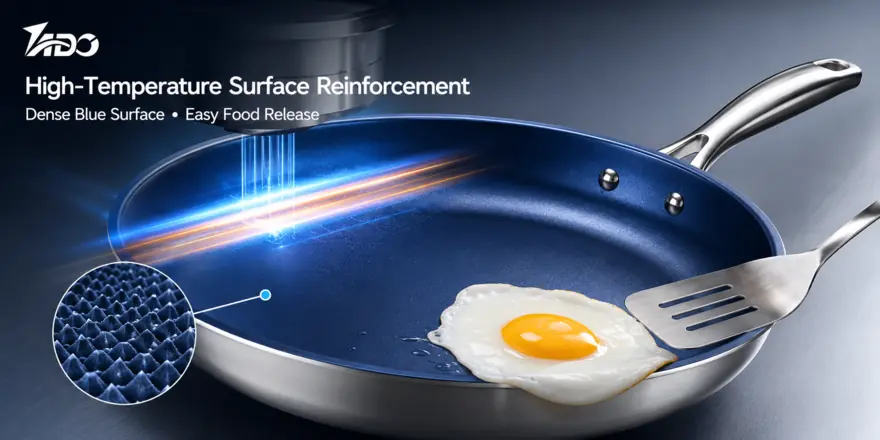
TADO’s Nano-Core Technology Series uses the proprietary Superfluid Condensation Nano-Micro Reinforcement Technology. This is a separate product platform and does not depend on a hammered surface.
Inspired by the natural Lotus Leaf Effect, the technology controls the contact angle and nano-micro structure of the titanium surface. The engineered topography reduces direct food contact at a microscopic level, making it more difficult for food to form continuous adhesion across the pan.
Its principal benefits include:
- smoother coating-free food release;
- reduced direct adhesion between food and titanium;
- easier cleaning after everyday cooking;
- improved surface hardness and wear resistance;
- more stable performance over repeated use; and
- no conventional PTFE nonstick film to peel or flake.
The visible hammered series and the Nano-Core Technology Series therefore reach the same commercial goal through two different surface-engineering routes. This gives brands greater flexibility in product design, appearance, market positioning and price architecture.
Why the Tri-Ply Body Is Essential
The cooking surface is only part of nonstick performance. A pan also needs to heat evenly.
TADO’s representative tri-ply structure uses:
- an inner Grade 1 commercially pure titanium food-contact layer;
- a 1050 aluminum core for rapid, even heat distribution; and
- a magnetic 430 stainless-steel exterior for durability and induction compatibility.
In selected TADO models, the titanium interior is approximately 0.4 mm thick. The aluminum core is enclosed within the composite body and does not serve as the normal food-contact surface.
This construction improves performance in three ways:
- It spreads heat across the base and walls instead of concentrating it in one area.
- It reduces the hot spots that commonly burn proteins, starches and sauces onto a pan.
- It provides a more predictable cooking surface on gas, electric, ceramic and induction cooktops.
Surface technology improves release; the tri-ply body gives that surface the consistent heat it needs to perform.
Coating-Free Titanium vs Conventional Nonstick
| Feature | TADO coating-free titanium | Conventional coated nonstick |
| Food-contact surface | Grade 1 commercially pure titanium | Applied nonstick coating |
| Release mechanism | Functional metal surface engineering | Low-friction coating film |
| Surface options | Hammered Series or separate Nano-Core Series | PTFE or ceramic coating systems |
| Wear behavior | No conventional nonstick film to peel or flake | Performance depends on coating condition |
| High-heat versatility | Suitable when the complete model is rated for the intended temperature | High heat is commonly restricted |
| Utensil compatibility | Reinforced surface designed for durable everyday use | Metal utensils are often discouraged |
| Induction capability | Magnetic stainless-steel exterior | Depends on base construction |
| Long-term value | Durable surface built into the pan | Coating may require more careful use or eventual replacement |
The purpose of coating-free titanium is not merely to copy a temporary coating effect. It delivers easy food release together with durability, high-temperature versatility and a stable food-contact surface.
How Does TADO Titanium Cookware Perform With Everyday Foods?
Eggs
Eggs release well when the pan is gently preheated and a light film of butter or oil is added. The engineered surface reduces continuous contact, while the aluminum core keeps the cooking zone more uniform.
Fish
Fish benefits from the controlled release of a titanium surface. Once the outer surface has browned, it loosens more naturally for turning. Patting the fish dry and allowing it time to sear produces the best result.
Meat
The tri-ply body supports even searing, while the durable titanium interior tolerates the temperatures needed to develop color and flavor. Meat may briefly grip the surface as the crust forms, then release as browning progresses.
Vegetables
The surface works well for sautéing, stir-frying and browning vegetables with a modest amount of oil. Even heating helps reduce scorched spots and uneven texture.
Sauces, rice and noodles
Controlled heat and timely stirring help prevent starches and sugars from drying onto any metal surface. The durable titanium interior can also be deglazed after cooking, making it suitable for pan sauces and one-pan meals.
How to Get the Best Nonstick Performance
TADO coating-free titanium cookware is designed for straightforward everyday use:
- Start with a clean, dry pan.
- Preheat gradually over medium or medium-low heat.
- Add a small amount of oil and distribute it across the surface.
- Add food once the oil is warm but not smoking.
- Allow proteins to brown before turning or moving them.
- Adjust induction power promptly because induction heats very quickly.
- After cooking, loosen fresh residue with warm water before it carbonizes.
These steps are not a workaround; they are the normal way to unlock the best release, browning and flavor from high-performance metal cookware.
Is Coating-Free Titanium Cookware PFAS-Free?
A genuine coating-free titanium food-contact surface does not require a fluoropolymer nonstick film. That distinguishes it from cookware in which titanium particles are added to a conventional coating.
The terms still need to be used accurately. PFAS are a large family of fluorinated substances, and PFOA is only one member of that family. “PFOA-free” alone is not the same as “PFAS-free” or “PTFE-free.”
TADO’s coating-free titanium positioning is based on the physical titanium food-contact surface rather than a conventional PTFE nonstick layer. Material declarations and market-specific test documentation should always correspond to the exact production model.
The U.S. Environmental Protection Agency identifies PFAS as a broad group that includes PFOA, PFOS and many other substances. In Europe, food-contact materials must meet the safety and inertness principles of Regulation (EC) No 1935/2004, including requirements related to safety, traceability and compliance documentation.
Why Consumers Are Interested in Coating-Free Cookware
Consumers are increasingly comparing not only how a pan performs on the first day, but also what touches their food and how long the product is expected to last.
Independent research cited by NSF found that 58% of safety-minded consumers were concerned about the safety of cookware materials and coatings. NSF’s home-product program evaluates areas such as materials, durability, cleanability and product performance. NSF’s cookware information reflects the growing importance of independent verification and clear material communication.
TADO titanium cookware responds to this demand with four easily understood benefits:
- a real titanium food-contact surface;
- no conventional nonstick coating to peel or flake;
- durable easy-release performance; and
- even-heating, induction-compatible tri-ply construction.
These benefits create a strong story for product pages, retail packaging, in-store demonstrations and social content without relying on vague “titanium-infused” claims.
Why This Category Is Valuable for Cookware Brands and Importers
Coating-free titanium cookware provides more than a technical difference. It gives B2B buyers a commercially useful product platform.
Clear premium differentiation
The food-contact material, surface technology and tri-ply construction create visible and explainable differences from standard coated aluminum cookware.
Multiple product stories
The Hammered Titanium Series offers strong shelf presence and a handcrafted metallic identity. The separate Nano-Core Technology Series offers a more technology-led story focused on microscopic surface engineering. Brands can select the route that best matches their target customer and design language.
Strong educational content
Material cross-sections, cooking demonstrations, abrasion tests, heat-distribution visuals and cleaning tests give retailers substantial content for ecommerce, social media and sales training.
Long-term category value
A durable surface supports a premium value proposition based on product life, everyday versatility and reduced dependence on replaceable coatings.
OEM, ODM and private-label flexibility
TADO supports cookware brands, importers and distributors with product selection, size development, handles, lids, logos, packaging and target-market documentation. Its integrated R&D and manufacturing background helps move projects from sample evaluation to stable mass production.
What Should Professional Buyers Confirm?
A serious titanium cookware program should make the essential product facts clear:
- the exact material that contacts food;
- the titanium grade and nominal thickness;
- whether the product uses the Hammered Series or Nano-Core Technology Series;
- the tri-ply layer structure;
- available abrasion, hardness, heat and handle testing;
- food-contact documentation for the destination market;
- approved-sample and quality-control procedures; and
- OEM/ODM scope, production lead time and packaging requirements.
TADO can provide product specifications, samples and available test documentation for evaluation. Additional validation can be planned according to the buyer’s market, retail channel and compliance strategy.
Final Verdict: Is Titanium Cookware Really Nonstick?
Yes. TADO’s engineered titanium cookware delivers stable, coating-free nonstick and easy-release performance through two separate product technologies.
The Hammered Titanium Series uses a reinforced three-dimensional texture to reduce contact and support oil distribution. The Nano-Core Technology Series uses proprietary nano-micro surface engineering to optimize contact angle and reduce adhesion. Both are supported by a fully clad tri-ply body that distributes heat evenly.
For consumers, the result is durable, versatile cookware without a conventional nonstick coating to peel or flake. For brands and importers, it is a differentiated premium category with strong product storytelling, clear technical value and flexible OEM/ODM opportunities.
Developing a titanium cookware collection? Contact TADO for specifications, samples and an OEM or ODM consultation.
Frequently Asked Questions
Is titanium cookware naturally nonstick?
Commercially pure titanium provides a stable food-contact surface. Reliable nonstick performance is further improved through engineered surface structure and even heat distribution. TADO uses either Advanced Hammered Surface Technology or its separate Nano-Core Technology, depending on the product series.
Are TADO’s hammered and Nano-Core technologies used together?
No. They are two independent surface solutions used in different product series. The Hammered Titanium Series relies on functional three-dimensional texture, while the Nano-Core Technology Series relies on a separately engineered nano-micro surface.
Can you cook eggs in a TADO titanium pan?
Yes. Gently preheat the pan, add a light film of butter or oil and use medium-low heat. The engineered titanium surface and conductive core support even cooking and reliable release.
Does TADO titanium cookware use PTFE?
TADO’s coating-free titanium cooking surface is made of Grade 1 commercially pure titanium,it does not rely on any coating,including PTFE.
.Does titanium cookware need seasoning?
TADO domestic titanium cookware does not require traditional cast-iron-style seasoning. A light layer of cooking oil is sufficient for normal use.
Can metal utensils be used?
TADO’s reinforced titanium surfaces are designed for durable everyday cooking and utensil contact. Follow the care instructions supplied with the specific handle, finish and model.
Is TADO titanium cookware induction compatible?
Yes. The magnetic 430 stainless-steel exterior enables compatibility with induction as well as gas, electric and ceramic cooktops.
What is the main benefit of hammered titanium cookware?
The hammered texture reduces continuous food contact, supports oil distribution, reinforces the cooking surface and creates a distinctive premium appearance.
What is the main benefit of TADO Nano-Core Technology?
It optimizes the titanium surface at a nano-micro scale, reducing direct food adhesion and supporting smooth, durable, coating-free food release
Contact Us:
Xi ‘an Taidou Metal Products Technology Co., Ltd.
Room 1604, Block D, Baihualin Financial Innovation Center, No. 51 Fengcheng Second Road, Weiyang District, Xi’an City, Shaanxi Province, P.R.China
Email: overjunjun@gmail.com
WhatsApp: +64274075362
Tel: +86 18629501987