
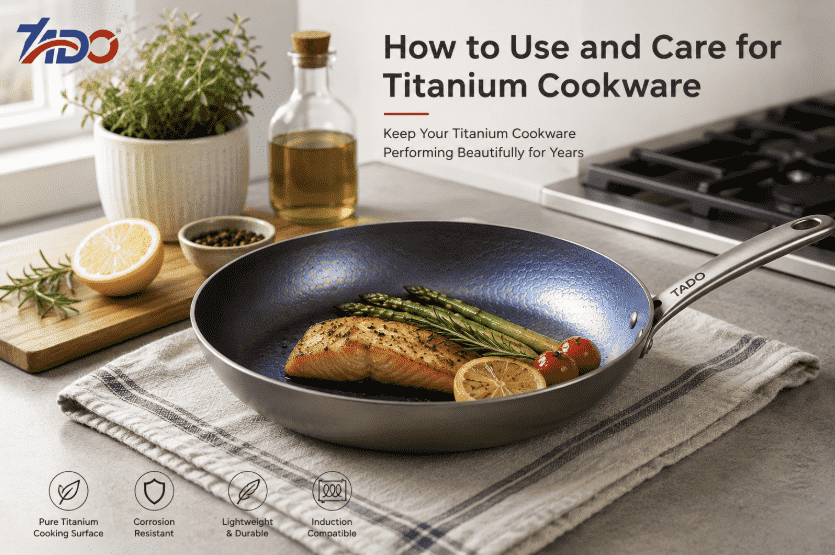
How to Use and Care for Titanium Cookware: A Complete Guide
Titanium cookware is valued for its durability, corrosion resistance, lightweight performance, and stable cooking surface. But like any premium cookware, getting the best results depends on understanding how the pan is constructed and how to use it correctly.
This is especially important with titanium cookware because not all titanium pans are the same. Some are made from thin single-layer titanium, some use titanium-reinforced coatings, while premium cookware may use a multilayer construction that combines titanium with other metals for better cooking performance.
TADO cookware uses a Grade 1 (TA1) titanium cooking surface, a 1050 aluminum core for heat distribution, and a 430 stainless steel exterior for induction compatibility. This three-layer composite structure combines the food-contact properties of titanium with the thermal performance of aluminum and the versatility of magnetic stainless steel.
In this guide, we’ll explain how to use titanium cookware, how to season a titanium pan, how to prevent food from sticking, how to clean titanium cookware, and how to maintain it for long-term use.
Quick Answer: How Should You Care for Titanium Cookware?
For everyday cooking, use low to medium heat, allow the pan to preheat gradually, and add cooking oil before ingredients that are likely to stick.
After cooking, allow the pan to cool before washing it with warm water, dish soap, and a soft sponge. Avoid unnecessarily overheating an empty pan.
If your titanium cookware develops blue, gold, purple, or other subtle color variations over time, this does not automatically mean that the surface is damaged. Titanium can develop different oxide colors depending on temperature and surface conditions.
With proper use and cleaning, high-quality titanium cookware can provide reliable performance for many years.
1. Understanding Your Titanium Cookware
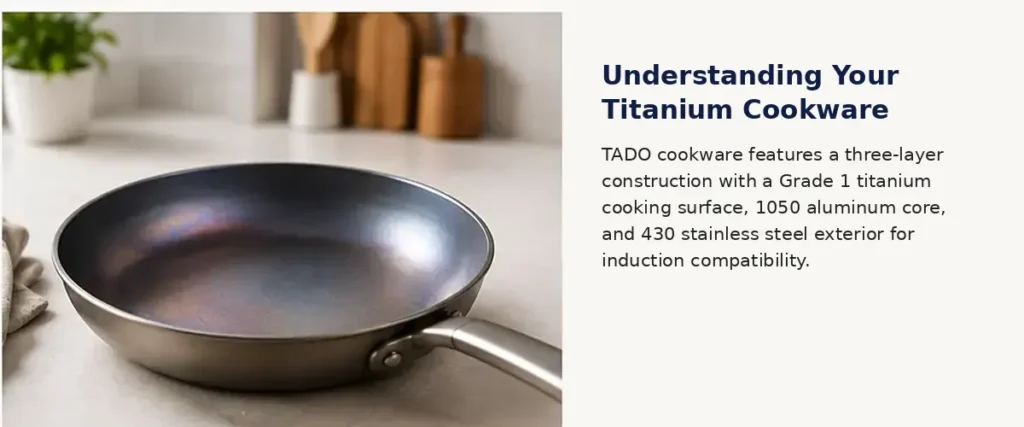
Before discussing seasoning and cleaning, it helps to understand what makes titanium cookware different.
Grade 1 Titanium Cooking Surface
The food-contact surface of TADO cookware is made from Grade 1 (TA1) titanium, a commercially pure titanium known for its excellent corrosion resistance and chemical stability.
Titanium naturally develops a thin, protective oxide layer when exposed to oxygen. This passive surface is one reason titanium performs well in environments where corrosion resistance matters.
For everyday cooking, this means the titanium cooking surface is highly resistant to rust and suitable for contact with a wide range of foods, including acidic and salty ingredients.
Why Does Titanium Cookware Look Blue?
Depending on the surface treatment, titanium cookware may have a blue, purple, gold, or mixed metallic appearance.
This color does not necessarily come from paint or a conventional non-stick coating.
With TADO’s surface treatment process, controlled high-temperature treatment modifies the titanium surface and creates a distinctive titanium oxide appearance. The resulting blue-purple color is associated with the surface itself rather than a layer of decorative paint applied on top.
Minor variations in color are therefore normal and can make individual pieces look slightly different.
Is TADO Titanium Cookware Coated?
TADO’s titanium cooking surface does not rely on a conventional PTFE non-stick coating to create its primary cooking surface.
Instead, the titanium surface is engineered through TADO’s Tao Jing Ceramic Crystal Nano Technology, which modifies the surface under controlled high-temperature conditions.
This distinction matters because the cooking surface is not simply a conventional non-stick film applied over another metal.
However, titanium should not be treated exactly like a traditional PTFE-coated non-stick pan. Correct heat control, preheating, and the use of a small amount of cooking oil remain important for achieving the best release performance.
2. How to Season a Titanium Pan
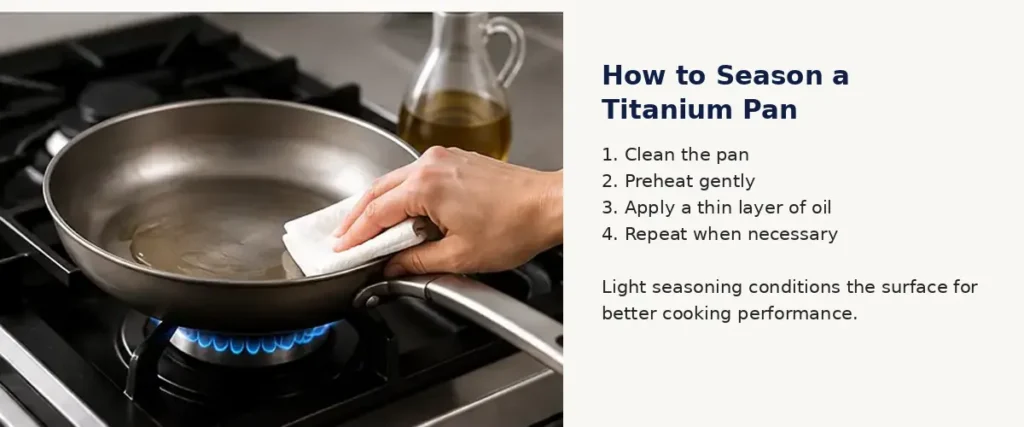
One of the most common questions is:
Do you need to season titanium cookware?
For TADO titanium cookware, light seasoning can help improve the initial cooking experience and create a thin oil film on the surface. It is not the same type of seasoning required for traditional cast iron, and you do not need to build a thick, black polymerized layer.
The goal is simply to condition the cooking surface before regular use.
Step 1: Wash the Pan
Before first use, wash the cookware with warm water and mild dish soap to remove dust or residue from manufacturing, packaging, and transportation.
Rinse thoroughly and dry completely.
Step 2: Preheat Gently
Place the empty pan over low heat for a short period.
Do not immediately use maximum heat. Gradual preheating allows the entire cookware structure to reach temperature more evenly.
Step 3: Apply a Thin Layer of Oil
Turn off the heat and allow the pan to cool slightly.
Apply a small amount of cooking oil across the cooking surface using a clean paper towel or soft cloth. You need only a very thin layer—more oil does not necessarily produce better results.
Wipe away any obvious excess.
Step 4: Repeat When Necessary
During the first few uses, you can repeat this light conditioning process when needed.
As you become familiar with the pan, correct temperature control and normal cooking with oil become more important than repeatedly seasoning the cookware.
TADO Tip: Think of seasoning titanium cookware as surface conditioning, not traditional cast-iron seasoning.
3. How to Cook with Titanium Cookware
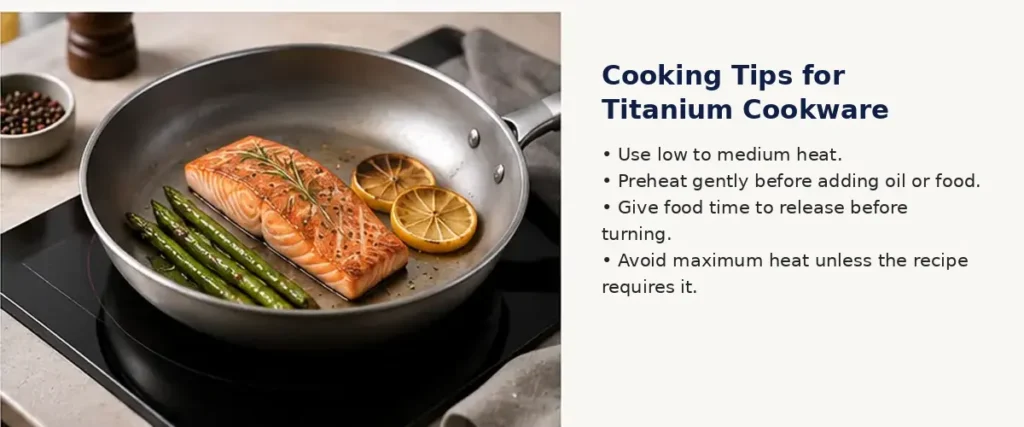
Learning how to cook with titanium cookware is largely about temperature control.
One important misconception is that titanium itself is an exceptional heat conductor. Pure titanium actually conducts heat less efficiently than aluminum.
This is why TADO uses a three-layer composite construction.
The Grade 1 titanium provides the cooking surface, while the 1050 aluminum core spreads heat across the pan. The outer 430 stainless steel layer provides magnetic compatibility for induction cooking.
Understanding this construction makes the cooking technique much easier.
Use Low to Medium Heat
For most everyday cooking, low to medium heat is sufficient.
The aluminum core helps distribute heat efficiently across the cooking surface, so maximum burner settings are rarely necessary.
Excessively high heat can make temperature control more difficult and increase the chance of burning oil or food.
Preheat the Pan Gradually
Give the pan a short, gentle preheat before adding ingredients.
For foods that tend to stick—such as eggs, fish, or certain proteins—add a small amount of oil after preheating and allow it to spread across the cooking surface.
Then add the food.
Give Food Time Before Turning It
One of the most common mistakes with metal cookware is trying to move food too early.
When searing meat, fish, or other proteins, allow the surface to cook and develop a crust before attempting to turn it.
Proper temperature control, sufficient oil, and patience usually produce better release than simply increasing the heat.
Avoid Maximum Heat Unless the Recipe Requires It
Titanium has excellent high-temperature stability, but that does not mean cookware should always be used at maximum burner settings.
The goal is not to test the maximum temperature the material can withstand. The goal is to cook food effectively while protecting cooking oils, ingredients, handles, and the overall cookware structure.
4. How to Clean Titanium Cookware
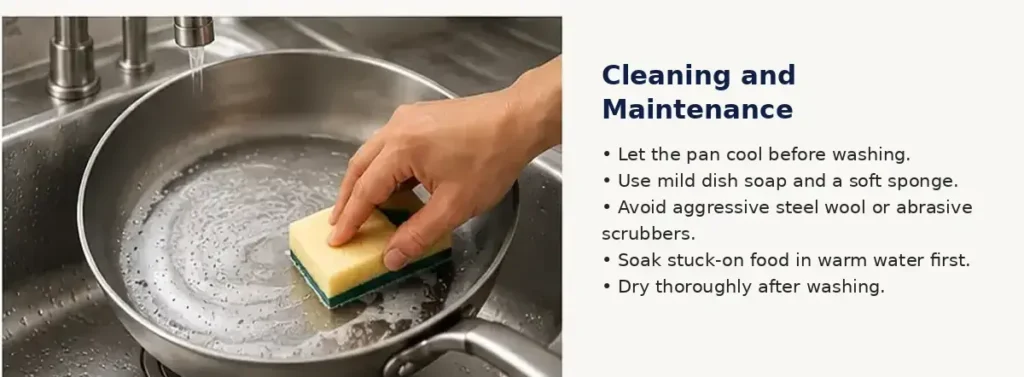
Titanium cookware is relatively easy to maintain when cleaned correctly.
For routine cleaning, you usually need only warm water, mild dish soap, and a soft sponge.
Let the Pan Cool First
Avoid moving a very hot pan directly into cold water.
Sudden temperature changes can place unnecessary thermal stress on multilayer cookware. Allow the pan to cool naturally before washing.
Wash with a Soft Sponge
For normal grease and food residue:
- Rinse the pan with warm water.
- Add a small amount of mild dishwashing liquid.
- Clean with a soft sponge or cloth.
- Rinse thoroughly.
- Dry with a clean towel.
Drying after washing also helps prevent visible water spots.
What If Food Is Stuck?
Do not immediately attack stubborn residue with aggressive scrubbing.
Instead, soak the pan in warm water for several minutes to soften the residue. Then clean it gently with a sponge.
For more difficult residue, repeat the soaking process before using stronger mechanical cleaning.
Can You Use Steel Wool on Titanium Cookware?
Although titanium is durable, aggressive steel wool or highly abrasive cleaning tools can change the appearance of a finished surface and leave visible scratch marks.
For routine cleaning, a soft sponge is the better choice.
If a product has a specialized hardened surface, its scratch resistance may be higher than untreated titanium, but gentle cleaning will still help preserve its appearance for longer.
5. Why Does Titanium Cookware Change Color?
Seeing blue, purple, gold, or rainbow-like colors on titanium sometimes causes users to worry that the cookware has been damaged.
In many cases, however, color changes are related to titanium oxide formation.
Titanium naturally forms a very thin oxide layer on its surface. When the thickness of this layer changes, light interacts with it differently, creating visible interference colors.
That is why heated titanium can display shades ranging from gold and blue to purple.
Does Discoloration Mean the Pan Is Unsafe?
Not necessarily.
A change in titanium’s surface color alone does not mean the cookware has developed a harmful coating or become unusable.
However, it is important to distinguish normal oxide coloration from burned food residue, carbonized cooking oil, or contamination on the surface.
If the color appears together with sticky or rough residue, clean the pan first before evaluating the surface itself.
How to Clean Surface Discoloration
Start with the least aggressive method:
- Warm water
- Mild dishwashing liquid
- Soft sponge
If the appearance is caused by food or oil residue, normal cleaning may remove or reduce it.
Some oxide-related color changes, however, may remain because they are associated with the titanium surface rather than surface dirt. These cosmetic variations generally do not prevent normal cooking.
6. Important Titanium Cookware Care Tips
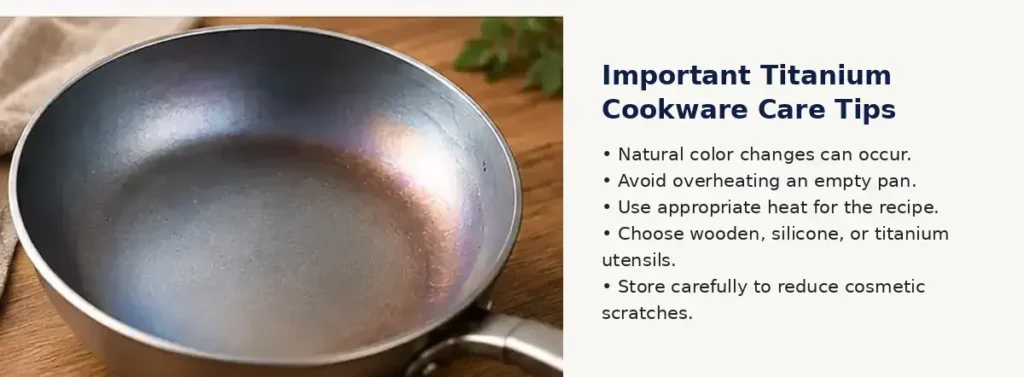
A few simple habits can significantly improve both cooking performance and the long-term appearance of your cookware.
Avoid Overheating an Empty Pan
Do not leave an empty pan over high heat for an extended period.
Even though titanium itself tolerates high temperatures, cookware contains multiple materials and components. Unnecessary overheating can affect surface appearance, cooking oils, handles, and overall cookware performance.
Use Appropriate Heat
Low to medium heat is sufficient for most cooking.
Use higher temperatures only when the cooking method genuinely requires them.
Choose Suitable Cooking Utensils
Wooden, silicone, and titanium utensils are good everyday choices.
Metal utensils may be suitable for certain titanium surfaces, but aggressive scraping can still create cosmetic marks. If preserving the original appearance is important, softer utensils are preferable.
Don’t Panic About Minor Scratches
Cookware is a working kitchen tool.
Small cosmetic marks can naturally develop with regular use. A superficial scratch does not automatically mean that the titanium cooking surface has failed.
What matters more is whether the cookware remains structurally sound and performs normally.
Store Cookware Carefully
If you stack pans, place a soft pan protector, cloth, or paper towel between pieces.
This reduces metal-to-metal contact and helps maintain the exterior finish.
Titanium Cookware Care: What to Do and What to Avoid
| Recommended | Avoid |
|---|---|
| Use low to medium heat for everyday cooking | Leaving an empty pan on maximum heat |
| Preheat gradually | Extreme rapid temperature changes |
| Use a small amount of cooking oil when needed | Assuming titanium behaves exactly like PTFE non-stick |
| Clean with mild detergent and a soft sponge | Aggressive daily scrubbing with steel wool |
| Allow the pan to cool before washing | Putting a very hot pan directly into cold water |
| Dry after cleaning | Leaving food residue on the surface for long periods |
| Expect some natural color variation | Assuming every color change means damage |
Frequently Asked Questions About Titanium Cookware Care
Does titanium cookware need to be seasoned?
Light surface conditioning can improve the initial cooking experience, particularly with uncoated or surface-treated titanium cookware. Unlike cast iron, titanium cookware does not require a thick, permanent seasoning layer. Correct preheating, heat control, and cooking oil are more important for everyday performance.
How do you keep food from sticking to a titanium pan?
Use moderate heat, preheat the pan gradually, add an appropriate amount of cooking oil, and allow proteins to cook before trying to turn them. Excessive heat can actually make sticking and burning worse.
Can titanium cookware be used on induction cooktops?
Pure titanium itself is not strongly magnetic. However, TADO’s three-layer cookware uses a 430 stainless steel exterior layer, providing the magnetic properties required for induction compatibility.
Can titanium cookware rust?
Titanium is highly resistant to corrosion because it naturally develops a protective oxide layer. However, stains or deposits from food, water, or contact with other metals can sometimes be mistaken for rust and should be cleaned before evaluating the surface.
Why did my titanium pan turn blue or purple?
Titanium can develop different colors as the thickness of its surface oxide layer changes. Blue, gold, and purple tones can occur through high-temperature surface treatment or heating and do not automatically indicate damage.
Can I use metal utensils with titanium cookware?
Titanium is durable, but metal utensils can still create cosmetic marks depending on the surface treatment and force used. Wooden, silicone, or titanium utensils are good choices when you want to preserve the appearance of the cookware.
Can I use high heat with titanium cookware?
Titanium has excellent high-temperature resistance, but maximum burner heat is unnecessary for most recipes. TADO’s aluminum-core construction distributes heat efficiently, so low to medium heat is usually sufficient for everyday cooking.
How long does titanium cookware last?
Service life depends on construction quality, frequency of use, cooking technique, and maintenance. High-quality titanium cookware is valued for corrosion resistance and durability and can provide long-term performance when properly used and maintained.
Final Thoughts: Proper Care Makes Better Titanium Cookware
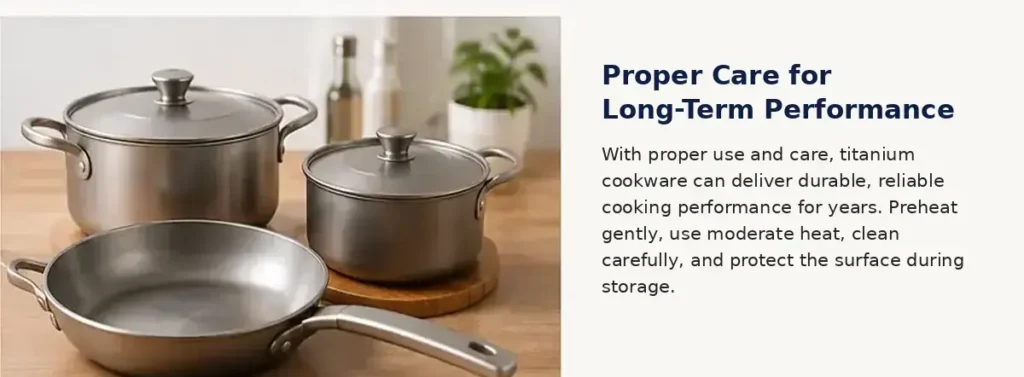
Titanium cookware combines several qualities that are highly desirable in a modern kitchen: corrosion resistance, low weight, durability, and a stable cooking surface.
But material alone does not determine cooking performance.
Construction matters.
TADO combines a Grade 1 titanium cooking surface, 1050 aluminum heat-conducting core, and 430 stainless steel induction base to create cookware designed to balance material stability, heat distribution, durability, and compatibility with modern cooktops.
Using that cookware correctly is equally important.
Remember the essentials:
Preheat gently. Use moderate heat. Add oil when appropriate. Give food time to release. Clean gently. Avoid unnecessary empty-pan overheating.
These simple habits can help maintain both cooking performance and appearance over years of everyday use.
Looking for Titanium Cookware for Your Brand?
TADO specializes in titanium cookware manufacturing and OEM/ODM solutions for international cookware brands, distributors, and retail partners.
If you’re evaluating titanium cookware for your product line, our team can help you explore material structures, product sizes, surface treatments, handle designs, packaging, and private-label manufacturing options.