
Titanium Cookware Explained: 3-Layer Construction, Benefits & What Buyers Should Know
Titanium cookware is becoming increasingly visible in premium kitchens, but the phrase “titanium cookware” can describe very different products.
Some cookware is made from thin single-layer titanium. Some pans use a titanium-containing non-stick coating. Others use titanium as the food-contact layer within a multi-metal structure.
These products do not cook the same way.
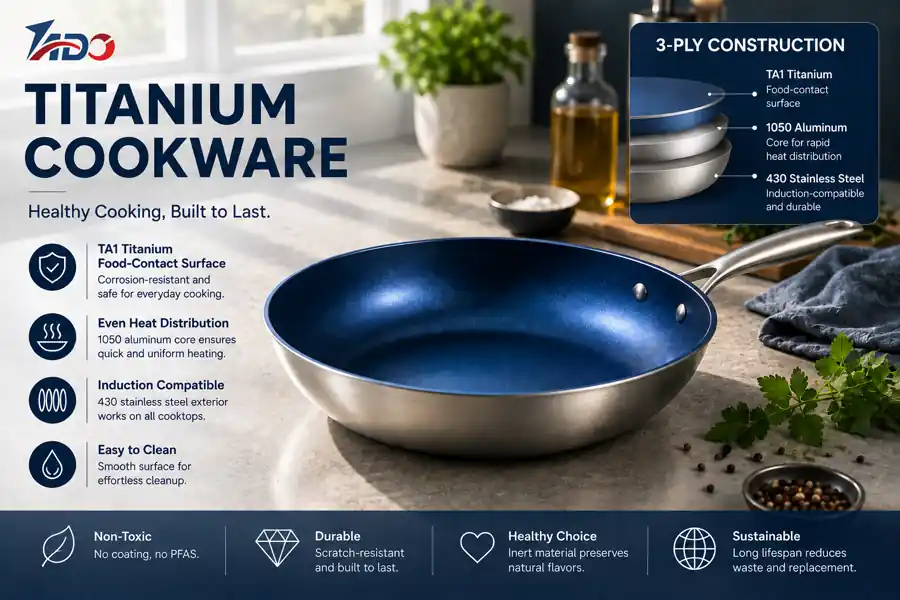
TADO cookware uses an engineered three-layer construction:
TA1 / Grade 1 titanium food-contact surface + 1050 aluminum core + 430 stainless steel exterior.
The goal is simple: use each metal for the property it performs best.
Titanium provides corrosion resistance and a stable food-contact surface. Aluminum improves heat distribution. Magnetic stainless steel provides structure and induction compatibility.
That distinction is central to understanding modern titanium cookware.
Quick Answer: Is Titanium Cookware Worth Considering?
For buyers looking for cookware that combines:
- a titanium food-contact surface,
- strong corrosion resistance,
- lower maintenance than reactive cookware,
- even heat distribution,
- induction compatibility,
- and long-term durability,
a well-designed multi-layer titanium pan can be a strong option.
But the important question is not simply:
“Does this pan contain titanium?”
The better question is:
What material actually touches the food, and how is the complete cookware structure engineered?
What Is Titanium Cookware?
Titanium is a lightweight transition metal known for strength and excellent corrosion resistance. PubChem describes pure titanium as having low density, good strength and excellent corrosion resistance.
These characteristics make titanium attractive for demanding applications where durability and chemical stability matter.
In cookware, however, titanium can appear in several different forms.
Single-Layer Pure Titanium
Common in ultralight outdoor cookware.
Advantages include very low weight and corrosion resistance.
The drawback is that titanium itself does not distribute heat as effectively as metals such as aluminum or copper.
Titanium-Reinforced Coated Cookware
The pan may still have a conventional non-stick coating, with titanium particles added to improve wear resistance.
In this case, the food-contact surface is still fundamentally a coating.
Multi-Layer Titanium Cookware
This combines titanium with another heat-conductive metal and often a magnetic exterior.
This is the design approach used by TADO.
How TADO 3-Layer Titanium Cookware Works
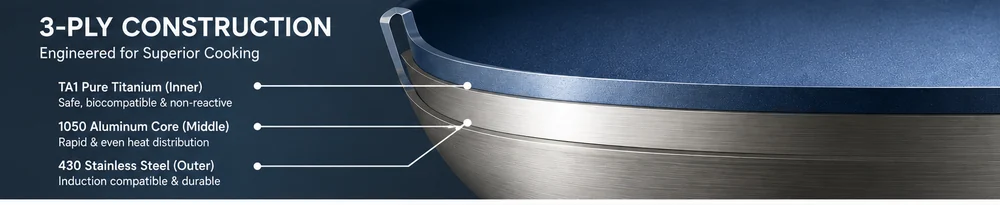
TADO’s construction uses three different metals because no single cookware material delivers every desirable property.
Layer 1: TA1 / Grade 1 Titanium Food-Contact Surface
The interior cooking surface uses unalloyed Grade 1 titanium.
Grade 1 titanium is one of the commercially pure titanium grades and is valued for ductility, formability and corrosion resistance.
For cookware, the key advantage is not a medical association.
It is the combination of:
corrosion resistance + material stability + direct titanium food contact.
Titanium is also highly resistant to many acids and chloride-containing environments.
This makes it attractive for cooking foods such as tomato-based sauces, citrus dishes and salty ingredients.
Importantly, finished cookware safety should still be supported by appropriate food-contact testing rather than inferred solely from the raw metal grade.
EU Regulation (EC) No 1935/2004 requires food-contact materials to be sufficiently inert so they do not release constituents at levels harmful to health or unacceptably change food composition, taste or odor.
Layer 2: 1050 Aluminum Core
Titanium has many useful properties.
High thermal conductivity is not one of them.
This is one of the most important technical facts buyers should understand.
NIST thermal-property references show titanium and aluminum have very different thermal behaviors, which is why aluminum is widely used as a heat-distribution layer in cookware.
TADO therefore places a 1050 aluminum core between the titanium interior and stainless exterior.
Its job is to:
- spread heat across the base,
- reduce localized hot spots,
- improve temperature response,
- and make medium-heat cooking more practical.
This is the thermal engine of the pan.
The titanium food-contact surface provides one set of benefits.
The aluminum core provides another.
Layer 3: 430 Stainless Steel Exterior
The outer layer uses 430 stainless steel.
Its role is different again.
It provides:
- structural support,
- exterior durability,
- and magnetic compatibility for induction cooktops.
Induction cooking requires cookware with a magnetic layer. Bosch explains that magnetic stainless steel and other magnetic materials can work on induction, while non-magnetic materials generally require a magnetic layer to become induction-compatible.
That is why the 430 stainless steel exterior is not decorative.
It is a functional part of the cookware architecture.
Why Not Make the Entire Pan From Pure Titanium?
This sounds attractive from a marketing perspective.
From a cookware-engineering perspective, it introduces trade-offs.
A thin single-layer titanium pan can be:
- extremely light,
- corrosion resistant,
- durable,
but it can also distribute heat less evenly than cookware with an aluminum or copper thermal layer.
The original TADO technical material makes this same distinction: pure titanium is valuable for food contact and corrosion resistance, while the aluminum core is introduced specifically to address heat distribution.
This is why high-performance cookware frequently uses multi-material construction.
The question is not:
Which metal is “best”?
It is:
Which metal should perform each job?
For TADO:
Titanium = food-contact surface
Aluminum = heat distribution
430 stainless steel = induction + structure
Titanium Cookware vs Pure Titanium Camping Cookware
Single-layer titanium cookware is excellent for applications where weight matters more than precise heat control.
That is why it is popular for hiking and camping.
For boiling water or preparing simple meals outdoors, this can be ideal.
For everyday kitchen cooking, especially:
- sautéing,
- frying,
- eggs,
- fish,
- sauces,
- or controlled searing,
more even heat distribution becomes important.
TADO’s three-layer construction adds an aluminum thermal core so the cookware behaves more like premium multi-ply kitchen cookware rather than ultralight camping gear.
The original source makes this same distinction between thin camping titanium and multi-layer cookware designed for culinary use.
Titanium Cookware vs Traditional Non-Stick Cookware
This comparison needs careful wording.
Not every non-stick coating is unsafe, and it would be misleading to say all coated cookware is inherently toxic.
The real structural difference is simpler.
Traditional coated cookware relies on an applied non-stick layer above the metal substrate.
A coating-free titanium food-contact surface does not rely on that type of polymer layer for its basic material identity.
That means there is no conventional PTFE-style surface layer that must remain intact for the food to stay separated from the underlying cookware body.
For buyers specifically looking for non-coating cookware, this is an important distinction.
However, coating-free titanium should also not be marketed as if it behaves exactly like PTFE non-stick.
Food release still depends on:
surface engineering + preheating + oil + cooking technique.
Titanium Cookware vs Stainless Steel
Stainless steel remains one of the most established cookware materials in the world.
It is durable, versatile and familiar.
Titanium cookware offers a different proposition.
A titanium food-contact surface emphasizes:
- corrosion resistance,
- lower material density,
- chemical stability,
- and a distinct surface technology platform.
But there is no reason to portray stainless steel as inherently unsafe.
Finished cookware safety depends on its material composition, manufacturing quality and food-contact compliance.
The more useful comparison is therefore:
| Feature | TADO 3-Layer Titanium | Stainless Steel Cookware |
|---|---|---|
| Food-contact surface | TA1 titanium | Stainless steel |
| Corrosion resistance | Excellent | Very good |
| Heat distribution | Aluminum core | Depends on construction |
| Induction | 430 magnetic exterior | Often compatible |
| Weight | Potentially lighter depending on design | Varies |
| Surface type | Coating-free titanium surface | Bare stainless surface |
| Maintenance | Relatively straightforward | Relatively straightforward |
Is Titanium Cookware Good for Acidic Foods?
Titanium has excellent corrosion resistance and is resistant to many organic acids and chloride-containing environments.
That makes it well suited as a food-contact material for many common cooking environments.
Examples include:
- tomato sauce,
- vinegar-based dishes,
- lemon,
- wine reductions,
- salty foods.
However, cookware compliance should always be evaluated at the finished-product level.
The European Commission’s food-contact framework explicitly focuses on the finished material or article and its behavior during intended use.
For professional buyers, the right question is therefore:
Can the supplier provide finished-product food-contact test documentation?
Does Titanium Cookware Work on Induction?
Pure titanium is not normally relied upon as the magnetic layer for induction cookware.
This is why TADO uses a 430 stainless steel exterior.
Magnetic stainless steel allows the cookware to interact with an induction cooktop’s electromagnetic field.
The complete structure therefore supports:
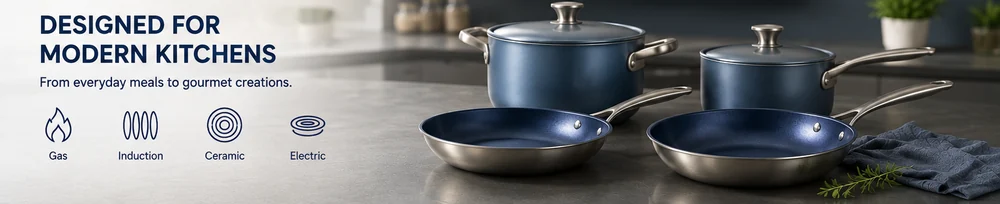
gas + electric + ceramic + induction
when the specific cookware model is designed and validated for those heat sources.
Is Titanium Cookware Lightweight?
Titanium itself has relatively low density compared with steel.
PubChem notes that titanium is lighter than steel while maintaining high strength.
But finished cookware weight depends on far more than one material.
It also depends on:
- total thickness,
- pan diameter,
- aluminum-core thickness,
- stainless-steel layer,
- handle design,
- lid,
- and reinforcement.
So claims such as “35% lighter” should only be used when TADO has a defined comparison model and measured data.
For SEO and B2B content, the safer and more credible claim is:
TADO engineers its multi-layer cookware to balance structural strength with manageable everyday weight.
What About Scratch Resistance?
TADO uses proprietary surface treatment to improve the durability of its titanium cooking surface.
This is one area where technical marketing should stay closely tied to measured test data.
If a particular production specification achieves a verified hardness range or abrasion-test result, that number can be included alongside the relevant test method.
But claims such as:
- “indestructible,”
- “cannot scratch,”
- “permanent non-stick,”
should be avoided.
A better professional message is:
The treated titanium surface is engineered for greater wear resistance than untreated titanium while remaining coating-free.
This is especially important for B2B buyers who may ask for:
- hardness reports,
- abrasion testing,
- metal-utensil resistance,
- and surface-treatment specifications.
What Should B2B Buyers Ask a Titanium Cookware Manufacturer?
This is where the term “titanium cookware” becomes commercially important.
A serious buyer should not purchase based on appearance alone.
Ask the supplier:
What exactly touches the food?
Is it:
- pure titanium,
- titanium alloy,
- titanium coating,
- or a polymer coating containing titanium?
What is the layer structure?
Ask for:
- titanium grade,
- aluminum grade,
- stainless-steel grade,
- total thickness,
- individual layer thicknesses.
What food-contact testing is available?
EU food-contact rules emphasize safety, inertness, documentation and traceability.
Request relevant finished-product reports for your target market.
Is the cookware induction compatible?
Do not assume.
Verify the magnetic exterior and induction performance.
What surface-treatment testing is available?
Ask for:
- hardness,
- abrasion resistance,
- thermal cycling,
- adhesion or integrity testing where relevant,
- and cleaning durability.
Can the supplier support OEM and ODM?
For brands and distributors, cookware engineering includes much more than the pan body.
It can include:
- dimensions,
- handle design,
- logo application,
- packaging,
- color,
- surface finish,
- lids,
- accessories,
- and market-specific testing.
Titanium Cookware FAQ
Is titanium cookware safe for cooking?
Titanium has excellent corrosion resistance and is widely regarded as a chemically stable engineering metal.
But the safety of cookware should be evaluated on the finished product, not merely the name of the raw material.
Food-contact testing and regulatory compliance remain important.
Is titanium cookware non-stick?
A coating-free titanium surface should not be treated as identical to conventional PTFE non-stick cookware.
Food release depends on:
surface treatment, temperature control, oil and cooking technique.
Does titanium cookware contain a coating?
Some cookware marketed as titanium uses titanium-reinforced coatings.
TADO’s titanium food-contact surface is designed as a treated titanium surface rather than a conventional PTFE non-stick layer.
Why does TADO use aluminum inside the pan?
Because titanium is not an especially high-conductivity cookware metal.
The aluminum core improves heat distribution and reduces localized heating. NIST thermal-property references document the very different thermal behaviors of titanium and aluminum.
Can titanium cookware be used on induction?
Yes, if the cookware incorporates a magnetic layer.
TADO uses a 430 stainless steel exterior for induction compatibility.
Is titanium cookware good for professional kitchens?
It can be, particularly when buyers value:
- corrosion resistance,
- coating-free food contact,
- manageable weight,
- multi-layer heat performance,
- and durability.
For commercial use, buyers should still evaluate specific model thickness, handle strength, testing and cooking performance.
Final Thoughts
Titanium cookware is most compelling when the material is used intelligently.
Pure titanium brings valuable properties such as:
corrosion resistance, low density and material stability.
But high-performance cookware requires more than one desirable metal property.
That is why TADO combines:
TA1 titanium food-contact surface
with
1050 aluminum for heat distribution
and
430 stainless steel for induction compatibility and structural support.
The result is not simply “a titanium pan.”
It is an engineered multi-layer cookware system.
For consumers, that can mean easier daily maintenance and more balanced cooking performance.
For cookware brands, distributors and retailers, the more important advantage is configurability: material structure, thickness, dimensions, handles, packaging and surface processing can all become part of an OEM/ODM program.
Good cookware is not about choosing one perfect metal.
It is about putting the right material in the right place.
For OEM/ODM titanium cookware development, TADO supports product engineering, material selection, manufacturing, quality control and customization for international cookware brands and distributors.