
How to Use and Care for Titanium Cookware: First Use, Cooking, Cleaning & Long-Term Care
How to Use and Care for Titanium Cookware: First Use, Cooking, Cleaning & Long-Term Care
Titanium cookware is valued for corrosion resistance, durability and long-term material stability. But good performance still depends on something much more practical:
how you heat it, how you cook with it, and how you clean it.
There is also an important distinction.
Not every product marketed as “titanium cookware” is constructed in the same way. Some products are thin pure titanium; others use titanium-containing coatings or titanium bonded to another metal. TADO cookware uses a TA1 pure titanium food-contact surface, an aluminum heat-distribution core and a 430 stainless steel exterior.
That means TADO cookware should not simply be treated like either a conventional PTFE non-stick pan or a thin camping-style pure titanium pan.
This guide explains the right way to prepare a titanium pan for first use, cook with it, clean it and maintain it over time.
Quick Answer: How Should You Use Titanium Cookware?
For everyday cooking, the basic routine is simple:
Preheat gradually → add a small amount of oil → add food → cook with controlled heat → cool naturally → wash → dry.
The original TADO care guidance already emphasizes low-to-medium heat, gradual heating, a small amount of cooking fat, natural cooling and gentle washing.
The most important rule is:
Use the heat your food needs—not the maximum heat your cookware can withstand.
First Use: How to Prepare TADO Titanium Cookware
A new TADO titanium pan does not require traditional cast-iron seasoning.
Titanium does not need a polymerized oil layer to protect it from rust. Its corrosion resistance is associated with the stable passive oxide film that forms on titanium surfaces.
However, TADO recommends a simple first-use surface-conditioning routine.
This is useful for preparing the cooking surface and establishing good cooking habits from the beginning.
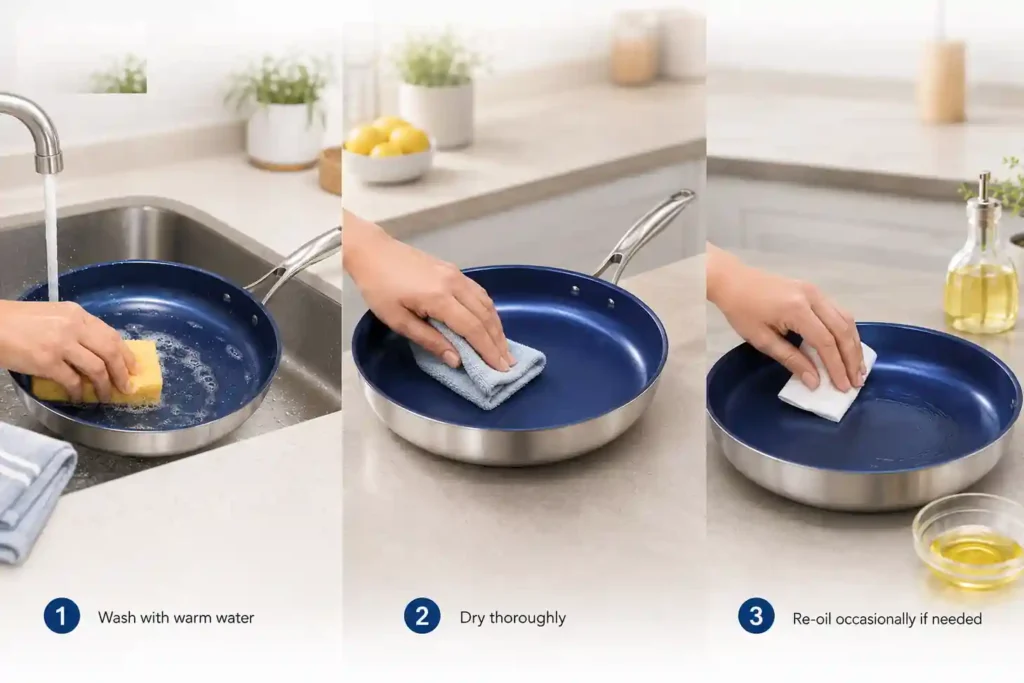
TADO First-Use Conditioning: 3 Steps
| Step | What to Do | Time |
|---|---|---|
| 1. Wash | Wash the inside and outside with mild dishwashing liquid and a soft sponge | — |
| 2. Gently Dry With Heat | Place the clean pan over low heat to evaporate remaining moisture | About 1–2 minutes |
| 3. Apply a Thin Oil Film | While the pan is still warm—not extremely hot—apply a very thin layer of cooking oil | Leave for ≥6 hours; overnight is convenient |
After conditioning, lightly wash or rinse away excess oil, dry the pan and it is ready for normal cooking.
Is this “seasoning”?
Not in the cast-iron sense.
Traditional cast-iron seasoning involves intentionally polymerizing oil onto iron.
For titanium cookware, it is more accurate to call this:
surface conditioning.
The original TADO care article already makes this distinction: light oil conditioning can be useful, but it should not be described as permanently converting the surface into conventional non-stick cookware.
How to Preheat Titanium Cookware
This is probably the most important part of using titanium cookware correctly.
Start at:
medium-low → medium heat
rather than immediately turning the burner to maximum.
Allow the pan to warm gradually.
Then add your cooking oil.
Then add the food.
For TADO’s three-layer construction, this is particularly important because the aluminum core—not titanium itself—is responsible for improving heat distribution across the pan.
Pure titanium is valued for strength and corrosion resistance, but it is not an exceptionally high-conductivity cooking metal. NIST thermal-property references document titanium separately from much more conductive metals, which is exactly why multi-material cookware construction matters.
So instead of saying:
Titanium conducts heat very quickly.
the technically correct TADO message is:
TADO combines a titanium food-contact surface with an aluminum core to improve heat distribution.
That is much stronger from an engineering standpoint.
Should You Use the Water-Drop Test?
You may see cooks test stainless or uncoated metal cookware by placing a small drop of water on the heated surface.
When the pan reaches an appropriate temperature range, water can form mobile droplets rather than immediately spreading and evaporating.
This can be used as an informal cooking cue, but it should not be treated as a precise temperature measurement.
For ordinary TADO cooking, you do not need to perform the test every time.
A simpler routine is:
medium-low heat → gradual preheat → oil → food.
How to Keep Food From Sticking to a Titanium Pan
TADO’s titanium food-contact surface should not be treated exactly like a conventional PTFE-coated pan.
Food release depends on:
temperature + oil + timing + food moisture.
The original care guide summarizes the same principle: titanium food release works best when heat, fat and patience are used together.
1. Preheat gradually
Avoid putting protein directly into a completely cold pan and then aggressively increasing the heat.
2. Add a small amount of oil
You do not normally need large quantities.
The oil helps create a temporary interface between the metal surface and the food.
3. Add food once the pan is ready
Eggs, fish and meat are particularly sensitive to pan temperature.
4. Do not force proteins to release
Meat and fish may initially adhere to a metal cooking surface.
As browning develops, they often release more easily.
If you immediately scrape or pull the food, you may tear it unnecessarily.
TADO Daily Cooking Routine
For most everyday meals, the routine can be reduced to three steps:
1. Preheat
Use medium-low to medium heat.
2. Add oil
Add a small amount once the pan is warm.
3. Add food
Adjust temperature according to what you are cooking.
Vegetables, eggs and fish usually do not require the same heat as high-temperature searing.
What about very high heat?
High heat is not prohibited simply because the cooking surface contains titanium.
The problem is unnecessary overheating, particularly prolonged empty heating.
Too much heat can burn cooking oil and residue, increase heat discoloration and generate unnecessary thermal stress in a multi-layer pan. The original article therefore recommends moderate heat for normal cooking and reserving higher heat for cooking methods that actually require it.
One Important Rule: Avoid Prolonged Empty High Heat
Your original Chinese instruction said:
Do not empty-burn the pan over high heat for more than three minutes.
I would not publish this internationally as:
“3 minutes is always safe.”
Burner output, pan size, induction power and starting temperature vary too much for three minutes to be treated as a universal engineering threshold.
A stronger version is:
Avoid prolonged empty heating, especially at high burner settings.
If TADO’s own validated product instruction specifies a 3-minute maximum under defined test conditions, that number can appear in the product manual.
For a general SEO blog, the principle is more scientifically defensible than a universal stopwatch rule.
How to Clean Titanium Cookware After Everyday Cooking
Normal cleaning is easy:
Allow the cookware to cool → use warm water + mild dishwashing liquid + soft sponge → rinse → dry.
The original guide recommends essentially the same routine.
Drying is still useful even though titanium itself has excellent corrosion resistance.
Why?
Because a finished TADO pan includes more than the titanium cooking surface. Drying also helps prevent water spots and keeps the stainless-steel exterior looking better.
Can You Use Steel Wool on Titanium Cookware?
This needs more careful wording than:
“Steel wool? Scrub it however you want.”
Some specially engineered or hardened titanium cookware surfaces can tolerate much more aggressive cleaning than conventional non-stick coatings.
But “titanium cookware” is not one standardized surface technology.
Pure titanium, titanium-treated steel, titanium-reinforced coatings and hardened titanium food-contact surfaces are different products.
The original article therefore correctly recommends this hierarchy for routine TADO care:
soft sponge → non-scratch pad → stronger mechanical cleaning only when necessary.
For TADO’s hardened titanium surface, stronger abrasion may be possible depending on the exact model and validated surface specification.
But from a care perspective:
Being able to withstand aggressive abrasion does not mean aggressive abrasion is necessary every day.
Repeated steel-wool cleaning can also change cosmetic gloss even when functional performance is unaffected.
Can You Use Metal Utensils?
A durable titanium surface can generally be more tolerant of normal utensil contact than a soft conventional coating.
Normal use of:
- metal spatulas,
- cooking spoons,
- tongs,
may be acceptable where the specific TADO model is designed for it.
But there is still no practical advantage to:
cutting food with a sharp knife inside the pan or repeatedly gouging the surface with sharp metal edges.
The original article similarly distinguishes normal utensil use from unnecessary sharp scratching.
So the better consumer message is:
Metal utensils: suitable for normal cooking where approved. Sharp cutting and deliberate scratching: unnecessary.
Can Titanium Cookware Handle Acidic Foods?
Titanium is well known for excellent corrosion resistance. PubChem describes pure titanium as having excellent corrosion resistance, while NASA corrosion materials explain the protective role of passive surface films.
That makes a genuine titanium food-contact surface attractive for ingredients such as:
- tomatoes,
- lemon,
- vinegar-based foods,
- salty sauces,
- many everyday acidic recipes.
The original article appropriately distinguishes this material property from finished-product compliance.
That distinction matters.
Raw titanium properties alone do not prove that every finished cookware product marketed as titanium is compliant with every food-contact regulation.
European food-contact law evaluates materials and articles in the context of their intended food-contact use.
Should You Clean Titanium Cookware With Strong Acids or Alkalis?
This is another place where I would change your original Chinese wording.
Do not publish:
“Strong acids and strong alkalis—use whatever you want.”
Titanium itself can have excellent chemical resistance, but a finished pan also includes:
- other metal layers,
- joints,
- handles,
- exterior finishes,
- lid components,
- decorative surfaces.
And aggressive chemicals are rarely necessary for household cleaning.
So the consumer-facing recommendation should remain:
Use ordinary mild dishwashing detergent for routine cleaning.
Titanium’s corrosion resistance is a material advantage, not an invitation to use unnecessarily aggressive chemicals.
How to Clean Burnt Food From a Titanium Pan
If something burns onto the cooking surface, do not immediately reach for the harshest abrasive.
Use this sequence:
1. Let the pan cool.
2. Add warm water.
3. Let the residue soak.
4. Loosen softened residue with a wooden, silicone or suitable cleaning tool.
5. For stubborn residue, use a mild baking-soda paste if appropriate.
6. Wash, rinse and dry.
The original article recommends this gradual approach because soaking often removes cooked-on food with less mechanical wear.
Never Put a Very Hot Pan Straight Into Cold Water
After cooking:
remove from heat → allow it to cool naturally → wash.
This is not because titanium itself is fragile.
A TADO pan is a multi-layer structure.
The titanium layer, aluminum core and stainless-steel exterior have different thermal characteristics. Rapid temperature changes can produce thermal stress in the complete cookware structure.
Your existing article correctly warns that thermal shock can contribute to distortion or warping.
Why Did My Titanium Pan Change Color?
Titanium can show:
blue → purple → gold → rainbow-like colors
as surface oxide thickness changes and interacts with light.
NASA’s corrosion education material specifically explains that differences in titanium oxide thickness can produce rainbow coloration through optical effects.
Therefore:
Color change does not automatically mean the titanium melted, failed or became unsafe.
Cookware appearance can also change because of:
- oil residue,
- mineral deposits,
- polymerized grease,
- food residue,
- thermal oxidation.
Your existing article already makes this distinction.
TADO’s blue titanium surface is intentionally created through surface treatment, so appearance should be evaluated differently from a conventional painted or polymer-coated pan.
Periodic Conditioning: Is It Necessary?
It is optional, not mandatory.
Every few weeks—or whenever the surface feels like it would benefit from conditioning—you may repeat:
wash → gently heat-dry → apply a very thin oil layer → rest → remove excess oil.
The important point is how we describe the effect.
I would not claim:
“The more oil layers you build, the pan becomes permanently non-stick.”
Instead:
Periodic light oil conditioning may improve the feel of the cooking surface and support consistent cooking habits, but it does not convert titanium into PTFE-style non-stick cookware.
That keeps the claim technically credible.
What Titanium Cookware Can Handle—and What Still Deserves Care
| Situation | TADO Care Recommendation |
|---|---|
| Soft sponge | ✅ Preferred for everyday cleaning |
| Metal spatula | ✅ Normal cooking use where approved |
| Steel wool | ⚠️ Hardened surfaces may tolerate it, but routine use is unnecessary |
| Acidic foods | ✅ Titanium offers strong corrosion resistance |
| Strong chemical cleaners | ⚠️ Not recommended for routine household care |
| Traditional coating peeling | TADO food-contact surface does not rely on a conventional PTFE non-stick layer |
| High-heat searing | ✅ Use when the recipe requires it |
| Prolonged empty high heat | ❌ Avoid |
| Hot pan into cold water | ❌ Avoid thermal shock |
| Knife cutting inside pan | ❌ Unnecessary |
| Stacking without protection | ⚠️ Use a pan protector to preserve appearance |
How TADO Titanium Cookware Is Different
Understanding care becomes easier when you understand the pan itself.
TADO cookware uses three materials for three different purposes.
TA1 Pure Titanium — Food-Contact Surface
Provides corrosion resistance and the foundation for TADO’s titanium surface technology.
1050 Aluminum — Heat-Distribution Core
Helps transfer and distribute heat much more effectively than relying on pure titanium alone.
430 Stainless Steel — Exterior
Provides structural support and induction compatibility.
That means TADO’s engineering philosophy is not:
“Titanium does everything.”
It is:
Use each material where its properties provide the greatest benefit.
Titanium Cookware Care: Quick Reference
| Situation | Recommended Approach |
|---|---|
| First use | Wash → low-heat dry → thin oil conditioning |
| Oil conditioning time | TADO recommendation: ≥6 hours; overnight is convenient |
| Preheating | Medium-low to medium |
| Before adding food | Warm pan → oil → food |
| Food sticking | Control temperature + oil + patience |
| Eggs and fish | Gentler heat |
| Daily cleaning | Warm water + mild detergent + soft sponge |
| Burnt food | Cool → soak → loosen → wash |
| Hot cookware | Allow to cool naturally |
| Discoloration | Identify residue/heat tint before assuming damage |
| Storage | Dry completely; protect surfaces when stacking |
| Periodic conditioning | Optional; repeat thin-oil treatment when desired |
Frequently Asked Questions
Does titanium cookware need seasoning?
Not like cast iron.
TADO’s first-use oil treatment is better described as surface conditioning. Titanium does not need an oil coating to prevent rust.
Is titanium cookware naturally non-stick?
Not in the same way as conventional PTFE-coated cookware.
Food release depends on surface condition, temperature, oil and technique. Your existing article correctly warns against describing coating-free titanium as though it behaves identically to traditional non-stick cookware.
Can I use steel wool?
A hardened titanium surface may tolerate aggressive abrasion better than traditional non-stick coatings.
For normal cleaning, however, a soft sponge remains the preferred first choice.
Can I use metal utensils?
Normal metal cooking utensils may be suitable for compatible TADO models, but sharp cutting or deliberate scratching inside the pan is unnecessary.
Can titanium cookware cook tomatoes or acidic sauces?
Titanium has excellent corrosion resistance, making it well suited to many common acidic cooking environments.
Finished cookware compliance should nevertheless be evaluated on the complete product and intended conditions of use.
Why is my titanium pan blue?
Titanium surface oxide can create blue, purple, gold and other interference colors depending on oxide thickness.
For TADO, the characteristic blue food-contact surface comes from the treated titanium surface rather than a conventional PTFE non-stick coating.
Can titanium cookware warp?
Yes.
Titanium is a strong engineering material, but the complete cookware structure can still deform if severely overheated or exposed to extreme thermal shock. Your existing guide correctly emphasizes gradual heating and cooling.
Final Thoughts
Good titanium cookware does not require complicated maintenance.
The habits that matter most are:
Wash before first use.
Condition lightly if desired.
Preheat gradually.
Use moderate heat for everyday cooking.
Add a little oil.
Let food brown before forcing it to release.
Allow the pan to cool naturally.
Wash gently.
Dry thoroughly.
Avoid prolonged empty overheating.
TADO cookware adds another important engineering principle:
the titanium surface does not work alone.
The TA1 titanium food-contact layer provides corrosion resistance; the aluminum core improves thermal distribution; and the stainless-steel exterior provides structure and induction compatibility.
That is why the most accurate care philosophy is not:
“Titanium is indestructible.”
It is:
Durable materials perform best when they are used intelligently.
And that is ultimately what good cookware care is about.