
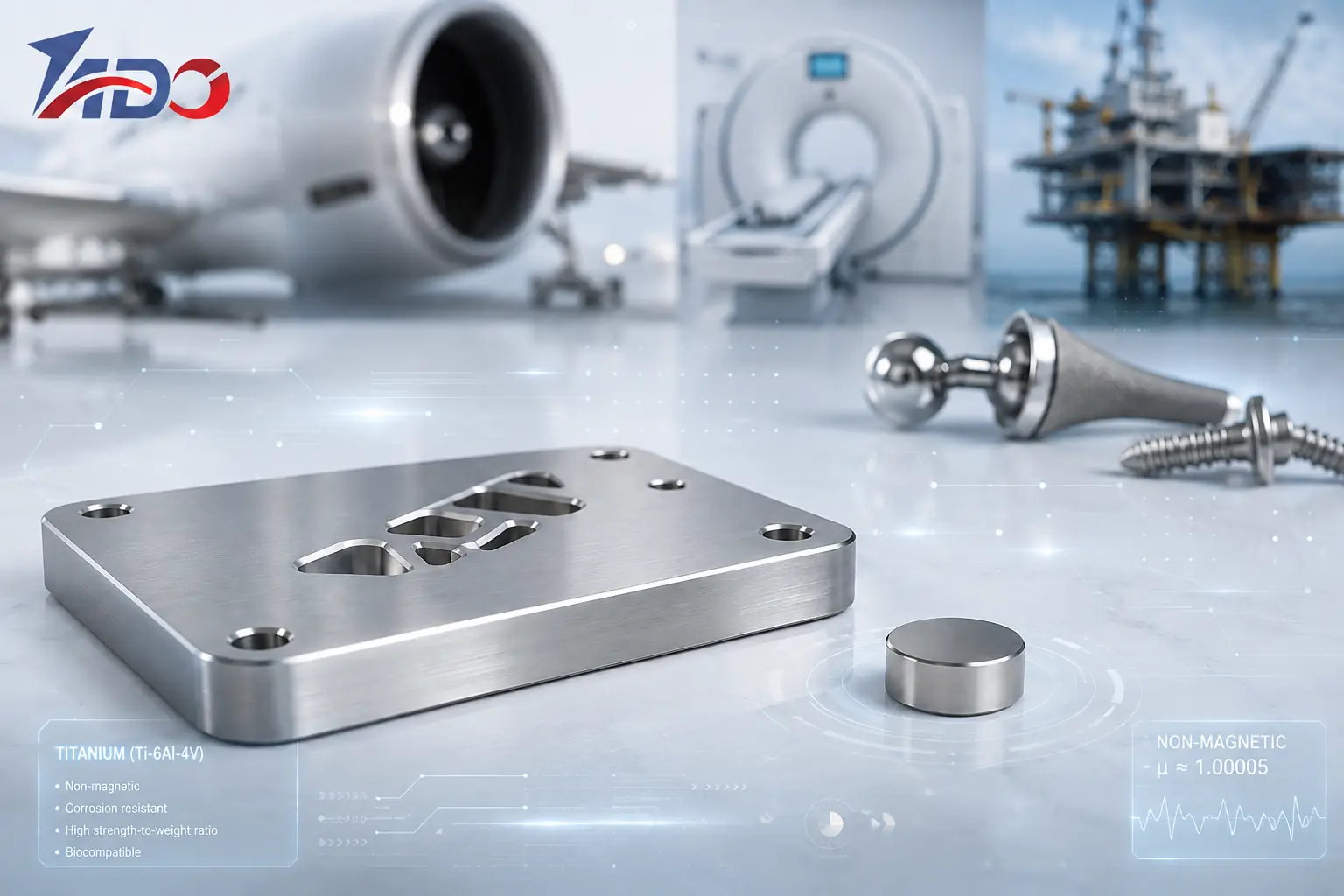
Is Titanium Magnetic? Why This High-Performance Metal Behaves Differently
Place an ordinary magnet against commercially pure titanium and almost nothing happens.
Unlike iron or many magnetic steels, titanium does not strongly attract a magnet and does not remain magnetized after the magnetic field is removed.
The technically accurate explanation is that titanium is weakly paramagnetic, not ferromagnetic. In everyday and most engineering situations, this response is so small that titanium is generally considered functionally non-magnetic.
That may sound like a minor property, but it becomes highly valuable in applications involving sensitive instruments, medical systems, aerospace equipment and precision engineering.
Combined with a density of about 4.5 g/cm³, a melting point near 1,668°C, excellent corrosion resistance and a high strength-to-weight ratio, titanium’s low magnetic response is one more reason it occupies a special position among engineering metals.
Is Titanium Magnetic?
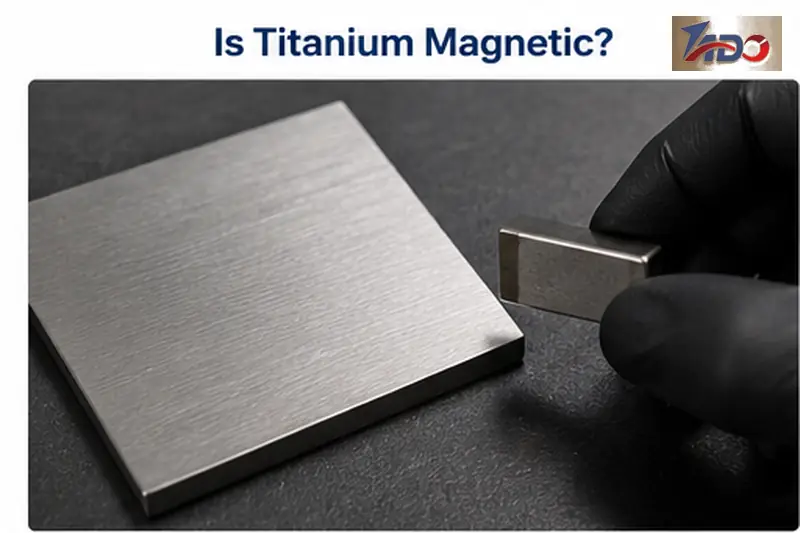
Titanium is not ferromagnetic. It is weakly paramagnetic.
In practical terms:
- Titanium does not noticeably stick to an ordinary household magnet.
- It does not behave like iron, carbon steel or ferritic stainless steel.
- It does not retain significant permanent magnetization.
- Commercially pure titanium and most common titanium alloys are considered functionally non-magnetic in ordinary use.
Calling titanium “non-magnetic” is therefore acceptable in most engineering and commercial contexts.
From a physics perspective, however, weakly paramagnetic is more precise.
Why Doesn’t Titanium Stick to a Magnet?
The difference comes from the way magnetic moments behave inside the material.
Ferromagnetic metals such as iron can develop regions in which large numbers of magnetic moments align together. This produces the strong magnetic attraction familiar in everyday life.
Titanium does not develop this type of long-range magnetic ordering.
At room temperature, commercially pure titanium mainly exists as alpha titanium (α-Ti) with a hexagonal close-packed crystal structure. Above approximately 882.5°C, titanium transforms into the beta phase with a body-centered cubic structure.
Different alloying elements can stabilize these phases and dramatically change strength, formability and temperature performance.
They do not, however, turn common titanium materials into conventional ferromagnetic metals.
This is why a titanium component can be structurally very strong while still showing almost no attraction to an ordinary magnet.
Is Pure Titanium Magnetic?
Commercially pure titanium, commonly called CP titanium or CP-Ti, is effectively non-magnetic in normal use.
Commercially pure titanium grades contain high levels of titanium with controlled amounts of elements such as oxygen, iron, nitrogen, carbon and hydrogen.
They are particularly valued for:
- corrosion resistance,
- formability,
- low density,
- and biocompatibility.
The material also retains its very low magnetic response, making it useful where magnetic interference needs to be minimized.
A household magnet can therefore provide a simple first observation: commercially pure titanium should not show the strong attraction expected from iron or magnetic steel.
However, this is not a definitive titanium identification test, because aluminum, copper and several other metals are also non-ferromagnetic.
Are Titanium Alloys Magnetic?
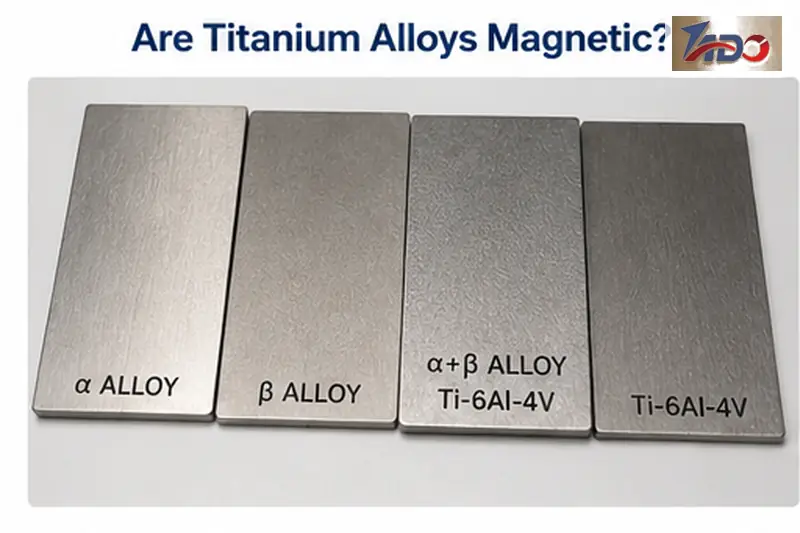
Most widely used titanium alloys also remain effectively non-ferromagnetic.
Titanium alloys are usually classified according to their metallurgical structure.
Alpha Titanium Alloys
Alpha alloys generally offer good weldability, corrosion resistance and thermal stability.
They are often selected for demanding applications where reliable performance at elevated temperatures is important. Their magnetic response remains extremely small.
Beta Titanium Alloys
Beta alloys may contain elements such as molybdenum, vanadium or niobium.
They can be engineered for significantly higher strength and specialized mechanical properties while remaining effectively non-ferromagnetic.
Alpha + Beta Titanium Alloys
The best-known example is Ti-6Al-4V, commonly known as Grade 5 titanium.
It combines approximately 6% aluminum and 4% vanadium with titanium and provides an excellent balance of strength, fatigue performance and manufacturability.
Ti-6Al-4V is widely used in aerospace and biomedical engineering and, like commercially pure titanium, does not behave as a conventional ferromagnetic metal.
This is why the term “titanium alloy” alone is not a complete specification.
For professional sourcing and engineering, the exact grade should always be identified.
Why Does Titanium’s Low Magnetic Response Matter?
Titanium’s magnetic behavior becomes valuable anywhere unwanted magnetic interference could affect equipment or performance.
This can include:
- precision sensors,
- scientific instruments,
- navigation systems,
- medical equipment,
- specialized electronics,
- and magnetic measurement systems.
A ferromagnetic metal positioned close to a sensitive sensor can distort the local magnetic field.
Titanium significantly reduces this problem while still providing structural strength and corrosion resistance.
This combination is much harder to achieve with many conventional materials.
A plastic may be non-magnetic but lack sufficient strength or temperature resistance. Aluminum is lightweight and non-ferromagnetic but may not provide the required corrosion or mechanical performance in certain demanding applications.
Titanium offers these properties in a single engineering material.
Titanium and MRI
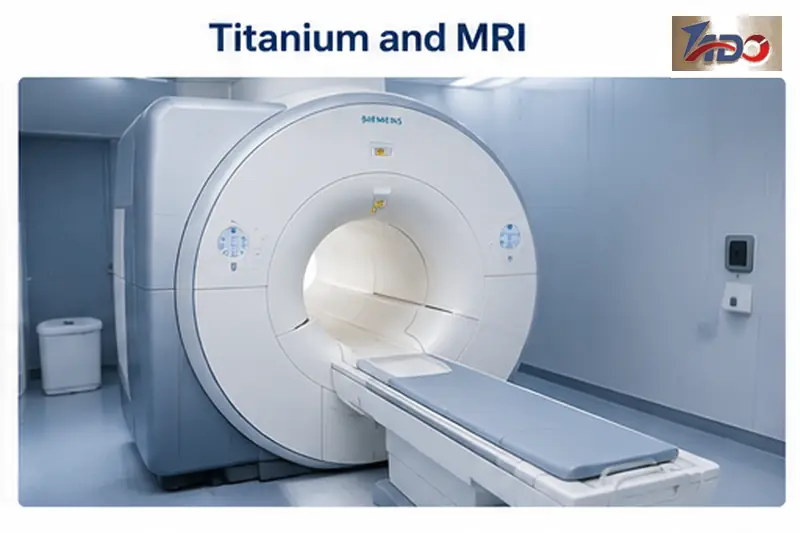
Titanium’s non-ferromagnetic nature is particularly relevant to medical technology.
Titanium and titanium alloys are widely used in products such as dental implants, artificial joints, bone screws, spinal components and surgical instruments. The combination of low magnetic response, corrosion resistance and biocompatibility makes titanium especially useful in this field.
However, one common statement needs qualification:
Titanium should not automatically be described as “MRI safe” simply because it is non-ferromagnetic.
A finished medical device may contain multiple materials and can interact with strong MRI fields in different ways.
Device-specific evaluation may consider:
- magnetic force,
- torque,
- radio-frequency heating,
- and imaging artifacts.
Titanium itself may still cause some MRI image distortion because non-ferromagnetic does not mean magnetically invisible.
The more accurate conclusion is:
Titanium’s weak magnetic response makes it highly suitable for many MRI-related and medical applications, but MRI safety depends on the complete medical device.
This distinction is important in professional technical communication.
More Than Non-Magnetic: Why Titanium Is a High-Performance Metal
Low magnetic response alone would not make titanium such an important engineering material.
Its value comes from several properties working together.
Low Density
Titanium has a density of approximately 4.5 g/cm³, compared with roughly 7.8 g/cm³ for typical steels.
This means titanium is around 40% lighter by volume than many steels.
For aerospace, transportation and portable equipment, that weight reduction can be commercially significant.
High Specific Strength
Titanium alloys can provide very high mechanical strength while retaining relatively low density.
Depending on grade and processing, titanium materials cover a wide strength range. Ti-6Al-4V is commonly engineered in tensile strength ranges around 800–1,000 MPa for structural applications.
This combination of strength and low weight is known as high specific strength.
It is one of titanium’s most important engineering advantages.
Excellent Corrosion Resistance
Titanium reacts rapidly with oxygen to form a thin, stable oxide film on its surface.
Rather than being a disadvantage, this reaction protects the underlying metal.
If the oxide layer is locally disrupted and oxygen or moisture is present, the protective film can form again.
This passive surface gives titanium excellent resistance in many environments involving seawater, chlorides and industrial chemicals.
High Melting Point
Titanium melts at approximately 1,668°C (3,034°F).
Melting point should not be confused with the safe operating temperature of a finished component, but it illustrates titanium’s fundamental thermal stability.
Specialized titanium alloys are therefore used in applications where lightweight metals such as aluminum may face greater temperature limitations.
Titanium in Aerospace and Precision Engineering
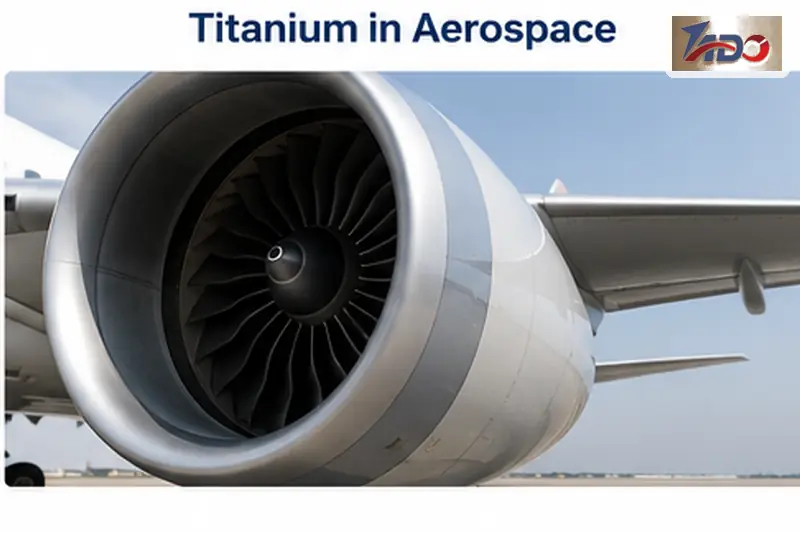
Aircraft and aerospace systems are some of the clearest examples of why engineers pay a premium for titanium.
Reducing weight matters enormously, but the component still needs to maintain mechanical strength, fatigue resistance and reliability.
Titanium provides that balance.
Its low magnetic response can also be advantageous around certain instruments and sensors where ferromagnetic materials could interfere with measurements.
The same principle applies to precision equipment.
Non-magnetic housings and structural components can help reduce interference with magnetometers, compasses and sensitive measuring devices while maintaining accurate mechanical alignment.
Why Titanium Is Used in Marine and Chemical Environments
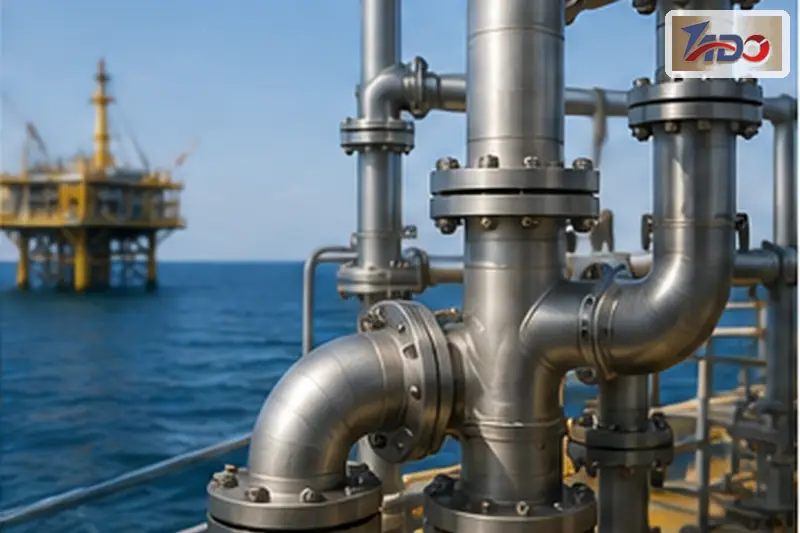
Titanium is also widely associated with environments where corrosion becomes a bigger concern than magnetism.
Its passive oxide film gives it excellent resistance to many chloride-rich environments.
This makes titanium attractive for equipment such as:
- heat exchangers,
- pump components,
- valves,
- marine systems,
- and chemical-processing equipment.
In these applications, titanium’s low magnetic response may be useful, but corrosion resistance is often the primary reason the material is selected.
Again, titanium’s strength lies in the combination of properties rather than one isolated characteristic.
Can You Identify Titanium With a Magnet?
A magnet is useful as a quick screening tool, but not as final proof.
If a metal strongly snaps toward an ordinary magnet, it is unlikely to be commercially pure titanium.
But if a metal does not stick to a magnet, it is not automatically titanium.
Aluminum, copper and several stainless steels can also show little magnetic attraction.
Professional material verification instead relies on techniques such as:
- material certificates,
- chemical composition analysis,
- XRF testing where appropriate,
- and traceable manufacturing documentation.
A magnet can tell you something about magnetic behavior.
It cannot tell you the complete chemical identity of the metal.
Frequently Asked Questions
Is titanium magnetic?
Titanium is weakly paramagnetic rather than ferromagnetic. In normal use, it is generally regarded as functionally non-magnetic.
Does titanium stick to magnets?
Commercially pure titanium will not noticeably stick to an ordinary household magnet.
Is Grade 1 titanium magnetic?
Grade 1 commercially pure titanium is non-ferromagnetic and shows only a very weak paramagnetic response.
Is Ti-6Al-4V magnetic?
Ti-6Al-4V is not a conventional ferromagnetic alloy and has a much weaker magnetic response than iron or strongly magnetic steels.
Why is titanium used in medical implants?
Titanium combines low magnetic response with corrosion resistance, useful mechanical properties and biocompatibility.
Can titanium be used around MRI systems?
Titanium’s non-ferromagnetic behavior is advantageous, but the MRI safety of a finished medical device must be determined from the device’s specific testing and labeling.
Can a magnet confirm that a metal is titanium?
No. Magnet testing can help rule out strongly ferromagnetic materials but cannot positively identify titanium.
Why Titanium Stands Apart
So, is titanium magnetic?
Not in the way iron or magnetic steel is.
Titanium is weakly paramagnetic and effectively non-magnetic in everyday use.
But that property becomes much more meaningful when considered alongside everything else titanium offers:
low density, high specific strength, excellent corrosion resistance, thermal stability and biocompatibility.
This is why titanium appears in aircraft, medical implants, precision instruments, marine equipment and chemical-processing systems.
Titanium is not considered a high-performance material because of a single impressive number.
It earns that position because few metals combine so many demanding properties at the same time.
Its quiet response to a magnet is simply one of the easiest ways to see that titanium behaves differently.