
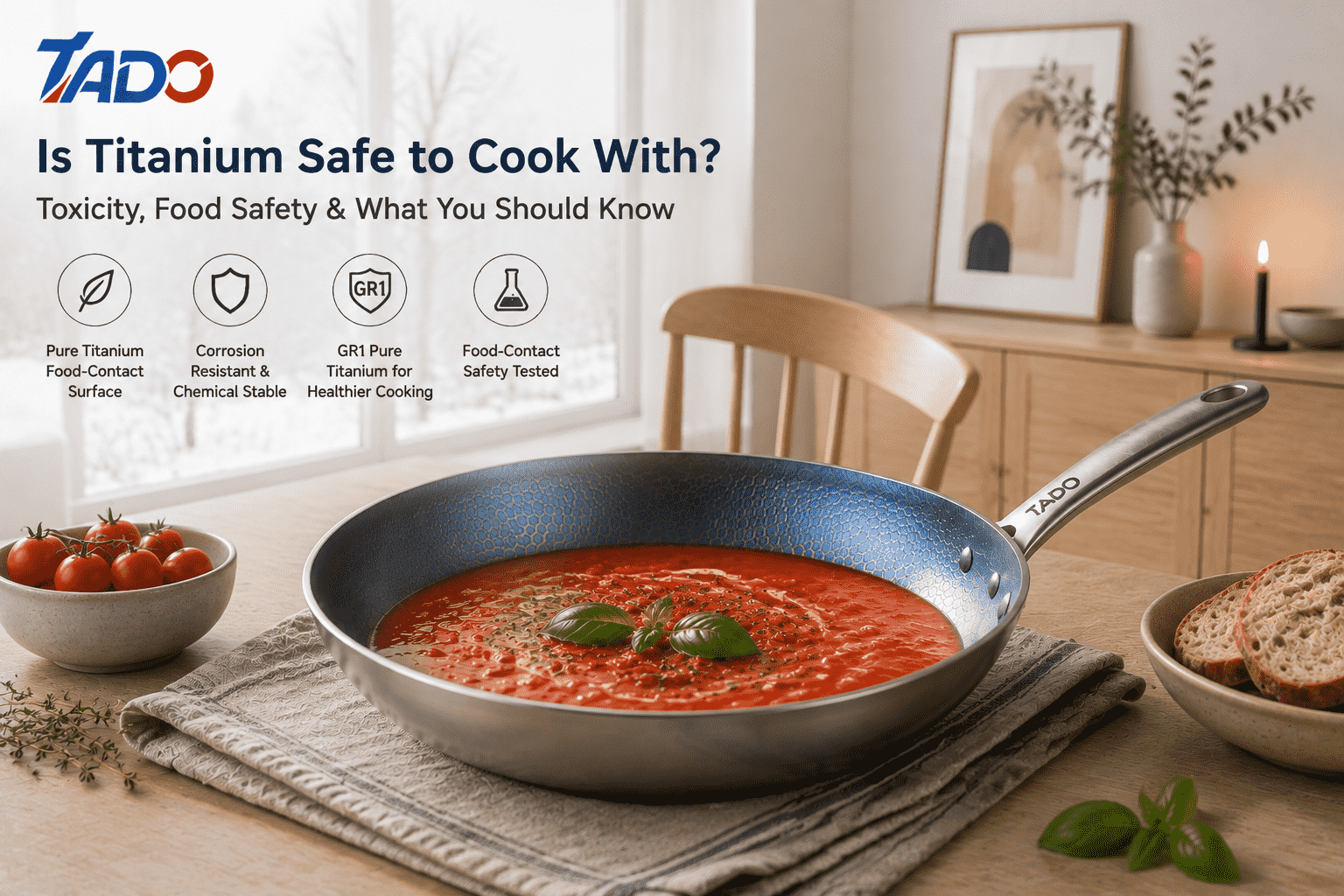
Is Titanium Safe to Cook With? Toxicity, Food Safety & What You Should Know
Titanium has a reputation for being strong, lightweight, corrosion-resistant, and highly stable. It is used in demanding industries ranging from aerospace and chemical processing to medical applications.
But when titanium becomes part of something you use every day—especially something that touches your food—the question becomes much more personal:
Is titanium actually safe to cook with?
For properly manufactured cookware, the short answer is yes: titanium is a highly corrosion-resistant and chemically stable food-contact metal.
However, there is an important detail that many cookware descriptions leave out:
Not every product marketed as “titanium cookware” has a real titanium cooking surface.
Some cookware uses solid or clad titanium as the food-contact surface. Others use a conventional non-stick coating reinforced with titanium particles or simply use “titanium” as part of the product name.
Understanding that difference is the key to evaluating titanium cookware safety.
Quick Answer: Is Titanium Cookware Safe?
Pure titanium is highly resistant to corrosion and forms a stable passive oxide layer on its surface. Under normal cooking conditions, properly manufactured titanium cookware is not expected to behave like a reactive cooking metal.
But cookware safety should never be judged by the raw material name alone.
A finished pan has undergone forming, bonding, surface treatment, polishing, cleaning, and assembly before reaching your kitchen.
For that reason, the best way to evaluate titanium cookware is to consider four things:
- What material actually touches the food?
- What grade of titanium is used?
- Is the surface real titanium or a titanium-containing coating?
- Has the finished cookware undergone appropriate food-contact testing?
These questions matter more than simply seeing the word “titanium” on a product page.
1. Why Is Titanium Considered a Stable Food-Contact Metal?
Titanium has excellent corrosion resistance because of what happens naturally at its surface.
When titanium is exposed to oxygen, it rapidly develops a very thin, adherent titanium oxide layer.
This passive layer protects the underlying metal and helps reduce further reaction with the surrounding environment.
That is one of the reasons titanium performs well in applications where corrosion resistance and material stability are important.
For cookware, this characteristic is especially relevant because food can contain:
- Salt
- Water
- Organic acids
- Cooking oils
- Vinegar
- Tomato
- Citrus
- Other chemically active ingredients
A stable food-contact surface helps prevent unwanted reactions between cookware and food during normal use.
2. Is Titanium Toxic When Used for Cooking?
One of the most common online questions is:
“Does titanium cookware release toxins?”
For real titanium cookware under normal cooking conditions, the primary concern is not titanium somehow “melting into” your food.
Titanium is known for its corrosion resistance and stable passive surface.
But there is a more responsible way to evaluate the question.
Instead of asking only:
Is titanium safe?
Ask:
Has this finished titanium cookware product been manufactured and tested appropriately for food contact?
That distinction matters.
Raw titanium material may have certain properties, but cookware manufacturing includes multiple processes.
A pan may be:
formed → bonded → heat treated → polished → cleaned → assembled → packaged.
Finished-product testing therefore provides more meaningful evidence than simply stating the raw titanium grade.
This is particularly important for cookware brands, importers, distributors, and retailers sourcing products for regulated international markets.
3. What Is GR1 Titanium?
TADO uses Grade 1 titanium (GR1 / TA1) as the interior food-contact layer of its titanium cookware.
Grade 1 is a commercially pure titanium grade valued for its corrosion resistance and formability.
This is fundamentally different from describing a pan as “titanium” simply because titanium particles have been incorporated into a coating.
With TADO cookware, the titanium layer itself is the food-contact cooking surface.
That distinction should be one of the first things buyers check when comparing titanium cookware.
What Should You Ask a Titanium Cookware Supplier?
Instead of asking:
“Is this a titanium pan?”
ask:
“What material directly touches the food?”
The answer tells you much more.
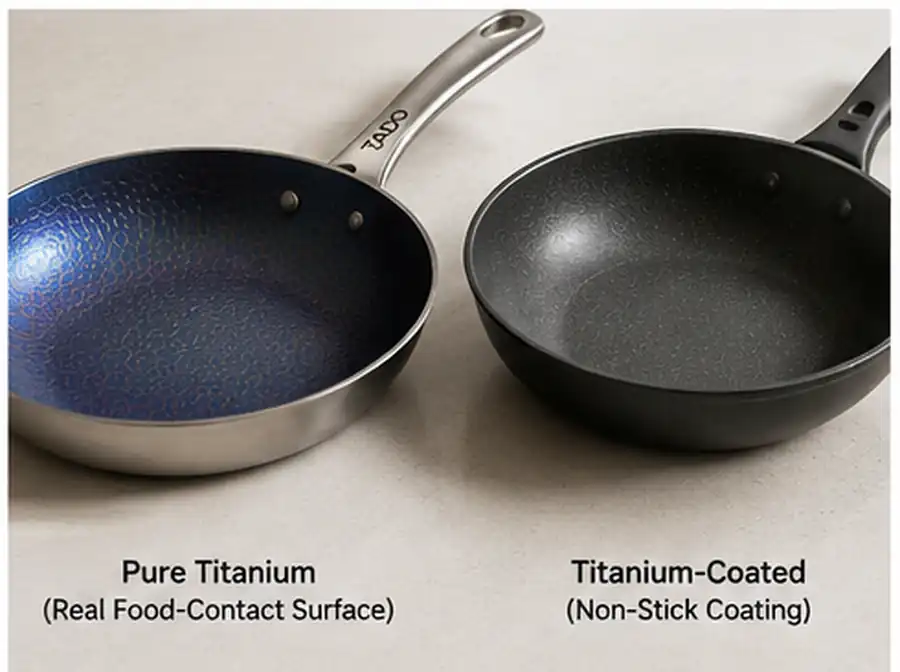
4. Pure Titanium vs Titanium-Coated Cookware
This is probably the most misunderstood part of the titanium cookware market.
The terms pure titanium cookware and titanium-coated cookware should not be used interchangeably.
Pure Titanium Food-Contact Surface
Food comes into direct contact with titanium metal.
The cookware may be made entirely from titanium or may use titanium as one layer within a multilayer structure.
Titanium-Coated Non-Stick Cookware
In these products, “titanium” may refer to titanium particles or compounds used to reinforce a conventional coating.
The food-contact behavior and temperature limitations therefore depend on the complete coating system, not pure titanium alone.
TADO Tri-Ply Titanium Cookware
TADO uses a multilayer construction:
GR1 Titanium — Food-Contact Layer
1050 Aluminum — Heat-Distribution Core
430 Stainless Steel — Exterior / Induction Layer
The purpose is to combine different material properties rather than expecting one metal to do everything.
Titanium provides the food-contact surface.
Aluminum improves heat distribution.
430 stainless steel provides exterior structure and induction compatibility.
5. Is Titanium Safe for Acidic Foods?
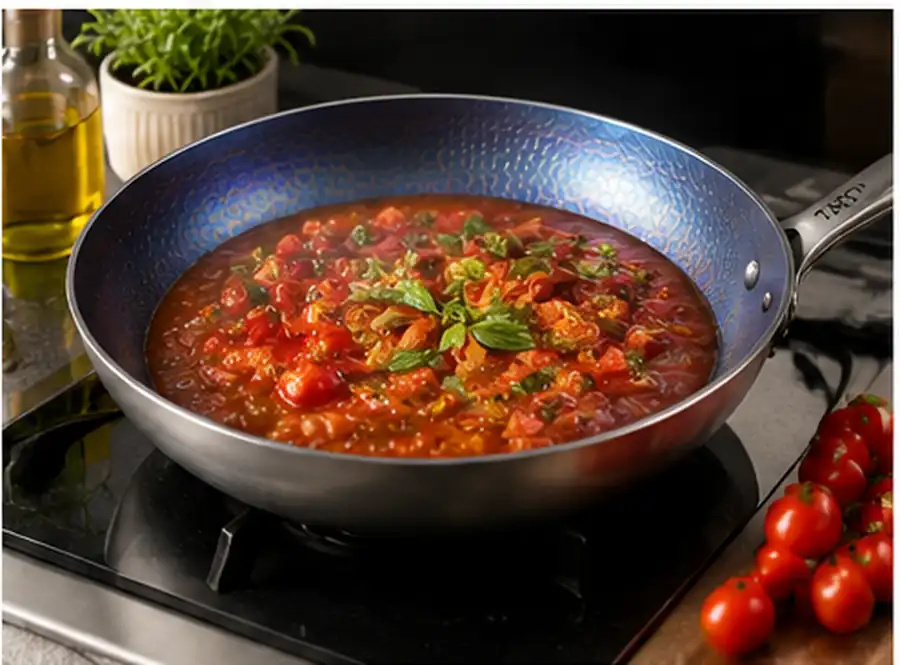
Acidic ingredients are one reason cookware material matters.
Common examples include:
- Tomatoes
- Lemon juice
- Vinegar
- Wine-based sauces
- Citrus marinades
Titanium’s corrosion resistance makes it suitable for contact with a broad range of common foods.
That means a properly manufactured titanium food-contact surface can be used for everyday recipes containing acidic or salty ingredients.
This is also where distinguishing real titanium from coating-based cookware becomes important.
If the product uses a coating, its food-contact performance should be judged according to that coating system.
If the food directly contacts GR1 titanium, the relevant material is the titanium surface itself.
6. Does Titanium Affect the Taste of Food?
A cookware surface should ideally allow the ingredients—not the pan—to determine the flavor.
Because titanium is highly corrosion-resistant and chemically stable, it is valued as a relatively neutral food-contact metal.
For home cooks, this can be particularly useful when preparing:
- Tomato sauces
- Seafood
- Soups
- Vegetables
- Acidic sauces
- Lightly seasoned foods
However, taste is also affected by cooking temperature, burned oil, food residue, seasoning, and cleaning practices.
A metallic or unusual flavor should therefore not automatically be attributed to titanium without first checking the condition and cleanliness of the cookware.
7. Does Titanium Cookware Contain Nickel or Chromium?
This question requires a precise answer because it depends on which part of the cookware you are talking about.
TADO’s food-contact surface is GR1 titanium.
The complete cookware body, however, is tri-ply:
GR1 titanium + 1050 aluminum + 430 stainless steel.
The 430 stainless steel is used on the exterior, primarily to provide structure and induction compatibility.
It is not the interior food-contact cooking surface.
This illustrates why statements such as “metal-free,” “stainless-steel-free,” or other overly broad marketing claims can be misleading when describing multilayer cookware.
The correct question remains:
What material is in direct contact with the food?
For TADO tri-ply cookware, that surface is GR1 titanium.
8. Is the Blue Titanium Surface a Coating?
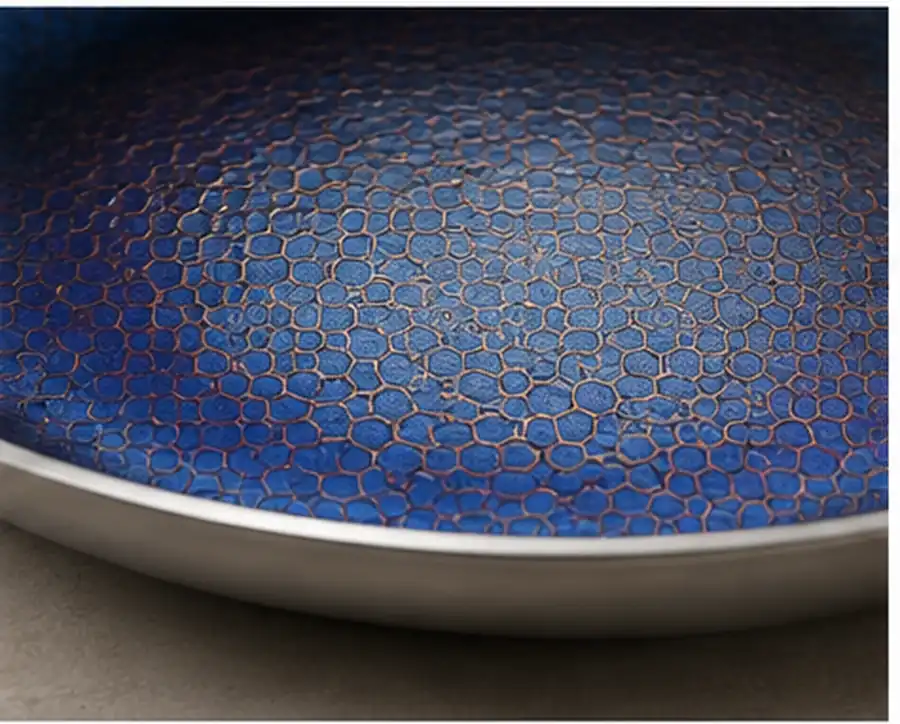
Not necessarily.
Titanium can naturally display colors such as:
- Blue
- Purple
- Gold
- Bronze
These colors can result from changes in the titanium oxide layer and do not automatically mean paint or a conventional non-stick coating has been applied.
TADO uses a high-temperature titanium surface-treatment process referred to as Titanium Molecular Reconstruction Technology.
According to TADO’s technical specifications, the GR1 titanium surface is treated at approximately 1200°C, producing a hardened, modified titanium surface with a target hardness of approximately HV800–900.
The important distinction is that the food-contact surface remains based on titanium rather than a conventional titanium-colored non-stick film.
We cover the high-temperature process, heat tint, and surface discoloration in detail in our separate guide to Titanium Cookware and High Heat.
9. Is Titanium Cookware Naturally Non-Stick?
This needs careful wording.
Pure titanium should not be described as naturally non-stick in the same way as PTFE-coated cookware.
Food release depends on multiple factors:
- Surface structure
- Surface treatment
- Cooking temperature
- Preheating
- Oil
- Food type
- Cooking technique
TADO uses a specialized hardened titanium surface rather than relying on a conventional PTFE layer as the primary food-contact surface.
But users should still learn proper heat control.
Eggs, fish, meat, and other proteins can stick to almost any uncoated metal surface if temperature and cooking technique are poorly controlled.
For practical instructions, see our guide:
How to Use and Care for Titanium Cookware.
That keeps this article focused on safety, rather than repeating the care article.
10. What Should You Check Before Buying Titanium Cookware?
The word “titanium” alone tells you surprisingly little.
Before buying, check the actual product construction.
| What to Check | Why It Matters |
|---|---|
| Titanium grade | Identifies the titanium material being used |
| Food-contact surface | Determines what actually touches your food |
| Pure titanium vs coating | These are fundamentally different constructions |
| Layer structure | Helps explain heat distribution and induction compatibility |
| Finished-product testing | More meaningful than raw-material claims alone |
| Surface treatment | Helps explain appearance, hardness and performance |
| Manufacturer information | Allows buyers to verify technical claims |
For B2B buyers, these questions are even more important.
A cookware importer or brand should be able to obtain technical information describing the material structure of the exact SKU being purchased.
11. What Makes TADO Titanium Cookware Different?
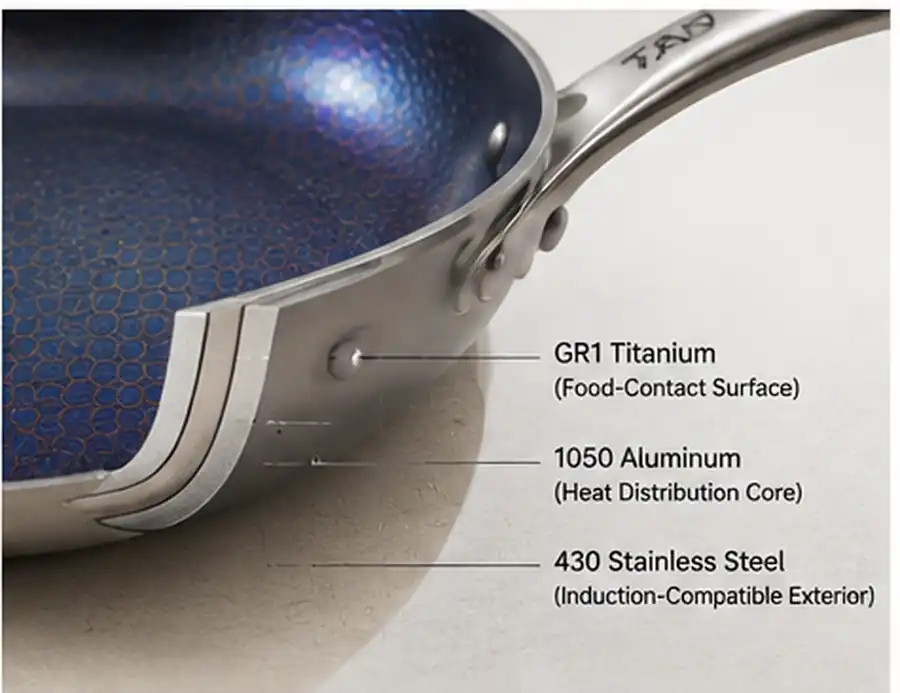
TADO’s approach is based on separating the functions of the cookware into different layers.
GR1 Titanium Interior
Provides the direct food-contact surface and titanium’s characteristic corrosion resistance.
1050 Aluminum Core
Pure titanium is not an exceptional heat conductor.
The aluminum core therefore performs an important thermal function by helping spread heat across the cookware.
430 Stainless Steel Exterior
Provides an induction-compatible magnetic exterior and additional structural support.
Hardened Titanium Surface
TADO’s high-temperature surface-treatment process modifies the GR1 titanium cooking surface, with a target hardness of approximately HV800–900 according to the company’s technical specifications.
The result is not simply “a titanium pan.”
It is a cookware system designed around the different properties of titanium, aluminum, and stainless steel.
Titanium Cookware Safety: Quick Comparison
| Question | Short Answer |
|---|---|
| Is titanium safe to cook with? | Properly manufactured titanium is a highly stable and corrosion-resistant food-contact metal. |
| Is titanium toxic when heated normally? | Normal cooking does not approach conditions where titanium would melt; finished-product safety should still be verified. |
| Can you cook tomatoes in titanium? | Titanium’s corrosion resistance makes it suitable for common acidic foods. |
| Is titanium cookware the same as titanium-coated cookware? | No. Always identify what actually touches the food. |
| Is titanium naturally PTFE-like non-stick? | No. Food release depends on surface treatment and cooking technique. |
| Does blue titanium mean a coating? | Not necessarily. Titanium oxide can naturally create blue, purple and gold colors. |
| What touches food in TADO cookware? | GR1 titanium. |
| Why does TADO use aluminum? | To improve heat distribution. |
| Why does TADO use 430 stainless steel? | For exterior structure and induction compatibility. |
Frequently Asked Questions About Titanium Cookware Safety
Is pure titanium cookware safe for everyday cooking?
Properly manufactured pure titanium is highly corrosion-resistant and chemically stable, making it suitable as a food-contact metal. Consumers should still evaluate the quality and testing of the finished cookware.
Is titanium cookware safe for children and family cooking?
The relevant consideration is the food-contact material and finished-product compliance, rather than the age of the person eating the food. A GR1 titanium cooking surface provides a stable food-contact surface, but claims about health outcomes should not replace appropriate product testing.
Does titanium leach into food?
Titanium is highly corrosion-resistant because of its passive oxide surface. For commercial cookware, finished-product food-contact testing is the appropriate way to evaluate migration or release under specified test conditions.
Can I cook tomato sauce in titanium?
Yes. Titanium’s corrosion resistance makes it suitable for cooking common acidic foods such as tomato-based dishes.
Is titanium cookware PTFE-free?
That depends on the product.
Do not assume every product labeled “titanium” is PTFE-free. Some titanium cookware is actually titanium-reinforced non-stick cookware.
TADO’s GR1 titanium food-contact surface is not a conventional PTFE non-stick film.
Is titanium cookware better than stainless steel?
Neither material is automatically “better” for every application.
Titanium offers low density and excellent corrosion resistance, while stainless steel has different thermal, mechanical, and cost characteristics.
Cookware construction matters more than comparing the material names in isolation.
Conclusion: Is Titanium Safe to Cook With?
For consumers asking “Is titanium safe to cook with?”, the most useful answer is not simply yes or no.
The more accurate answer is:
Properly manufactured titanium is a highly stable, corrosion-resistant food-contact metal—but you should know what kind of titanium cookware you are actually buying.
A pure titanium food-contact surface is fundamentally different from a pan that simply contains titanium in a non-stick coating.
TADO uses GR1 titanium directly on the food-contact surface, combined with a 1050 aluminum core for heat distribution and 430 stainless steel exterior for induction compatibility.
For consumers, that means looking beyond marketing labels.
For cookware brands and professional buyers, it means asking suppliers for the exact layer structure, titanium grade, surface technology, and relevant finished-product testing.
The most important question isn’t “Does this pan contain titanium?”
It’s “What material actually touches my food?”
For Cookware Brands, Distributors & Private-Label Buyers
TADO develops titanium frying pans, woks, saucepans, stock pots and titanium cookware sets for international cookware brands and distribution partners.
OEM/ODM programs can be developed around different sizes, structures, handles, surface treatments, packaging and private-label requirements.
For sourcing inquiries, start with the material structure and target market requirements—not simply the word “titanium.”