
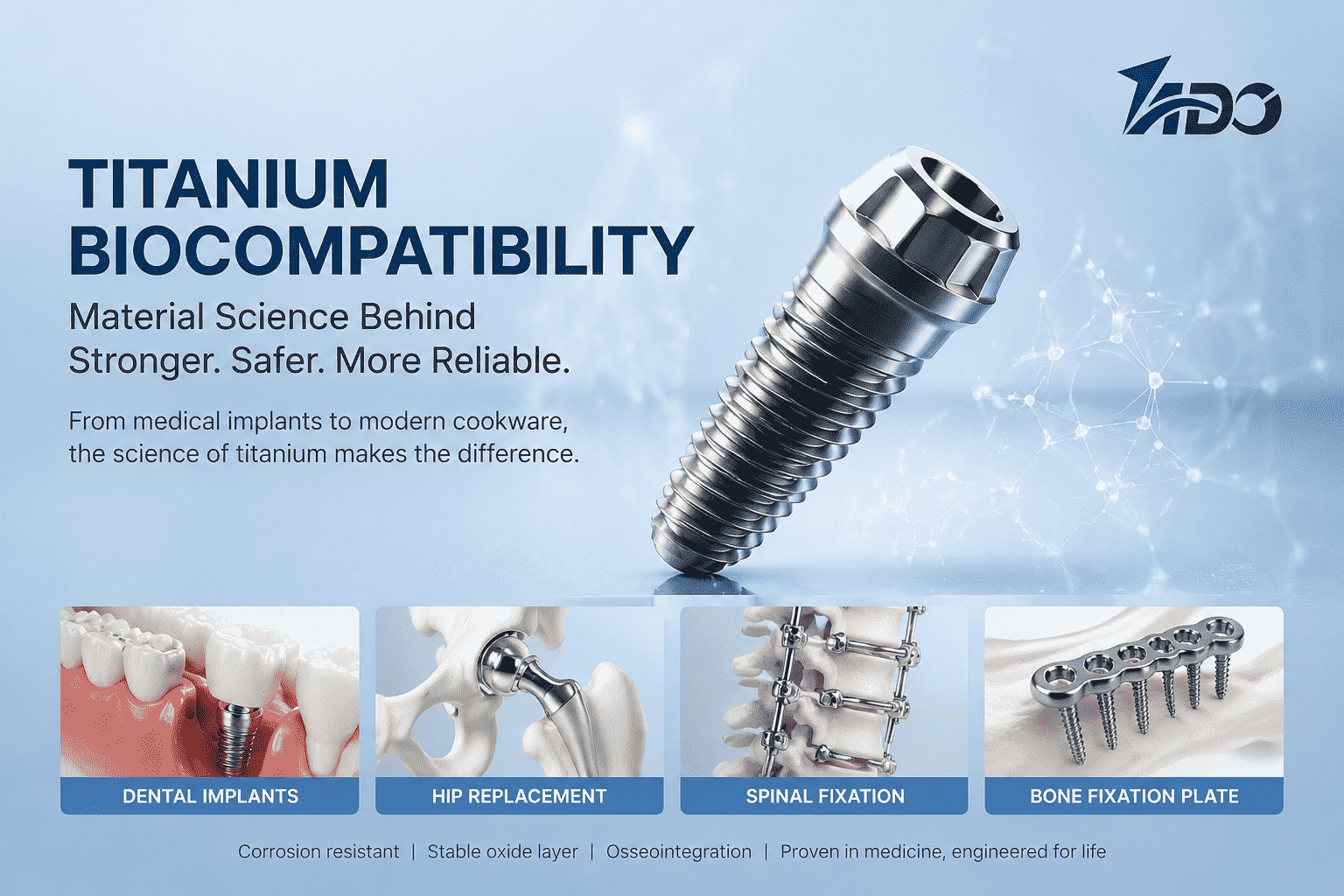
What Is Titanium Biocompatibility?
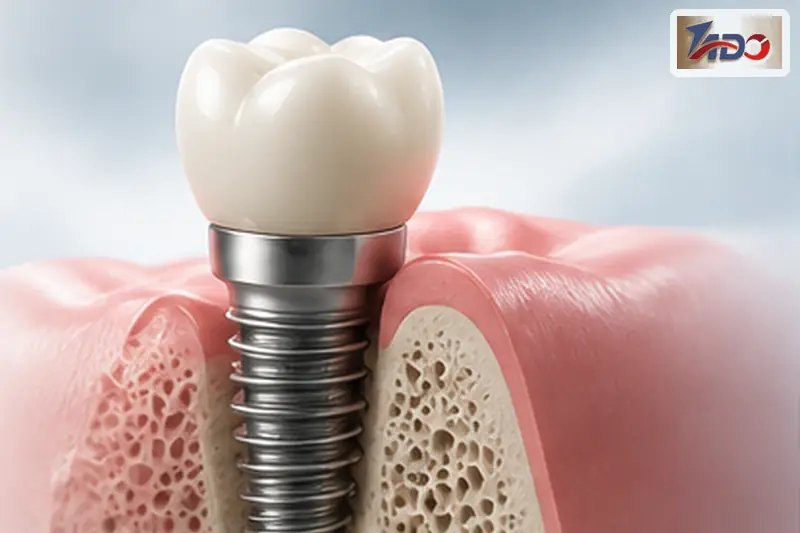
Titanium is one of the most established metallic materials used in biomedical engineering. Commercially pure titanium and titanium alloys are used in applications including dental implants, orthopedic fixation systems and other implantable devices.
The term titanium biocompatibility describes the ability of an appropriately selected and processed titanium material to interact with a biological environment while producing an acceptable response for its intended application.
This definition is important because biocompatibility is not a universal certification attached to a raw metal.
ISO 10993-1 evaluates biological safety within a risk-management framework that considers the finished medical device, its materials, intended biological contact and duration of exposure. A material with a strong history of biomedical use still needs to be evaluated in the context of the actual device.
For buyers evaluating titanium products, this distinction is useful.
Titanium’s biomedical record provides strong evidence of important material properties, particularly corrosion resistance and surface stability. It does not mean every titanium consumer product should be described as “medical grade” or “medically safe.”
Why Is Titanium Considered Highly Biocompatible?
Titanium’s performance is closely related to its surface chemistry.
When titanium is exposed to oxygen, a thin passive oxide film forms on the metal surface. This protective surface significantly reduces further interaction between the underlying titanium and its environment.
The passive layer is one of the reasons titanium demonstrates excellent corrosion resistance under many service conditions.
This is particularly valuable in biomedical applications because implant materials are exposed to complex environments containing water, electrolytes, proteins and chloride ions.
Titanium’s surface does not remain as exposed metallic titanium. Instead, the oxide-covered surface becomes the primary interface with the surrounding environment.
This helps explain an important point for professional buyers:
Titanium’s value is not only based on bulk composition. Surface condition is a major part of its performance.
The Titanium Oxide Layer Is Central to Its Performance
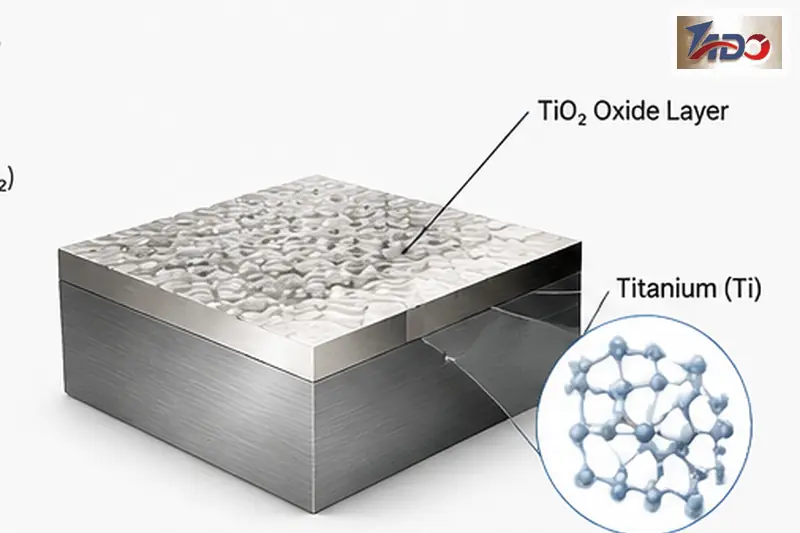
The protective surface of titanium is commonly associated with titanium oxides, particularly TiO₂.
Research on commercially pure titanium implants has demonstrated how changes in this oxide layer can affect performance.
In one experimental study using commercially pure Grade 2 titanium implants, anodic oxidation produced a thicker oxide layer containing crystalline TiO₂. The modified implant group showed higher removal torque and greater bone-to-implant contact than several comparison surfaces.
This does not mean thicker oxide is automatically better in every titanium application.
It demonstrates something more useful:
The behavior of titanium depends heavily on the engineering of its surface.
That principle applies across many industries.
Medical engineers modify titanium surfaces to influence tissue interaction. Industrial engineers optimize surfaces for corrosion, wear or fatigue conditions. Cookware manufacturers may optimize titanium surfaces for durability, cleaning and cooking performance.
The objectives differ, but the underlying materials-science principle remains the same.
Titanium Can Re-Passivate After Surface Disruption
Titanium’s passive layer also has the ability to re-form when fresh titanium is exposed to oxygen under appropriate conditions.
This behavior is called repassivation.
It is one reason titanium provides strong corrosion resistance even when its surface experiences minor mechanical disruption.
Repassivation should not be interpreted as physical “self-healing.” Scratches or mechanical deformation do not disappear.
Instead, the protective surface chemistry can develop again on newly exposed titanium.
For buyers, this is a more technically accurate explanation than describing titanium as “completely inert.”
Titanium is not a metal that never reacts.
Its exceptional performance comes partly from its ability to form a stable protective reaction layer.
What Does Osseointegration Tell Us About Titanium?
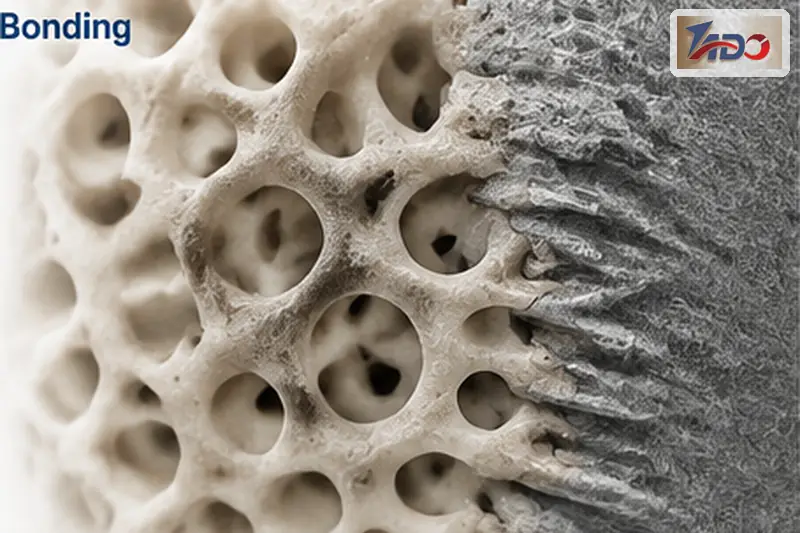
Titanium’s use in dental and orthopedic implants provides one of the strongest real-world examples of its interaction with biological systems.
A key concept is osseointegration, in which living bone develops direct structural contact with an implant surface.
Experimental implant research has repeatedly demonstrated direct bone contact with titanium surfaces.
For example, a study comparing six titanium implant surface conditions found direct bone-implant contact across all tested surfaces. The amount of bone contact varied substantially depending on surface treatment, ranging from approximately 20–25% for some smoother surfaces to 50–60% for certain sandblasted and acid-treated titanium surfaces in the experimental model.
Again, the commercial lesson is not simply that “bone accepts titanium.”
The more important lesson is that:
material + surface condition + manufacturing process = final performance.
This principle is directly relevant when evaluating titanium cookware suppliers.
Two companies may both advertise “titanium cookware” while using completely different food-contact materials, titanium grades, surface treatments and layer structures.
Why Titanium Is Used in Medical and Dental Applications
Titanium is attractive to biomedical engineers because several useful properties occur together.
It provides strong corrosion resistance, relatively low density compared with steels, useful mechanical performance and favorable compatibility with many biological environments.
Commercially pure titanium has been used for implant applications, while higher-strength titanium alloys are selected when more demanding mechanical properties are required.
The material selection depends on the application.
A dental implant, bone fixation plate and hip component do not necessarily use the same grade of titanium.
This is important when discussing titanium with customers because phrases such as “medical titanium” are often used too loosely.
Professional material specifications are more useful than marketing terminology.
Commercially Pure Titanium and Titanium Alloys Are Not the Same
Titanium products should always be evaluated by grade rather than simply by the word “titanium.”
ASTM B265 identifies several commercially standardized titanium grades. Grade 1 is classified as unalloyed titanium, UNS R50250, while Grade 5 is a titanium alloy containing approximately 6% aluminum and 4% vanadium.
Those materials serve different engineering requirements.
Commercially pure titanium grades generally place greater emphasis on corrosion resistance and formability, while certain titanium alloys provide significantly greater mechanical strength.
This is why a B2B buyer should ask:
What titanium grade is actually being used?
That question is much more meaningful than asking whether a product simply “contains titanium.”
Why TADO Uses GR1 Titanium
TADO uses Grade 1 titanium, also referred to as GR1 or TA1, as the interior food-contact surface of its titanium cookware.
Grade 1 is classified by ASTM B265 as unalloyed titanium.
For cookware production, GR1 offers an important combination of corrosion resistance and formability.
Cookware manufacturing requires sheet material to undergo significant forming operations. Depending on the product, these can include rolling, deep drawing, forming, polishing and subsequent surface processing.
A material therefore needs more than an attractive chemical composition.
It must also be suitable for industrial manufacturing.
For TADO, the purpose of the GR1 titanium layer is clear:
it is the metal surface directly contacting the food.
This is fundamentally different from cookware where the term “titanium” refers only to titanium-containing particles added to a conventional non-stick coating.
Titanium Cookware and Titanium-Coated Cookware Should Not Be Confused
This distinction is particularly important for international buyers.
“Titanium cookware” is not a sufficiently precise product description.
Some cookware marketed with titanium terminology may use a conventional coating system reinforced with titanium-containing materials. In such products, the food may primarily contact the coating rather than metallic titanium.
TADO’s construction follows a different principle.
The interior layer is GR1 titanium metal.
For a buyer evaluating cookware, the first question should therefore be:
What material actually touches the food?
This question quickly separates material-based titanium cookware from products that use titanium mainly as a coating-related marketing term.
Medical Biocompatibility Does Not Equal Cookware Certification
Titanium’s medical use is relevant to understanding the material, but it should not be used incorrectly.
A dental implant is designed for contact with living tissue.
Cookware is designed for contact with food.
These products have different exposure conditions, regulatory frameworks and performance requirements.
ISO 10993-1 specifically concerns the biological evaluation of medical devices.
Food-contact cookware should instead be evaluated according to the applicable regulations and testing requirements of its target market.
For TADO and its OEM/ODM partners, the correct commercial statement is therefore not:
“Titanium is used in implants, so the cookware is medically safe.”
A more defensible statement is:
“Titanium’s biomedical use provides extensive evidence of its unusual surface stability and corrosion resistance. For cookware, these material advantages are combined with appropriate food-contact material selection, manufacturing controls and finished-product testing.”
That distinction improves technical credibility and reduces the risk of exaggerated health claims.
Why Biocompatibility Is Relevant to Food-Contact Material Selection
Although medical and food-contact applications are different, some underlying material characteristics remain relevant.
A cookware surface repeatedly encounters water, salts, oils, organic acids and cleaning agents. It also experiences repeated heating and cooling cycles.
A food-contact metal therefore benefits from strong chemical stability and corrosion resistance.
Titanium’s passive surface makes these properties particularly interesting for cookware.
For TADO, the objective is not to reproduce the biological behavior of an implant.
The objective is to use the stable, corrosion-resistant titanium surface as the direct food-contact layer of a cooking vessel.
That is a technically defensible connection between titanium biocompatibility research and cookware engineering.
Why TADO Uses a Multi-Metal Structure Instead of Pure Titanium Alone
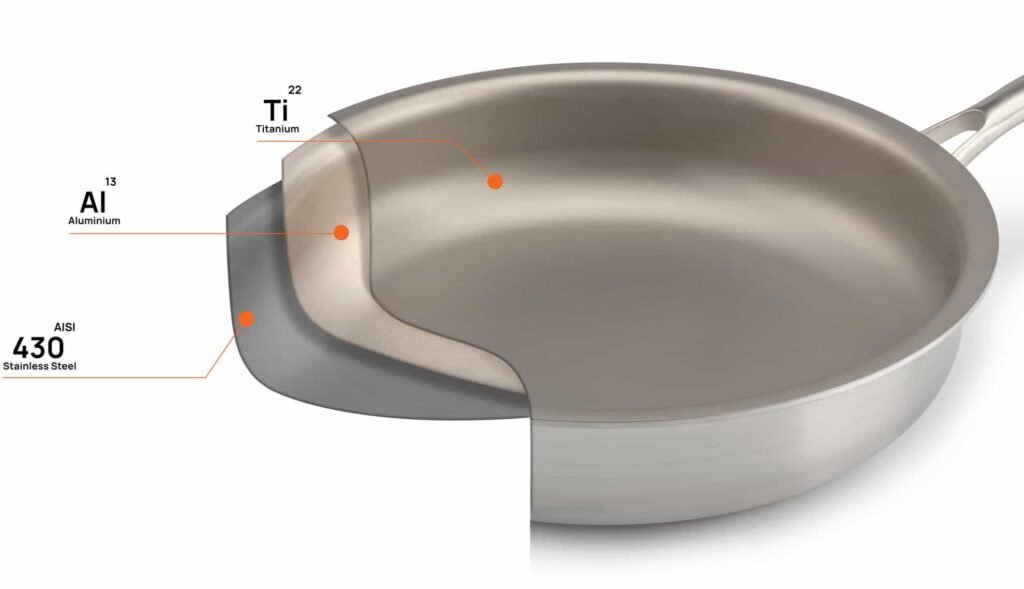
Excellent corrosion resistance does not automatically create excellent cookware.
Pure titanium has an important limitation for cookware engineering: its thermal conductivity is substantially lower than that of aluminum.
If a manufacturer focuses only on titanium purity and ignores heat transfer, the result may be chemically attractive but thermally inefficient cookware.
TADO therefore uses a three-layer composite structure:
| Layer | Material | Primary Function |
|---|---|---|
| Cooking surface | GR1 titanium | Food contact, corrosion resistance and surface stability |
| Heat-distribution core | 1050 aluminum | Faster and more even heat distribution |
| Exterior | 430 stainless steel | Structural support and induction compatibility |
This structure addresses different performance requirements with different materials.
The titanium is placed where its chemical and surface characteristics provide the greatest value.
The aluminum is placed where thermal conductivity is required.
The 430 stainless steel exterior enables magnetic induction compatibility and supports the cookware structure.
For B2B buyers, this provides a more useful product specification than a generic “titanium pan” description.
Surface Engineering Is as Important as Material Selection
Biomedical titanium research demonstrates that titanium surface characteristics can significantly influence performance.
A study evaluating different titanium implant surfaces found that differences in roughness produced measurable differences in bone-to-implant contact.
Another study on anodized commercially pure titanium showed that altering the oxide structure changed implant interface performance.
Cookware does not require osseointegration, but the underlying engineering lesson is relevant:
surface processing changes how titanium performs.
TADO applies a proprietary high-temperature treatment to the GR1 titanium cooking surface.
According to TADO’s technical specifications, the titanium surface is processed at approximately 1,200°C, with a target surface hardness of approximately HV800–900.
The purpose is cookware surface performance, including greater surface hardness and durability.
These figures should be presented as TADO technical specifications, rather than generalized properties of untreated Grade 1 titanium.
That distinction is important.
A buyer should never assume that the properties of a specially treated titanium surface are identical to ordinary raw titanium sheet.
Titanium’s Blue and Purple Colors Are Related to Surface Oxidation
Titanium surfaces can develop blue, purple, gold and bronze tones when the oxide layer changes.
These colors are associated with the way light interacts with oxide films of different thicknesses.
For titanium cookware, this is relevant because buyers occasionally assume that a blue titanium interior must be a conventional colored coating.
That is not necessarily the case.
A controlled titanium surface treatment can create visible oxide-related coloration without applying a conventional PTFE non-stick coating.
However, color alone should never be used as proof that a cookware surface is genuine titanium.
Material verification should be based on manufacturing documentation, material specifications and appropriate testing.
For a B2B buyer, traceable material information is more valuable than appearance.
Biocompatible Does Not Mean Indestructible
Professional product communication should also avoid another common exaggeration.
Titanium is highly corrosion resistant, but it is not immune to every form of mechanical or electrochemical degradation.
Implant research itself demonstrates that titanium surface condition and environment matter. This is precisely why surface treatment, device engineering and biological evaluation continue to be studied rather than assuming titanium is universally inert.
The same logic applies to cookware.
Titanium cookware should still be used within appropriate cooking conditions.
Extreme empty heating, severe thermal shock or inappropriate mechanical treatment can affect cookware performance even when the titanium itself has a very high melting point.
Material strength should not be confused with unlimited product operating conditions.
What Titanium Biocompatibility Means for a Cookware Buyer
From a procurement perspective, the value of titanium biocompatibility is not a medical marketing claim.
It provides evidence of a broader materials-science characteristic:
titanium has a remarkably stable and corrosion-resistant surface.
For cookware brands, distributors and private-label buyers, this creates several relevant product-development advantages.
A titanium food-contact surface can provide a durable metallic alternative to conventional coated cooking surfaces. GR1 titanium also enables a supplier to communicate a clear, traceable material specification rather than relying on vague “titanium reinforced” terminology.
At the same time, professional buyers should evaluate the complete cookware system rather than titanium alone.
Material grade, layer thickness, composite bonding, heat distribution, induction performance, handle construction, surface processing and finished-product testing all contribute to commercial product quality.
How B2B Buyers Should Evaluate Titanium Cookware
A serious sourcing discussion should move beyond “Is this titanium?”
Buyers should establish the exact titanium grade, determine whether metallic titanium actually forms the food-contact surface, confirm the complete cookware layer structure, understand how the surface has been treated, and review relevant food-contact documentation for the intended sales market.
For TADO, the core material specification is:
GR1 titanium cooking surface / 1050 aluminum core / 430 stainless steel exterior.
The product can then be evaluated further according to cookware thickness, surface hardness, handle design, induction behavior, mechanical testing, packaging requirements and market-specific food-contact compliance.
This information allows an OEM or private-label customer to compare suppliers on engineering specifications rather than on marketing terminology.
Titanium Biocompatibility: Key Technical Points for Buyers
| Buyer Question | Technical Answer |
|---|---|
| Why is titanium biocompatible? | Its stable passive surface, corrosion resistance and favorable biological response are major contributing factors. |
| Does titanium have a protective surface? | Yes. Titanium rapidly develops a passive oxide film in oxygen-containing environments. |
| Is titanium used in medical implants? | Yes. Commercially pure titanium and titanium alloys are established biomedical materials. |
| Does titanium support bone integration? | Properly engineered titanium implant surfaces can support osseointegration. Experimental studies show direct bone-to-implant contact. |
| Is every titanium grade the same? | No. ASTM B265 distinguishes unalloyed titanium grades and titanium alloys with different compositions and properties. |
| What titanium does TADO use? | GR1 / Grade 1 titanium as the food-contact cooking surface. |
| Is TADO cookware a medical product? | No. Medical-device biocompatibility and cookware food-contact compliance are separate evaluations. |
| Why not manufacture the whole pan from titanium? | Titanium provides the food-contact surface, while the aluminum core improves heat distribution and 430 stainless steel provides induction compatibility. |
| Does a blue surface prove it is titanium? | No. Material documentation and testing are more reliable than color alone. |
| What should OEM buyers verify? | Material grade, layer structure, surface treatment, thickness, performance testing and target-market food-contact compliance. |
Why This Matters for European and North American Cookware Brands
For established cookware brands, titanium should not be treated merely as a premium-material label.
The commercial opportunity is stronger when titanium is supported by a clear engineering explanation.
A buyer can understand precisely which layer is titanium, why that titanium was selected, how heat distribution is managed, and how the finished cookware differs from titanium-reinforced coated products.
This matters particularly in markets where consumers increasingly compare cookware by material construction rather than appearance alone.
For manufacturers, it also makes product claims easier to support.
Instead of relying on broad statements such as “healthiest cookware” or “medical-grade pan,” brands can communicate specific, verifiable features:
GR1 titanium food-contact surface.
No conventional PTFE coating on the titanium cooking surface.
1050 aluminum heat-distribution core.
430 stainless steel induction-compatible exterior.
These statements provide buyers with information they can actually evaluate.
TADO’s Approach to Titanium Cookware Engineering
TADO’s cookware development starts with the material that touches the food.
GR1 titanium is selected for the interior surface because of its corrosion resistance, surface stability and suitability for forming.
The titanium layer is then combined with a 1050 aluminum core to improve thermal distribution and a 430 stainless steel exterior to provide induction compatibility.
TADO further applies its high-temperature titanium surface-treatment process to improve surface hardness and durability.
The result is designed as a multi-material cookware system, rather than relying on titanium alone to perform every function.
For OEM and ODM customers, this also creates flexibility in product development.
Cookware size, overall thickness, handle configuration, lid design, surface appearance, packaging and private-label requirements can be developed around the same core material architecture.
A More Accurate Way to Communicate Titanium
For B2B markets, accuracy is a competitive advantage.
Titanium does not need exaggerated claims to be interesting.
Its real material characteristics are already strong enough.
It has an established history in biomedical engineering. Its passive oxide surface contributes to exceptional corrosion resistance. Properly engineered titanium implant surfaces can support direct bone interaction. Commercially pure titanium is available in standardized grades, and Grade 1 is formally classified as unalloyed titanium under ASTM B265.
None of that proves that a titanium pan is a medical device.
It proves that titanium is a highly developed engineering material whose surface behavior has been studied extensively.
For cookware, that is the more valuable message.
Conclusion: What Titanium Biocompatibility Means for Modern Cookware
Titanium biocompatibility is primarily a result of the way titanium interacts with its environment.
Its stable passive oxide surface contributes to excellent corrosion resistance, while decades of implant research demonstrate that appropriately selected and engineered titanium surfaces can perform effectively in biological environments.
For cookware, the application is different.
The relevant benefit is not medical implantation.
It is the opportunity to use GR1 titanium as a stable, corrosion-resistant metallic food-contact surface.
TADO combines that surface with a 1050 aluminum heat-distribution core and 430 stainless steel induction-compatible exterior, allowing each metal to perform the function for which it is best suited.
For cookware brands and professional buyers, this leads to a more useful sourcing question than simply:
“Is this a titanium pan?”
The better questions are:
What grade of titanium is used? What material actually contacts the food? How is the cookware constructed? How has the surface been engineered? And what testing supports the finished product?
Those are the questions that turn titanium from a marketing term into a measurable cookware specification.
TADO develops titanium cookware for OEM, ODM and private-label partners seeking a clearly defined titanium food-contact surface, multi-layer heat-distribution structure and scalable product development for international markets.