
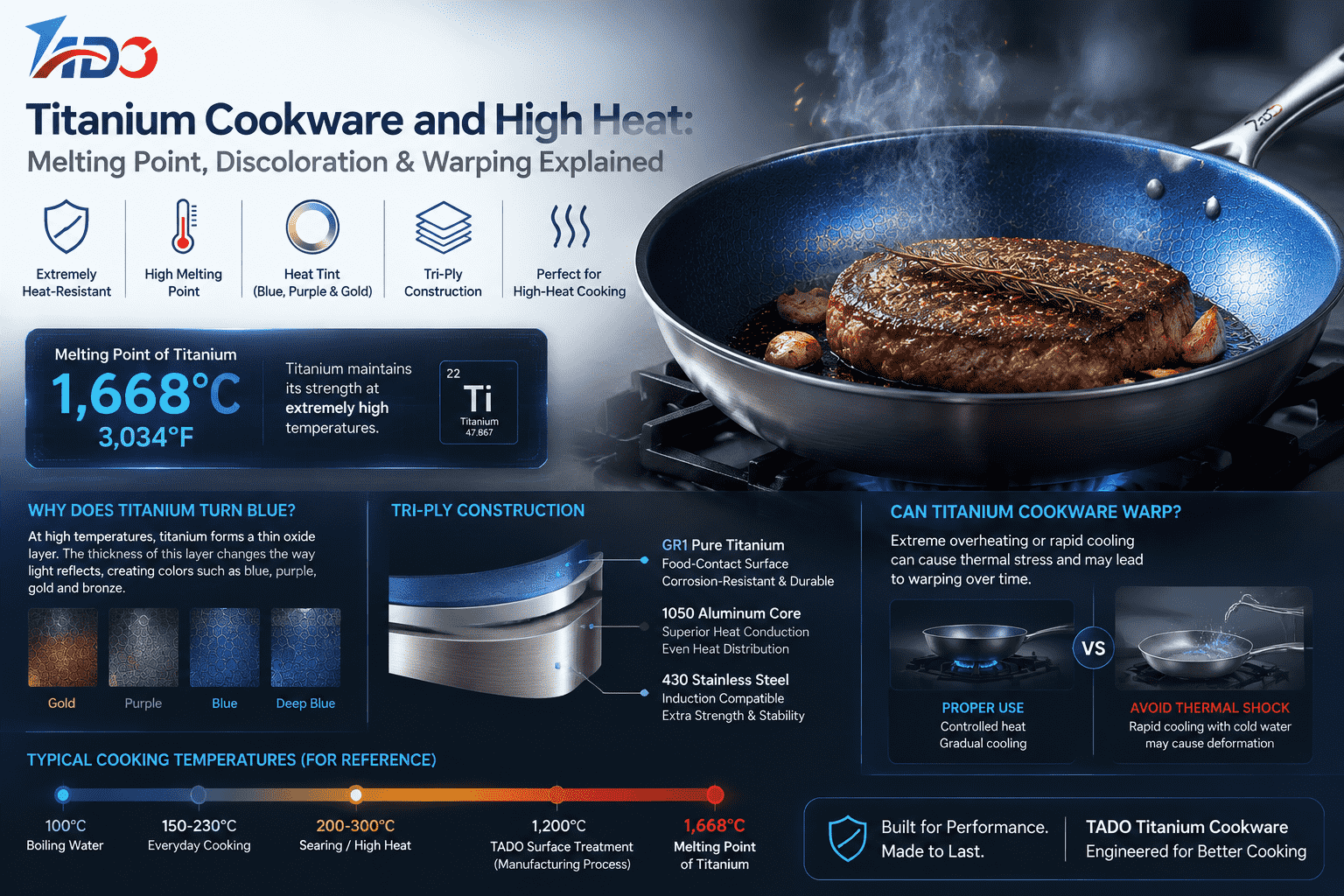
Titanium Cookware and High Heat: Melting Point, Discoloration & Warping Explained
Titanium is known for performing in environments far more demanding than the average kitchen. It is lightweight, corrosion-resistant, strong for its weight, and capable of maintaining its structure at temperatures far beyond those normally encountered during cooking.
But this creates a common misunderstanding:
If titanium melts at around 1,668°C (3,034°F), does that mean a titanium frying pan can safely handle almost unlimited heat?
No.
Titanium itself has exceptional high-temperature properties, but the melting point of titanium is not the same as the recommended operating temperature of finished titanium cookware.
A frying pan is a complete cooking system. Its performance depends not only on titanium, but also on its construction, thickness, heat-distribution layers, handles, joining methods, surface treatment, and how the pan is heated.
This guide explains what actually happens when titanium cookware gets hot, why titanium pans can turn blue or purple, whether titanium cookware can warp, and how multilayer titanium cookware behaves during high-temperature cooking.
Quick Answer: Can Titanium Cookware Handle High Heat?
Yes. Titanium itself is extremely heat-resistant, with a melting point of approximately:
1,668°C / 3,034°F
Normal frying, sautéing, boiling, searing, and household oven cooking occur far below this temperature.
However, this does not mean you should leave a titanium frying pan empty over maximum heat indefinitely.
Long before titanium itself could melt, other problems can occur:
- Cooking oil can smoke or burn
- Food residue can carbonize
- The pan can develop heat tint
- Multilayer cookware can experience thermal stress
- Handles and other components can reach their practical limits
- Severe overheating followed by rapid cooling can contribute to warping
So when evaluating titanium cookware for high-heat cooking, cookware construction matters more than melting point alone.
1. What Is the Melting Point of Titanium?
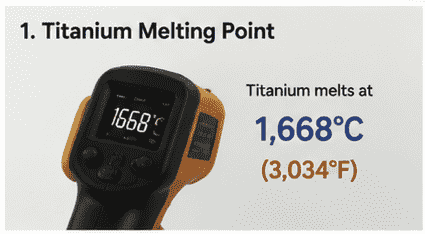
Pure titanium has a melting point of approximately:
1,668°C (3,034°F)
For comparison, ordinary home cooking happens at dramatically lower temperatures.
| Situation | Approximate Temperature |
|---|---|
| Boiling water | 100°C / 212°F |
| Typical frying | Roughly 150–230°C / 302–446°F |
| High-temperature searing | Often around 200–300°C / 392–572°F at the cooking surface |
| Typical home oven | Usually below 300°C / 572°F |
| TADO titanium surface-treatment process | Approx. 1,200°C / 2,192°F |
| Pure titanium melting point | Approx. 1,668°C / 3,034°F |
The exact temperature of a pan varies depending on the stove, cookware construction, food, oil, and heating time, but the difference is clear:
Normal cooking does not come remotely close to melting titanium.
This is one reason questions such as “Can my stove melt my titanium pan?” are generally misplaced.
The more useful question is:
What happens to the finished cookware when it is exposed to excessive heat?
2. Titanium Melting Point vs Safe Cookware Temperature
This distinction is critical.
A material’s melting point tells us when that material transitions from solid to liquid.
It does not define the safe-use temperature of an entire consumer product.
Consider a titanium frying pan with:
- A titanium cooking surface
- An aluminum heat-distribution layer
- A stainless steel exterior
- Metal or other handle components
- Rivets or welds
- A lid and knob
Every component behaves differently when heated.
Cooking oil introduces another limitation. Different oils begin smoking and degrading at temperatures hundreds or even more than a thousand degrees below titanium’s melting point.
Food itself can burn long before the metal is in danger.
Therefore:
A 1,668°C titanium melting point demonstrates the material’s exceptional thermal stability. It is not a recommended cooking temperature.
This distinction is particularly important when comparing cookware marketing claims.
3. What Actually Happens When Titanium Gets Hot?
Titanium reacts with oxygen at its surface and forms a thin oxide layer.
At elevated temperatures, changes in this oxide layer can become visible as different colors.
You may see:
Gold → bronze → purple → blue → deeper blue tones
This phenomenon is often referred to as heat tint.
The color does not necessarily come from pigment, paint, or a conventional non-stick coating.
Instead, variations in the thickness of the oxide layer affect the way light reflects from the titanium surface.
That is why titanium can display striking blue, purple, gold, or rainbow-like colors without being painted.
4. Why Does a Titanium Pan Turn Blue or Purple?
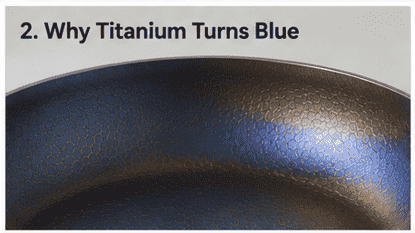
If you have searched:
“Why did my titanium pan turn blue?”
the answer is usually related to oxidation and heat.
Titanium naturally forms a protective oxide film. As temperature changes the thickness and structure of that film, the surface can display different colors.
This is a physical surface phenomenon rather than automatic evidence that the cookware has been damaged.
Normal Heat Tint May Look Like:
- Blue
- Purple
- Gold
- Bronze
- Rainbow tones
- Gradual color transitions
Possible Residue May Look or Feel Like:
- Sticky brown patches
- Black carbonized spots
- Thick uneven deposits
- Greasy areas
- Burned food residue
These two things should not be confused.
If the surface feels sticky or rough, clean the cookware first. What appears to be “titanium discoloration” may simply be polymerized cooking oil or burned food.
5. Does Blue Titanium Mean the Pan Is Damaged?
Color alone does not necessarily indicate damage.
A titanium surface that has changed from silver to blue, purple, or gold may still be structurally intact.
What deserves more attention is a physical change such as:
- Cracking
- Peeling
- Flaking
- Severe deformation
- Delamination
- Loose handles or rivets
Those are fundamentally different from ordinary oxide-related color changes.
This distinction is particularly relevant to TADO cookware because its titanium cooking surface is intentionally subjected to a high-temperature surface-treatment process.
6. How TADO’s Titanium Surface Is Treated at High Temperature
TADO uses GR1 titanium as the interior food-contact layer.
The titanium surface undergoes a proprietary high-temperature treatment referred to by TADO as Titanium Molecular Reconstruction Technology.
During this process, the titanium surface is locally exposed to temperatures of approximately:
1,200°C / 2,192°F
The objective is to modify and harden the titanium surface rather than apply a conventional polymer non-stick film.
According to TADO’s technical specifications, the treated surface reaches a target hardness of approximately:
HV800–900
This process also contributes to the distinctive blue-toned appearance associated with the cookware.
An important distinction remains:
The fact that the manufacturing process reaches approximately 1,200°C does not mean consumers should heat finished cookware to 1,200°C.
Manufacturing conditions and normal cooking conditions are completely different.
7. Can Titanium Cookware Warp?
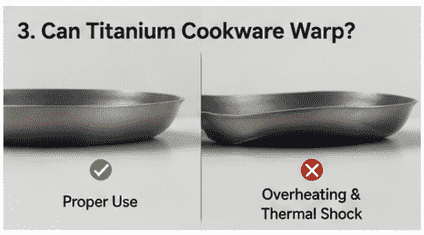
Yes—because melting and warping are not the same thing.
A frying pan does not need to approach its melting point before thermal stress can affect its shape.
Warping is influenced by factors including:
- Pan thickness
- Multilayer construction
- Diameter
- Heating speed
- Temperature distribution
- Empty heating
- Cooling speed
- Differences in thermal expansion between materials
This is particularly important for multilayer cookware.
Different metals expand and contract at different rates when heated and cooled. Good cookware engineering is therefore partly about controlling these stresses.
What Causes Cookware to Warp?
One of the most common causes is extreme temperature change.
Imagine heating an empty frying pan over maximum power until it becomes extremely hot.
Then immediately placing it under cold running water.
The cookware surface cools very rapidly while other parts of the pan remain hot.
That temperature difference creates thermal stress.
Repeated severe thermal shock can increase the risk of deformation in many types of metal cookware—not just titanium cookware.
Better Practice
After high-temperature cooking:
Turn off the heat → remove the food → allow the pan to cool naturally → wash it after the temperature has dropped.
There is rarely a reason to shock an extremely hot pan with cold water.
8. Why Pure Titanium Alone Is Not Perfect for Heat Distribution
Titanium has many desirable properties.
Exceptional corrosion resistance? Yes.
Low density? Yes.
High melting point? Yes.
But titanium is not an exceptional thermal conductor compared with aluminum.
This matters enormously in cookware.
A very thin single-wall titanium pan can develop concentrated hot areas if heat is applied strongly from a small burner.
That is one reason ultralight titanium cookware is popular for camping: low weight is often more important than restaurant-style heat distribution.
For everyday kitchen cookware, however, more even heat distribution is desirable.
This is why TADO does not ask titanium to perform every function by itself.
9. Why TADO Uses Titanium + Aluminum + Stainless Steel
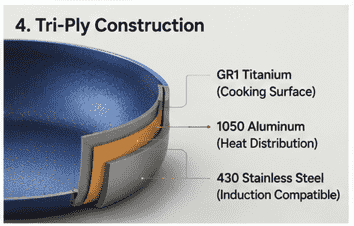
TADO titanium cookware uses a three-layer construction:
Inner Layer: GR1 Titanium
The titanium forms the cooking surface.
Its role is primarily related to food contact, corrosion resistance, durability, and surface performance.
Middle Layer: 1050 Aluminum
The aluminum core helps distribute heat across the cookware.
This compensates for one of pure titanium’s limitations as a cookware material: relatively low thermal conductivity compared with aluminum.
Outer Layer: 430 Stainless Steel
The exterior layer provides additional structural support and magnetic properties for induction cooking.
The basic engineering logic is therefore:
Titanium for the cooking surface.
Aluminum for heat distribution.
430 stainless steel for exterior structure and induction compatibility.
Rather than asking which single metal is “best,” multilayer cookware uses different metals for the jobs they perform well.
10. Is Titanium Cookware Good for High-Heat Searing?
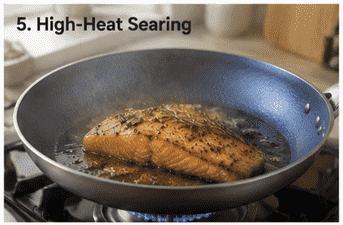
It can be—provided the cookware distributes heat effectively.
High-heat searing requires more than a material that can simply survive high temperatures.
A good searing pan must:
- Store and distribute sufficient heat.
- Recover temperature after cold food is added.
- Minimize extreme hot spots.
- Provide predictable surface behavior.
This is why the aluminum core is particularly important in TADO’s tri-ply construction.
The titanium surface interacts with the food, while the aluminum layer helps move thermal energy across the pan.
How to Sear With a Titanium Frying Pan
For steak, fish, chicken, or other proteins:
Step 1: Preheat Gradually
Begin at medium heat rather than immediately using maximum burner power.
Step 2: Allow the Pan to Reach Cooking Temperature
Give the cookware time to distribute heat across the cooking area.
Step 3: Add an Appropriate Cooking Oil
Choose an oil suitable for the cooking temperature.
Step 4: Add the Food
Avoid overcrowding the pan, which can cause the temperature to fall rapidly.
Step 5: Let the Food Develop a Sear
Proteins often release more easily after proper browning has developed.
High heat should be used strategically, not continuously.
11. Can You Overheat Titanium Cookware?
Yes.
Again, the issue is usually not that the titanium will melt.
The problem is what happens to the entire cooking system.
Excessive empty heating can cause:
- Oil residue to carbonize
- Food to burn rapidly
- Stronger heat tint
- Uneven thermal expansion
- Unnecessary stress on multilayer construction
- Handle temperatures to rise
- Energy waste
If you accidentally leave a titanium pan empty on high heat, turn off the burner and allow the pan to cool naturally.
Do not immediately immerse an extremely hot pan in cold water.
12. Does High Heat Destroy Titanium’s Surface?
Under normal cooking conditions, the concern should not be titanium “melting away.”
Titanium’s passive oxide surface is one of the reasons the material has excellent corrosion resistance.
However, the appearance of a titanium cooking surface can evolve over time.
Heat, oil, food residues, cleaning methods, and normal mechanical use may gradually change its appearance.
This does not mean every visual change represents functional damage.
For users, the more meaningful questions are:
Is the surface structurally intact?
Is there peeling or flaking?
Is the pan still flat?
Are the handles secure?
Can the surface be properly cleaned?
Those observations are more useful than expecting titanium cookware to remain cosmetically identical forever.
13. Titanium Cookware High-Heat Safety: What Not to Do
Titanium’s high melting point is impressive, but good cookware does not need to be abused to prove it.
Avoid these common mistakes:
- Leaving an empty pan over maximum heat for long periods
- Heating the cookware simply to test how hot it can become
- Pouring cold water into an extremely hot empty pan
- Assuming every titanium-coated pan has pure titanium’s temperature properties
- Ignoring the temperature limitations of handles and lids
- Allowing cooking oil to repeatedly burn onto the surface
- Using melting point as the recommended operating temperature
A better rule is simple:
Use the amount of heat the food requires—not the maximum heat the cookware can theoretically survive.
Titanium Cookware High Heat: Quick Facts
| Question | Answer |
|---|---|
| What is titanium’s melting point? | Approx. 1,668°C / 3,034°F |
| Can a household stove melt titanium? | Not under ordinary cooking conditions |
| Is 1,668°C the safe-use temperature of a titanium pan? | No |
| Why does titanium turn blue? | Changes in the surface oxide layer can produce heat tint |
| Does blue color automatically mean damage? | No |
| Can titanium cookware warp? | Yes, especially under severe overheating or thermal shock |
| Is pure titanium a great heat conductor? | No; aluminum conducts heat much more effectively |
| Why does TADO use an aluminum core? | To improve heat distribution |
| Can titanium cookware sear meat? | Yes, with appropriate cookware construction and heat control |
| What temperature is used in TADO’s titanium surface treatment? | Approx. 1,200°C during manufacturing |
| What is TADO’s target treated surface hardness? | Approx. HV800–900 |
Frequently Asked Questions
What temperature can titanium cookware withstand?
Titanium itself has a melting point of approximately 1,668°C (3,034°F), but that should not be treated as the operating temperature of finished cookware. The practical limit depends on the entire pan construction and manufacturer guidance.
Will a gas stove damage titanium cookware?
Normal gas-stove cooking is far below titanium’s melting point. However, prolonged empty heating over an intense flame can unnecessarily overheat the finished cookware and should be avoided.
Why did my titanium pan turn rainbow colors?
Titanium can develop blue, purple, gold, bronze, and rainbow-like colors as its surface oxide layer changes with temperature. This is commonly known as heat tint.
Can titanium pans warp on induction?
Any multilayer cookware can potentially deform if exposed to extreme localized heating or severe thermal shock. Proper burner sizing, controlled preheating, and gradual cooling reduce unnecessary thermal stress.
Is titanium good for searing steak?
Titanium cookware can be used for searing, but heat distribution is important. TADO uses an aluminum core to improve thermal distribution beneath the titanium cooking surface.
Should I heat a titanium pan on maximum power?
Usually not. For most cooking, gradual preheating at low-to-medium or medium heat gives better control. Increase the heat when the cooking method actually requires it.
Is a blue titanium pan still safe to use?
Color alone does not automatically indicate damage. Inspect the cookware for structural problems such as peeling, cracking, severe deformation, or delamination rather than judging it only by color.
Conclusion: High Melting Point Is Only Part of the Titanium Cookware Story
Titanium’s 1,668°C / 3,034°F melting point is impressive.
But it is not the most important number in your kitchen.
A good titanium pan is not designed merely to survive extreme temperatures. It must also distribute heat effectively, resist thermal stress, provide a durable cooking surface, and remain predictable during everyday cooking.
That is why cookware construction matters.
TADO combines:
GR1 Titanium Cooking Surface
+ 1050 Aluminum Heat-Distribution Core
+ 430 Stainless Steel Induction-Compatible Exterior
The titanium provides the food-contact surface and corrosion resistance. The aluminum helps compensate for titanium’s relatively low thermal conductivity. The stainless steel exterior provides structure and induction compatibility.
TADO’s titanium surface is also treated at approximately 1,200°C during manufacturing, producing a hardened blue-toned surface with a target hardness of approximately HV800–900.
The takeaway is simple:
Titanium can tolerate far more heat than normal cooking requires—but the best cooking performance comes from controlling heat, not maximizing it.
Looking for a Titanium Cookware Manufacturer?
TADO develops and manufactures titanium frying pans, woks, saucepans, stock pots, and titanium cookware sets for international cookware brands, distributors, and private-label partners.
OEM and ODM projects can be developed around cookware dimensions, multilayer structures, handles, surface treatments, packaging, branding, and target-market requirements.
For professional sourcing, evaluate the complete cookware construction—not simply the melting point of titanium.